


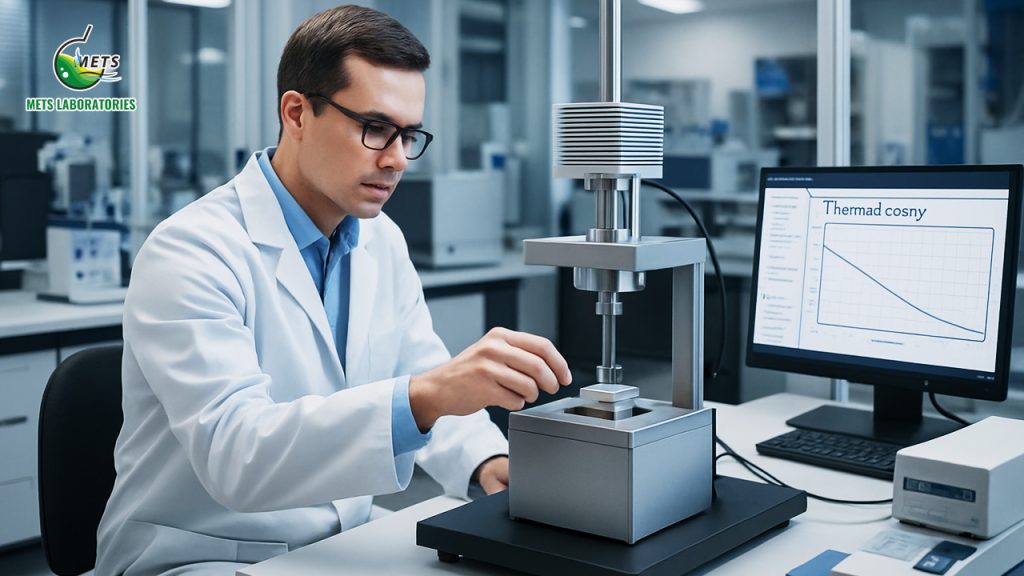
Thermal Conductivity Testing – METS Laboratories
Thermal Conductivity Testing / Thermal Testing
Utilizing professional thermal conductivity testing services is a fundamental method used to measure a material’s ability to conduct heat. This systematic analysis determines the thermal conductivity (k-value), which quantifies how efficiently heat passes through a material under steady-state conditions.
Thermal Testing is a broader term that encompasses various techniques to evaluate a material’s thermal properties, including:
- Thermal conductivity (heat transfer efficiency)
- Thermal diffusivity (how quickly heat spreads)
- Specific heat capacity (heat storage ability)
- Thermal resistance (insulation effectiveness)
Core Material Importance of Thermal Conductivity Testing Services
Thermal conductivity testing and thermal testing are crucial in various industries and applications due to their role in evaluating material properties, ensuring product reliability, and optimizing performance. Here’s why they are important:
- Material Characterization
- Determines how well a material conducts heat, which is critical for selecting materials in applications like electronics, construction, and aerospace.
- Helps compare different materials (metals, ceramics, polymers, composites) for specific thermal management needs.
- Electronics & Semiconductor Industry
- Prevents overheating in electronic devices (CPUs, GPUs, batteries) by ensuring efficient heat dissipation.
- Evaluates thermal interface materials (TIMs) used in heat sinks and cooling systems.
- Energy Efficiency & Building Materials
- Assesses insulation materials (e.g., aerogels, fiberglass) to improve energy efficiency in buildings.
- Ensures compliance with thermal regulations (e.g., LEED certification, building codes).
- Aerospace & Automotive Applications
- Tests thermal protection systems (e.g., heat shields in spacecraft).
- Evaluates engine components, battery thermal management in EVs, and braking systems.
- Manufacturing & Quality Control
- Verifies consistency in material production (e.g., ceramics, metals, composites).
- Detects defects like voids or delamination that affect thermal performance.
- Research & Development
- Supports innovation in advanced materials (e.g., graphene, phase-change materials).
- Helps design thermal management solutions for high-performance applications.
- Safety & Reliability
- Ensures materials can withstand extreme temperatures (e.g., in nuclear reactors, chemical plants).
- Prevents failures in devices or structures due to thermal stress.
- Consumer Products
- Tests appliances, cookware, and textiles for thermal safety and efficiency.
Main Engineering Purpose of Thermal Conductivity Testing Services
The purpose of thermal conductivity testing (or thermal testing in general) is to evaluate how effectively a material can conduct or transfer heat. This is crucial in various industries and applications where thermal management is critical. Key purposes include:
- Material Characterization
- Determine the thermal conductivity (k-value) of materials (metals, ceramics, polymers, composites, insulation, etc.).
- Compare different materials for suitability in specific applications.
- Quality Control & Compliance
- Ensure materials meet industry standards (ASTM, ISO, etc.) and specifications.
- Verify consistency in manufacturing processes.
- Performance Evaluation in Applications
- Electronics & Semiconductors: Prevent overheating in devices by selecting materials with optimal heat dissipation.
- Building & Construction: Assess insulation materials for energy efficiency in homes and industrial structures.
- Aerospace & Automotive: Test thermal properties of materials used in engines, brakes, and thermal shielding.
- Energy Systems: Evaluate heat exchangers, phase-change materials, and thermal storage systems.
- Research & Development
- Develop new materials (e.g., high-conductivity composites or thermal insulators).
- Study the effects of temperature, pressure, or material composition on thermal behavior.
- Safety & Reliability
- Identify potential thermal risks (e.g., overheating, thermal expansion, or insulation failure).
- Ensure materials can withstand extreme thermal conditions.
- Energy Efficiency Optimization
- Improve thermal insulation to reduce energy loss in buildings and industrial processes.
- Enhance heat dissipation in cooling systems for better efficiency.
Common Methods for Thermal Conductivity Testing Services
- Steady-State Methods (e.g., Guarded Hot Plate, Heat Flow Meter) for precise conductivity measurements.
- Guarded Hot Plate (ASTM C177, ISO 8302) – Measures conductivity in insulation materials.
- Heat Flow Meter (ASTM C518, ISO 8301) – Uses a heat flux sensor for steady-state measurements.
- Transient Methods (e.g., Laser Flash Analysis, Hot Wire) for faster results and small samples.
- Laser Flash Analysis (ASTM E1461, ISO 22007-4) – Determines thermal diffusivity by applying a short laser pulse.
- Thermogravimetric Analysis (TGA) and Differential Scanning Calorimetry (DSC) for thermal stability
- Transient Plane Source (ISO 22007-2) – Uses a sensor to measure conductivity and diffusivity simultaneously.
Industrial Applications of Thermal Conductivity Testing Services
- Building materials (insulation, concrete, glass)
- Electronics (thermal management in devices)
- Aerospace & automotive (heat-resistant materials)
- Manufacturing & quality control
Industry-Specific Standards and Accreditation
- Electronics (JEDEC, IPC) – Thermal management of PCBs & chips.
- Building Materials (ASTM C518, ISO 8301) – Insulation testing.
- Aerospace (MIL-STD-810, DO-160) – Thermal shock & conductivity tests.
Specialized Types of Thermal Conductivity Testing Services
Thermal conductivity testing and thermal testing involve various techniques and standards to measure how materials conduct or resist heat. Below are common types of tests, methods, and standards used in thermal conductivity and thermal testing:
These measure how well a material conducts heat (W/m·K).
A. Steady-State Methods(measure heat flow under constant temperature gradient)
- Guarded Hot Plate (ASTM C177, ISO 8302) – Measures low-conductivity materials (insulators).
- Heat Flow Meter (ASTM C518, ISO 8301) – Uses a calibrated sensor to measure heat flux.
- Guarded Heat Flow Meter – Improved accuracy for anisotropic materials.
- Radial Heat Flow Method – For cylindrical samples (e.g., pipes).
B. Transient Methods(measure thermal properties based on time-dependent heat flow)
- Hot Wire Method (ASTM D5930, ISO 8894) – For liquids, pastes, and solids; measures thermal diffusivity.
- Laser Flash Analysis (LFA, ASTM E1461, ISO 22007-4) – High-speed measurement of thermal diffusivity.
- Transient Plane Source (TPS, ISO 22007-2) – Uses a sensor to apply short heat pulses.
- 3-Omega Method – For thin films and nanomaterials.
C. Comparative Methods
- Hot Disk (ISO 22007-2) – Uses a sensor for simultaneous thermal conductivity and diffusivity.
- Thermal Resistance (R-value) Testing (ASTM C518, ASTM C177) – Measures insulation effectiveness.
- Thermal Interface Material (TIM) Testing – Evaluates heat transfer between surfaces.
- Laser Flash Analysis (LFA, ASTM E1461) – Measures how quickly heat spreads.
- Transient Grating Spectroscopy – For thin films.
- Dilatometry (ASTM E228, ASTM D696) – Measures dimensional changes with temperature.
- ASTM E1131, ISO 11358 – Measures material decomposition under heat.
- ASTM D3418, ISO 11357 – Measures heat flow in materials during phase changes.
- ASTM E2582 – Non-contact thermal imaging for defect detection.
- JEDEC JESD22-A104, MIL-STD-810 – Tests material durability under repeated heating/cooling.
What Thermal Conductivity Testing Services METS Laboratories Offers
NABL accredited, METS LABORTORIES INDIA PVT.LTD can test to a variety of the established methods (e.g., ISO, ASTMD, AOAC, APHA, FSSAI, BIS,)
- Our laboratory conducts testing on a wide range of products, materials, and components to verify compliance with standards, specifications, and regulatory requirements. Our team is happy to provide expert advice and guidance to ensure the appropriate water testing is carried out for your needs.
- Our dedicated, experienced, and friendly team is here to help—providing expert knowledge, guidance, and access to cutting-edge water testing capabilities and technologies in our laboratory.
- We conduct comprehensive product evaluations for appearance, quality, and performance. Our technical support network provides expert guidance—answering questions, interpreting results, and assisting with quality assurance program management.
- We participate in inter-laboratory proficiency testing and comparative analyses to ensure accuracy, reliability, and compliance with industry standards.
- We implement and maintain rigorous ISO/IEC 17025:2017 accreditation, ensuring internationally recognized standards for testing competence, measurement accuracy, and operational excellence in every analysis.
- We maintain strict customer confidentiality by treating all data as proprietary information.
- AccreditedISO/IEC 17025:2017 compliant services
- End-to-end environmental monitoring and sampling
- Customized test plans for industry, agriculture, urban planning, and residential safety
- Advanced instrumentation: GC-MS, ICP-OES, AAS, HPLC, FTIR, etc.
- On-site sampling by trained professionals
- Digital reports with compliance interpretation
- Emergency testing and quick-turnaround options
Beyond numbers, we offer peace of mind by delivering science you can trust and reports you can act on.
What Our Advanced Material Lab Workflows Ensure
- Data Integrity: Every result is generated and verified under strict quality assurance.
- Compliance: All tests conform to the latest regulatory and industry-specific guidelines.
- Transparency: Clear, easy-to-understand reports and consultation support.
- Confidentiality: Your data remains secure, private, and protected.
- Environmental Stewardship: Our labs follow eco-friendly practices and aim to minimize testing-related waste and emissions.
Who Needs Our Accredited Thermal Performance Analysis?
- Manufacturers, importers, and distributors of EEE products (e.g., electronics, cables, circuit boards, batteries).
- Industrial Facilities: To monitor effluents, emissions, and workplace safety
- Construction and Real Estate: For soil contamination, water logging, and indoor air quality
- Municipal Corporations: To assess urban air and water quality
- Schools, Hospitals & Hotels: For ensuring safe indoor environments
- Agricultural Communities: To test irrigation water and soil health
- NGOs & Research Institutions: For pollution studies and policy advocacy
- Citizens & RWAs: For local monitoring and complaint-based testing
Protect Consumers. Satisfy Authorities. Boost Market Confidence.
In today’s safety-driven and sustainability-minded world, businesses are held accountable by customers, investors, and regulators alike. METS Laboratories empowers you to:
- Protect your workforce, consumers, and industrial assets through strict thermal verification.
- Achieve complete compliance with national building codes, as well as global International Organization for Standardization (ISO) thermal insulation standards and ASTM parameters.
- Build a reputation as an energy-efficient and environmentally responsible brand.
- Avoid costly material failures, structural hazards, and legal action due to thermal non-compliance.
- Earn stakeholder trust with verified insulation efficiency claims and green building performance reporting.
Thermal conductivity testing isn’t just a legal formality—it’s a strategic asset.
Frequently Asked Questions
How do I book a test?
You can contact METS Laboratories via phone, email, or our website to schedule sampling or drop off a sample at our facility.
Is your lab accredited?
Yes, METS Laboratories is accredited under ISO/IEC 17025:2017.
How long does it take to get results?
Turnaround time depends on the parameters, but standard reports are typically delivered within 3–7 working days.
Do you provide on-site sampling?
Yes, we have trained field teams who follow strict SOPs for on-site sample collection.
Can I get help understanding the report?
Absolutely. We offer report interpretation and guidance on corrective actions or next steps.
What locations do you serve?
We serve clients across India and can coordinate with international partners when required.
Can you help with regulatory approvals?
Yes, our test reports are accepted by government authorities, and we can assist in documentation for environmental clearances.