


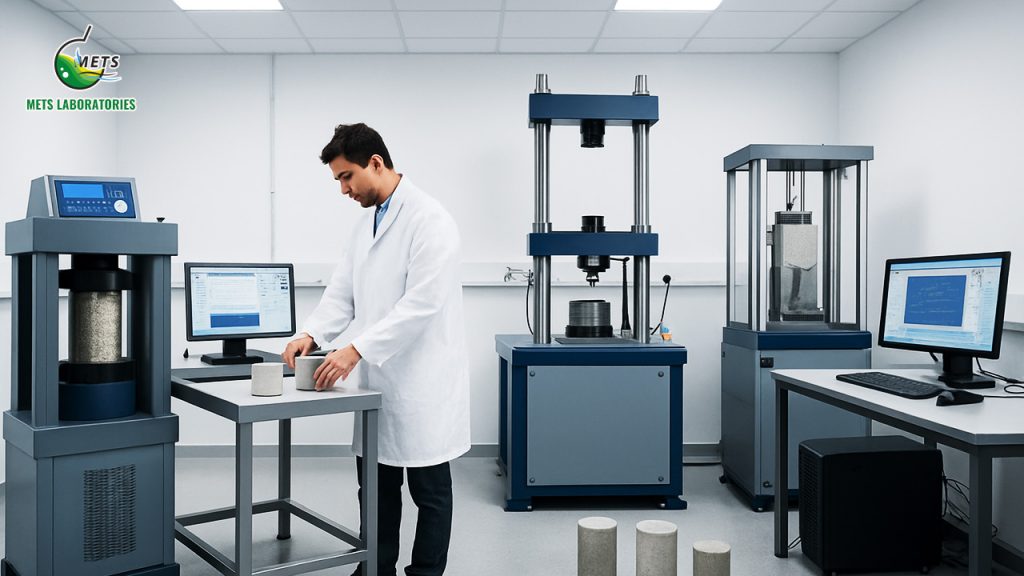
Building, Infrastructure & Construction Materials Testing – METS Laboratories
Building, infrastructure, and construction material testing are critical processes to ensure the safety, durability, and compliance of structures with national and international standards. By partnering with an independent laboratory for professional building material testing services, structural engineers can seamlessly verify load-bearing safety parameters before groundbreaking. The quality of construction materials directly impacts the structural integrity, longevity, and performance of buildings, roads, bridges, and other infrastructure projects. Rigorous testing helps identify defects, assess material properties, and prevent failures that could lead to safety hazards or costly repairs.
Testing involves evaluating various mechanical, physical, and chemical properties of materials such as concrete, steel, aggregates, soil, asphalt, bricks, and composites. Key parameters include compressive strength, tensile strength, density, moisture content, corrosion resistance, and load-bearing capacity. These tests ensure compliance with industry standards and regulatory requirements.
Core Structural Importance of Building Material Testing Services
- Structural Integrity & Safety
- Ensures buildings, bridges, and roads can withstand design loads and environmental stresses.
- Detects weaknesses in concrete, steel, or soil that could lead to collapses or failures.
- Regulatory Compliance
- Mandatory for adherence to BIS, ASTM, ISO, and IS codes (e.g., IS 456 for concrete, IS 800 for steel).
- Prevents legal liabilities and ensures approvals from authorities.
- Durability & Longevity
- Identifies corrosion risks, moisture damage, and wear resistance in materials.
- Extends the lifespan of infrastructure by preventing premature degradation.
- Cost & Risk Mitigation
- Reduces repair costs by detecting defects early in construction.
- Prevents project delays due to material failures.
- Environmental & Sustainability Compliance
- Ensures eco-friendly materials (low-carbon concrete, recycled aggregates) meet green building standards.
- Quality Assurance in Manufacturing
- Validates the strength and consistency of prefabricated materials (precast concrete, steel beams).
- Geotechnical Stability
- Soil testing prevents foundation failures, landslides, and subsidence risks.
Broad Classification of Construction Materials For Testing
Type | Description |
Concrete | Cement, aggregates, admixtures, reinforced concrete |
Steel & Metals | Structural steel, rebar, welding quality, corrosion resistance |
Soil & Geotechnical | Bearing capacity, compaction, permeability, shear strength |
Aggregates | Crushed stone, sand, gravel (gradation, abrasion resistance) |
Asphalt & Bitumen | Pavement quality, viscosity, durability |
Bricks & Blocks | Compressive strength, water absorption, thermal resistance |
Timber & Wood | Moisture content, strength, termite resistance |
Composites | Fiber-reinforced polymers, waterproofing membranes |
Application | Purpose |
Structural Safety | Ensure load-bearing capacity and stability |
Road Construction | Verify pavement durability and skid resistance |
Foundation Testing | Assess soil stability and settlement risks |
Quality Control | Compliance with BIS, ASTM, IS codes |
Pre-Construction | Material suitability assessment |
Main Engineering Purpose of Building Material Testing Services
1. Quality Control
Objective: Ensure all construction materials comply with project specifications and industry standards before use.
Key Aspects:
- Verifies strength, durability, and performance of concrete, steel, aggregates, and asphalt.
- Conducts batch testingfor consistency in material properties.
- Prevents defects in precast elements, reinforcement bars, and structural components.
Standards:IS 456 (Concrete), IS 800 (Steel), ASTM C33 (Aggregates).
2. Failure Analysis
Objective: Investigate structural failures to determine root causes and prevent recurrence.
Key Aspects:
- Identifies reasons for cracks, corrosion, collapses, or deformationin structures.
- Uses Non-Destructive Testing (NDT)like Ultrasonic Testing (UT) and Rebound Hammer.
- Analyzes material degradationdue to environmental exposure or poor workmanship.
3. Research & Development (R&D)
Objective: Innovate and improve sustainable, high-performance construction materials.
Key Aspects:
- Tests eco-friendly materials(low-carbon concrete, recycled aggregates).
- Evaluates new composites(fiber-reinforced polymers, geopolymers).
- Supports green building certifications(LEED, GRIHA).
4. Pre-Construction Assessment
Objective: Evaluate site conditions and material suitability before project commencement.
Key Aspects:
- Soil testingfor bearing capacity, compaction, and liquefaction risks.
- Checks material compatibility(e.g., alkali-silica reaction in concrete).
- Ensures foundation stabilityto prevent settlement issues.
5. Regulatory Certification
Objective: Obtain mandatory approvals from government and safety authorities.
Key Aspects:
- Compliance with BIS, ASTM, NBC (National Building Code), and municipal norms.
- Required for occupancy certificates, environmental clearances, and tenders.
- Ensures public safety and legal adherence in infrastructure projects.
Key Building Material Testing Services Parameters & Standards
Biocompatibility testing is categorized based on the type of biological response being evaluated. The following are the primary tests conducted:
Parameter | Standard |
Compressive Strength | IS 516, ASTM C39 |
Slump Test | IS 1199, ASTM C143 |
Permeability | ASTM C1202 |
Rebound Hammer Test | IS 13311 (Part 2) |
Parameter | Standard |
Tensile Strength | IS 1608, ASTM E8 |
Hardness Test | ASTM E18 (Rockwell/Brinell) |
Corrosion Resistance | ASTM G59 |
Parameter | Standard |
Proctor Test (Compaction) | IS 2720, ASTM D698 |
CBR (Bearing Capacity) | IS 2720 (Part 16) |
Permeability Test | ASTM D2434 |
Parameter | Standard |
Penetration Test | IS 1203, ASTM D5 |
Ductility Test | IS 1208 |
Parameter | Standard |
Ultrasonic Testing | IS 13311 (Part 1) |
Rebound Hammer Test | IS 13311 (Part 2) |
What Building Material Testing Services METS Laboratories Offers
NABL accredited, METS LABORTORIES INDIA PVT.LTD can test to a variety of the established methods (e.g., ISO, ASTMD, AOAC, APHA, FSSAI, BIS,)
- Our laboratory conducts testing on a wide range of products, materials, and components to verify compliance with standards, specifications, and regulatory requirements. Our team is happy to provide expert advice and guidance to ensure the appropriate water testing is carried out for your needs.
- Our dedicated, experienced, and friendly team is here to help—providing expert knowledge, guidance, and access to cutting-edge water testing capabilities and technologies in our laboratory.
- We conduct comprehensive product evaluations for appearance, quality, and performance. Our technical support network provides expert guidance—answering questions, interpreting results, and assisting with quality assurance program management.
- We participate in inter-laboratory proficiency testing and comparative analyses to ensure accuracy, reliability, and compliance with industry standards.
- We implement and maintain rigorous ISO/IEC 17025:2017 accreditation, ensuring internationally recognized standards for testing competence, measurement accuracy, and operational excellence in every analysis.
- We maintain strict customer confidentiality by treating all data as proprietary information.
- AccreditedISO/IEC 17025:2017 compliant services
- End-to-end environmental monitoring and sampling
- Customized test plans for industry, agriculture, urban planning, and residential safety
- Advanced instrumentation: GC-MS, ICP-OES, AAS, HPLC, FTIR, etc.
- On-site sampling by trained professionals
- Digital reports with compliance interpretation
- Emergency testing and quick-turnaround options
Beyond numbers, we offer peace of mind by delivering science you can trust and reports you can act on.
What Our Destructive & Non-Destructive Workflows Ensure
- Data Integrity: Every result is generated and verified under strict quality assurance.
- Compliance: All tests conform to the latest regulatory and industry-specific guidelines.
- Transparency: Clear, easy-to-understand reports and consultation support.
- Confidentiality: Your data remains secure, private, and protected.
- Environmental Stewardship: Our labs follow eco-friendly practices and aim to minimize testing-related waste and emissions.
Who Needs Our Accredited Civil Engineering Assessment Services?
- Manufacturers, importers, and distributors of EEE products (e.g., electronics, cables, circuit boards, batteries).
- Industrial Facilities: To monitor effluents, emissions, and workplace safety
- Construction and Real Estate: For soil contamination, water logging, and indoor air quality
- Municipal Corporations: To assess urban air and water quality
- Schools, Hospitals & Hotels: For ensuring safe indoor environments
- Agricultural Communities: To test irrigation water and soil health
- NGOs & Research Institutions: For pollution studies and policy advocacy
- Citizens & RWAs: For local monitoring and complaint-based testing
Protect Consumers. Satisfy Authorities. Boost Market Confidence.
In today’s safety-driven and sustainability-minded world, businesses are held accountable by customers, investors, and regulators alike. METS Laboratories empowers you to:
• Protect your workforce, end-consumers, and surrounding infrastructure installations from structural faults.
• Achieve complete compliance with national building mandates, satisfying the latest Bureau of Indian Standards (BIS) civil engineering and construction codes and ISO parameters.
• Build a reputation as a highly reliable, safety-first engineering or contracting brand.
• Avoid costly material failures, structural collapses, project delays, and severe legal action due to quality non-compliance.
• Earn stakeholder, municipal authority, and developer trust with verified material durability and structural testing reports.
Building material testing isn’t just a legal formality—it’s a strategic asset.
Frequently Asked Questions
How do I book a test?
You can contact METS Laboratories via phone, email, or our website to schedule sampling or drop off a sample at our facility.
Is your lab accredited?
Yes, METS Laboratories is accredited under ISO/IEC 17025:2017.
How long does it take to get results?
Turnaround time depends on the parameters, but standard reports are typically delivered within 3–7 working days.
Do you provide on-site sampling?
Yes, we have trained field teams who follow strict SOPs for on-site sample collection.
Can I get help understanding the report?
Absolutely. We offer report interpretation and guidance on corrective actions or next steps.
What locations do you serve?
We serve clients across India and can coordinate with international partners when required.
Can you help with regulatory approvals?
Yes, our test reports are accepted by government authorities, and we can assist in documentation for environmental clearances.