


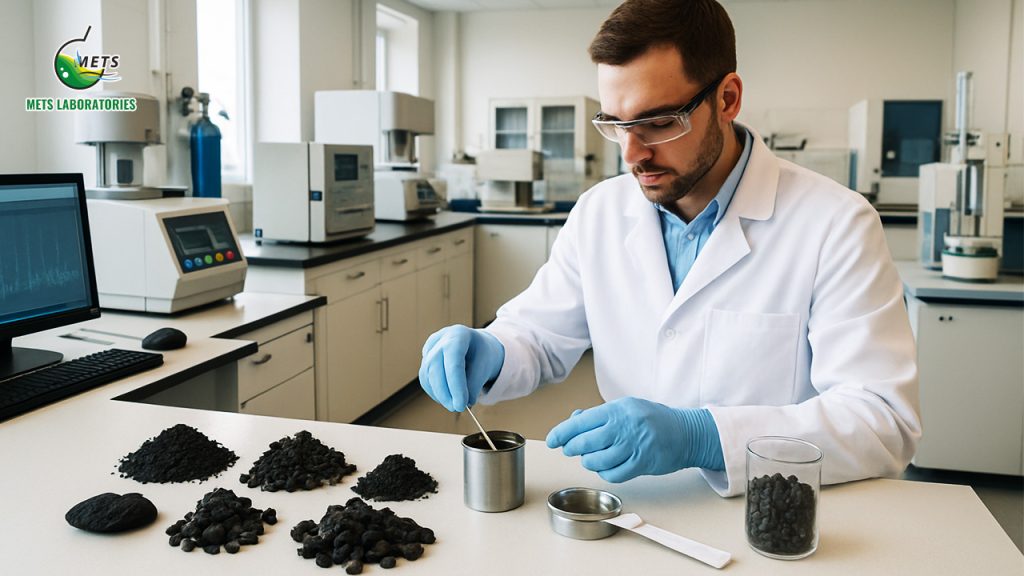
Coal Testing/Solid Fuels Testing – METS Laboratories
Coal and solid fuels play a vital role in energy production, industrial processes, and heating applications worldwide. By utilizing our accredited coal and solid fuel testing services, power generation facilities and manufacturing plants can accurately baseline fuel grades. Ensuring the quality and safety of these fuels is critical for optimizing combustion efficiency, reducing emissions, and complying with environmental regulations. Coal and solid fuel testing involve comprehensive analysis of various parameters, including calorific value, moisture content, ash composition, sulfur content, and trace elements. These tests help verify fuel quality, improve combustion performance, and minimize environmental impact.
Core Industrial Importance of Coal and Solid Fuel Testing Services
- Optimizes Combustion Efficiency
The quality of coal and solid fuels directly impacts combustion performance and energy output. Poor-quality fuel can lead to:
- Incomplete Combustion – Wasted fuel, increased emissions (CO, particulate matter).
- Boiler Slagging & Fouling – Ash deposits reduce heat transfer efficiency.
- Higher Operating Costs – Low calorific value requires more fuel for the same energy output.
How Testing Helps:
- Calorific Value Analysis – Ensures maximum energy extraction.
- Proximate Analysis – Balances moisture and volatile matter for efficient burning.
- Ash Content Testing – Reduces slagging in boilers.
- Ensures Environmental Compliance
Coal combustion releases pollutants such as sulfur oxides (SOx), nitrogen oxides (NOx), and heavy metals. Strict regulations (EPA, IED, Clean Air Act) mandate emission controls.
Key Testing Parameters:
- Sulfur Content (ISO 19579) – High sulfur fuels require scrubbers.
- Mercury & Heavy Metals (ASTM D6722) – Monitors toxic emissions.
- Ash Composition – Predicts fly ash disposal requirements.
Consequences of Non-Compliance:
- Fines & Penalties – Regulatory violations lead to financial losses.
- Operational Shutdowns – Non-compliant plants may face closures.
- Enhances Fuel Selection & Blending
Power plants and industries often blend different coal grades to optimize cost and performance.
Testing Supports:
- Petrographic Analysis – Identifies coal rank and reactivity.
- Grindability Index (HGI) – Determines milling efficiency.
- Trace Element Screening – Avoids harmful contaminants in blends.
- Reduces Equipment Damage & Maintenance Costs
Poor-quality fuel accelerates wear and tear in boilers, turbines, and emission control systems.
Critical Tests:
- Ash Fusion Temperature (ISO 540) – Predicts slagging tendencies.
- Chlorine & Alkali Content – Corrosion risk assessment.
- Abrasion Index – Evaluates equipment wear potential.
- Supports Sustainable & Alternative Fuels
With growing emphasis on renewable energy, testing extends to:
- Biomass Pellets – Moisture, ash, and calorific value checks.
- Waste-Derived Fuels (RDF/SRF) – Contaminant screening.
- Bio coal & Torrefied Biomass – Quality validation for co-firing.
Technical Classification of Coal and Solid Fuel Testing Services
Type of Test | Description |
Proximate Analysis | Determines moisture, volatile matter, fixed carbon, and ash content. |
Ultimate Analysis | Measures carbon, hydrogen, nitrogen, sulfur, and oxygen content. |
Calorific Value Testing | Evaluates energy content (Gross & Net Calorific Value). |
Ash Fusion Temperature | Assesses ash melting behavior under high temperatures. |
Trace Element Analysis | Detects heavy metals (mercury, arsenic, lead) and other pollutants. |
Sulfur Content Testing | Measures total sulfur to assess environmental compliance. |
Grindability Index (HGI) | Evaluates coal’s ease of pulverization for combustion. |
Petrographic Analysis | Examines coal composition and rank (bituminous, anthracite, etc.). |
Operational Purpose of Coal and Solid Fuel Testing Services
- Quality Assurance – Verifies fuel meets specifications for end-use.
- Regulatory Compliance – Ensures adherence to emission norms.
- Cost Optimization – Identifies high-efficiency fuel blends.
- Risk Management – Detects contaminants before combustion.
- Research & Innovation – Facilitates cleaner energy technologies.
Commercial Applications of Coal and Solid Fuel Testing Services
- Power Generation – Ensures optimal fuel quality for thermal power plants.
- Cement & Steel Industries – Verifies fuel suitability for high-temperature processes.
- Environmental Compliance – Helps meet emission standards (EPA, EU Directives).
- Coal Trading & Pricing – Determines fuel grade and market value.
- Biomass & Alternative Fuels – Assesses renewable fuel efficiency.
- Research & Development – Supports cleaner combustion technologies.
Key Testing Parameters Evaluated Under International Standards
Parameter | Standard Method |
Moisture Content | ISO 589, ASTM D3302 |
Volatile Matter | ISO 562, ASTM D3175 |
Ash Content | ISO 1171, ASTM D3174 |
Fixed Carbon | By calculation |
Parameter | Standard Method |
Carbon Content | ASTM D5373 |
Hydrogen Content | ASTM D5373 |
Nitrogen Content | ASTM D5373 |
Sulfur Content | ISO 19579, ASTM D4239 |
Oxygen Content | By calculation |
Parameter | Standard Method |
Gross Calorific Value | ISO 1928, ASTM D5865 |
Net Calorific Value | Calculated from GCV |
Parameter | Standard Method |
Ash Fusion Temperature | ISO 540, ASTM D1857 |
Mercury Content | ASTM D6722 |
Chlorine Content | ISO 587, ASTM D4208 |
What Coal and Solid Fuel Testing Services METS Laboratories Offers
NABL accredited, METS LABORTORIES INDIA PVT.LTD can test to a variety of the established methods (e.g., ISO, ASTMD, AOAC, APHA, FSSAI, BIS,)
- Our laboratory conducts testing on a wide range of products, materials, and components to verify compliance with standards, specifications, and regulatory requirements. Our team is happy to provide expert advice and guidance to ensure the appropriate water testing is carried out for your needs.
- Our dedicated, experienced, and friendly team is here to help—providing expert knowledge, guidance, and access to cutting-edge water testing capabilities and technologies in our laboratory.
- We conduct comprehensive product evaluations for appearance, quality, and performance. Our technical support network provides expert guidance—answering questions, interpreting results, and assisting with quality assurance program management.
- We participate in inter-laboratory proficiency testing and comparative analyses to ensure accuracy, reliability, and compliance with industry standards.
- We implement and maintain rigorous ISO/IEC 17025:2017 accreditation, ensuring internationally recognized standards for testing competence, measurement accuracy, and operational excellence in every analysis.
- We maintain strict customer confidentiality by treating all data as proprietary information.
- AccreditedISO/IEC 17025:2017 compliant services
- End-to-end environmental monitoring and sampling
- Customized test plans for industry, agriculture, urban planning, and residential safety
- Advanced instrumentation: GC-MS, ICP-OES, AAS, HPLC, FTIR, etc.
- On-site sampling by trained professionals
- Digital reports with compliance interpretation
- Emergency testing and quick-turnaround options
Beyond numbers, we offer peace of mind by delivering science you can trust and reports you can act on.
What Our Specialized Proximate & Ultimate Analytical Workflows Ensure
- Data Integrity: Every result is generated and verified under strict quality assurance.
- Compliance: All tests conform to the latest regulatory and industry-specific guidelines.
- Transparency: Clear, easy-to-understand reports and consultation support.
- Confidentiality: Your data remains secure, private, and protected.
- Environmental Stewardship: Our labs follow eco-friendly practices and aim to minimize testing-related waste and emissions.
Who Needs Our Accredited Solid Fuel Verification Solutions?
- Manufacturers, importers, and distributors of EEE products (e.g., electronics, cables, circuit boards, batteries).
- Industrial Facilities: To monitor effluents, emissions, and workplace safety
- Construction and Real Estate: For soil contamination, water logging, and indoor air quality
- Municipal Corporations: To assess urban air and water quality
- Schools, Hospitals & Hotels: For ensuring safe indoor environments
- Agricultural Communities: To test irrigation water and soil health
- NGOs & Research Institutions: For pollution studies and policy advocacy
- Citizens & RWAs: For local monitoring and complaint-based testing
Protect Consumers. Satisfy Authorities. Boost Market Confidence.
In today’s sustainability-driven world, businesses are held accountable by customers, investors, and regulators alike. METS Laboratories empowers you to:
• Protect your workforce and surrounding communities from hazardous combustion byproducts.
• Achieve compliance with strict Central Pollution Control Board (CPCB) industrial emission guidelines, SPCB, MoEF&CC, WHO, and ISO standards.
• Build a reputation as an environmentally responsible brand through verified fuel characterization.
• Avoid costly penalties and legal action due to non-compliance with atmospheric regulations.
• Earn stakeholder trust with verified environmental claims and transparent ESG reporting.
Fuel and environmental testing isn’t just a legal formality—it’s a strategic asset.
Frequently Asked Questions
How do I book a test?
You can contact METS Laboratories via phone, email, or our website to schedule sampling or drop off a sample at our facility.
Is your lab accredited?
Yes, METS Laboratories is accredited under ISO/IEC 17025:2017.
How long does it take to get results?
Turnaround time depends on the parameters, but standard reports are typically delivered within 3–7 working days.
Do you provide on-site sampling?
Yes, we have trained field teams who follow strict SOPs for on-site sample collection.
Can I get help understanding the report?
Absolutely. We offer report interpretation and guidance on corrective actions or next steps.
What locations do you serve?
We serve clients across India and can coordinate with international partners when required.
Can you help with regulatory approvals?
Yes, our test reports are accepted by government authorities, and we can assist in documentation for environmental clearances.