

Soap, Detergent & Toiletries Testing Services – METS Laboratories
The nonpolar portion is hydrophobic while the polar end is hydrophilic. The hydrophobic hydrocarbon portion is soluble in oils and greases, but not in water. The hydrophilic carboxylate group is soluble in water. The dirt in the cloth is due to the presence of dust particles intact or grease which sticks. When the soap is added to an oily or greasy part of the cloth, the hydrocarbon part of the soap dissolves in the grease, leaving the negatively charged carboxylate end exposed on the grease surface. Utilizing professional soap and detergent testing services is essential for consumer brands to evaluate these exact micelle formations, verify total active surfactant matter, and ensure dermatological and environmental product safety. By locking in strict chemical analytics before a batch goes to packaging, consumer goods firms safeguard public hygiene and eliminate corporate liability risks.
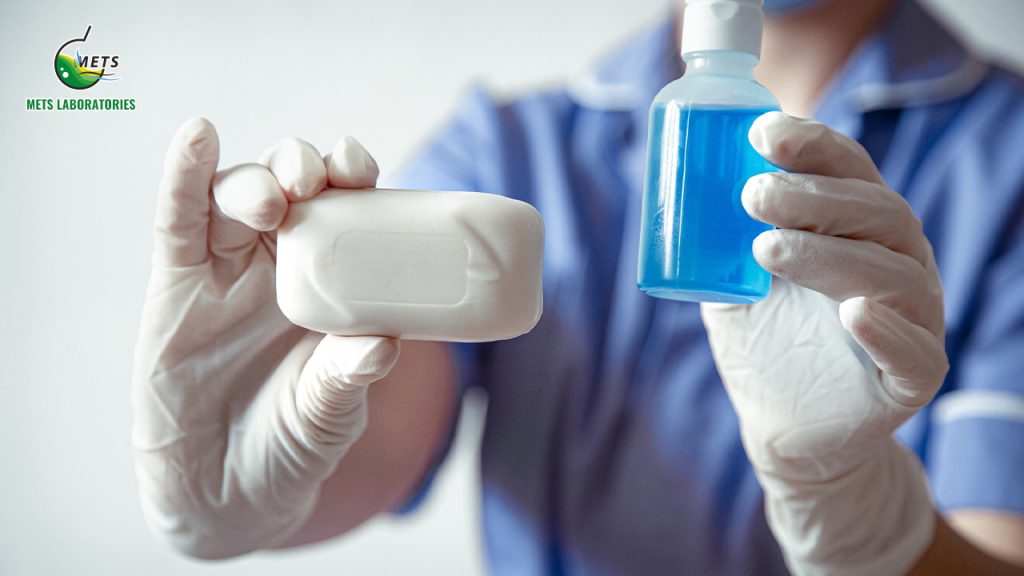
Soaps and detergents testing is a process used to evaluate the quality and performance of these cleaning products. This can include tests such as determining the pH level, measuring the foaming properties, and evaluating the cleaning effectiveness. The tests may be conducted in a lab setting and can be done on both liquid and bar soaps, as well as laundry detergents. The results of these tests can be used by manufacturers to improve their products and by consumers to make informed purchasing decisions. Detergent testing is carried out to determine whether detergents are effective, safe and meet quality standards. The main objective is to assess the cleaning power of the detergent, its compatibility with water and its effects on the skin. Biodegradability tests are also conducted to minimize environmental damage.
Technical Difference between Soaps and Detergents
Soaps are sodium or potassium salts of fatty acids used for cleaning, while detergents are synthetic agents effective in hard as well as soft water. Detergents clean better in hard water and do not form scum.
Commercial Classification and Types of Soap
- Only sodium and potassium soap are soluble in water and used for cleaning.
- Potassium soaps are generally more gentle to the skin than sodium soaps.
- They can be made using potassium hydroxide solution in place of sodium hydroxide.
- TOILET SOAPS: Toilet soaps should be entirely neutral, since excess alkali is injurious to the skin. Fillers such as sodium carbonate and sodium silicate, having a similar effect, should also be absent
- SALT-WATER SOAP: It is less easily precipitated by salt water thansoaps made from other fats, and generally contains a large amountof water, frequently over 50 percent.
- LAUNDRY OR COMMON SOAP: Laundry cake soap is probably used in larger quantities than any other. Ordinary laundry soap is generally made of soda andtallow, with some rosin; but the tallow is frequently replaced partly or wholly by grease, cottonseed oil, oleic acid, etc.
- AUTOMOBILE SOAP: Automobile soap is a soft soap made from vegetable oils and soda or potash or a mixture of soda and potash, and containing a small excess of neutral fatty oil.
- MILLED TOILET SOAP: The soap desired under this specification is a high-grade milled cake soap at least as good in every respect as one made exclusively from soda and a mixture of about best-grade tallow and pure coconut oil.
- DRUG SOAP: Drug soaps are added with medicinal properties. Deodorant is added to some soap.
- WASHING SOAP: Washing soaps include supplements such as sodium rosinate, sodium silicate, borax and sodium carbonate.
- BEARD SOAP: They contain glycerol to prevent beard soap from drying out quickly.When making this soap, the glue called rosin is applied.This makes sodium rosinate, which produces foam well. To make the soap shavings, a layer of melted soap is mounted on a cold cylinder and scraped into broken pieces.
Industrial Types of Detergents under Evaluation
- LAUNDRY DETERGENTS: Detergents used against dirt and stains on clothes. Available in powder, liquid and capsule forms.
- DISHWASHING DETERGENTS: Detergents used in dishwashers and hand washing. Fights grease and food debris.
- INDUSTRIAL DETERGENTS: Powerful cleaning agents used in factories, hospitals and large-scale enterprises.
- HOME CLEANING DETERGENTS: Multipurpose detergents used for cleaning surfaces, glass, bathrooms, kitchens, etc.
- BABY DETERGENTS: Gentle clothing cleaners formulated to be gentle on baby skin.
Assessing The Cleansing Action of Soap and Detergents
- To understand how soap works as a cleansing agent, let us consider sodium palmitate an example of soap.
- The cleansing action of soap is directly related to the structure of carboxylate ions (palmitate ions) present in the soap.
- The structure of the palmitate exhibits dual polarity. The hydrocarbon portion is nonpolar and the carboxyl portion is polar.
- The nonpolar portion is hydrophobic while the polar end is hydrophilic. The hydrophobic hydrocarbon portion is soluble in oils and greases, but not in water.
- The hydrophilic carboxylate group is soluble in water. The dirt in the cloth is due to the presence of dust particles intact or grease which sticks.
- When the soap is added to an oily or greasy part of the cloth, the hydrocarbon part of the soap dissolves in the grease, leaving the negatively charged carboxylate end exposed on the grease surface.
Key Methods Used for Soap and Detergent Testing Services
- Determination of the Amount of Water Insoluble Matter (TS 54)
- pH Determination (TS 518, TS 5270, TS 4811, TS 9676)
- Determination of Chloride (TS 54 ISO 457, TS 5155
- Determination of Inorganic Salts (TS 9676)
- Alkalinity Determination (ISO 4315)
- Determination of Free Alkali or Free Acidity (ISO 4314)
- Nonionic Active Substance Determination (ISO 2268)
Why Choose METS Laboratories for Soap and Detergent Testing Services?
- Product Development Support: They can assist with product development by evaluating formulations and providing insights to improve product performance.
- Regulatory Compliance: METS Laboratories helps ensure that products comply with regulatory requirements, such as those set by the FDA or EPA.
- Problem Solving: They can help identify and solve problems related to product quality, performance, or safety.
- Independent Testing: METS Laboratories provides independent and unbiased testing services, ensuring the reliability of results.
- Quick Turnaround Times: They strive to provide timely testing services to meet project deadlines.
- Cost-Effectiveness: METS Laboratories offers competitive pricing for their testing services.
- Confidentiality: They maintain strict confidentiality regarding client information and test results.
METS Laboratories for soap and detergent testing offers a comprehensive and reliable approach to ensuring product quality, safety, and regulatory compliance. Their expertise, advanced equipment, and adherence to industry standards guarantee accurate and dependable results. METS Laboratories provides detailed reporting, customized testing options, and valuable support for product development, making them an ideal partner for manufacturers. By choosing METS Laboratories, companies can confidently navigate the complexities of the soap and detergent industry, ensuring their products meet the highest standards of performance and consumer safety.
What Our Advanced Chemical Workflows Ensure
- Data Integrity: Every result is generated and verified under strict quality assurance.
- Compliance: All tests conform to the latest regulatory and industry-specific guidelines.
- Transparency: Clear, easy-to-understand reports and consultation support.
- Confidentiality: Your data remains secure, private, and protected.
- Environmental Stewardship: Our labs follow eco-friendly practices and aim to minimize testing-related waste and emissions.
Who Our Specialized Soap and Detergent Testing Services Are For
- Manufacturers, importers, and distributors of EEE products (e.g., electronics, cables, circuit boards, batteries).
- Industrial Facilities: To monitor effluents, emissions, and workplace safety
- Construction and Real Estate: For soil contamination, water logging, and indoor air quality
- Municipal Corporations: To assess urban air and water quality
- Schools, Hospitals & Hotels: For ensuring safe indoor environments
- Agricultural Communities: To test irrigation water and soil health
- NGOs & Research Institutions: For pollution studies and policy advocacy
- Citizens & RWAs: For local monitoring and complaint-based testing
Protect Consumers. Satisfy Authorities. Boost Market Confidence.
In today’s sustainability-driven world, consumer goods businesses are held strictly accountable by retailers, end-consumers, and international regulators alike. METS Laboratories empowers your enterprise to:
- Protect your consumer base and end-users from skin irritation, chemical burns, or toxic heavy metal exposures.
- Achieve complete market compliance by executing analytical protocols that conform cleanly to current Bureau of Indian Standards (BIS) chemical and consumer product safety specifications, ISO parameters, and global cosmetic safety mandates.
- Build a premium brand reputation rooted in scientifically validated formulation safety and high-performance cleaning characteristics.
- Avoid costly consumer lawsuits, multi-market batch recalls, and regulatory factory bans due to substandard or highly toxic manufacturing ingredients.
- Earn long-term stakeholder and investor trust with verified eco-friendly formulation claims and transparent ESG reporting.
Soap and detergent testing services aren’t just a regulatory formality—they are a vital strategic asset for product engineering safety and human health.
Frequently Asked Questions
How do I book a test?
You can contact METS Laboratories via phone, email, or our website to schedule sampling or drop off a sample at our facility.
Is your lab accredited?
Yes, METS Laboratories is accredited under ISO/IEC 17025:2017.
How long does it take to get results?
Turnaround time depends on the parameters, but standard reports are typically delivered within 3–7 working days.
Do you provide on-site sampling?
Yes, we have trained field teams who follow strict SOPs for on-site sample collection.
Can I get help understanding the report?
Absolutely. We offer report interpretation and guidance on corrective actions or next steps.
What locations do you serve?
We serve clients across India and can coordinate with international partners when required.
Can you help with regulatory approvals?
Yes, our test reports are accepted by government authorities, and we can assist in documentation for environmental clearances.