


Acoustic Engineering And Sound Proofing Materials Testing Services – METS Laboratories
The foundation of any successful construction project lies in the materials that make up the structure. The durability, strength, and performance of building materials directly impact the safety, longevity, and functionality of the completed structure. To ensure that the materials used meet the highest standards, we provide extensive building materials testing services. Our testing procedures are designed to ensure that every material used in construction adheres to domestic and international standards, offering both exceptional quality and regulatory compliance. By conducting thorough and detailed tests, we help guarantee the integrity of your construction projects, giving you the assurance that the materials meet the necessary performance benchmarks. By expanding your material pipeline through our specialized acoustic and soundproofing materials testing services, engineering groups can systematically validate Sound Transmission Class ($STC$) ratings and Noise Reduction Coefficients ($NRC$). Locking in these verified acoustic metrics prevents severe structural sound leaks, fulfills green-building code metrics, and secures architectural clearance.
Acoustic engineering and soundproofing material testing evaluate how materials interact with sound, focusing on their ability to absorb, reflect, and block sound waves. This testing is crucial for various applications, including building construction, industrial noise control, and product design, ensuring optimal sound quality and noise reduction.
Importance of Acoustic and Soundproofing Materials Testing Services
Acoustic testing is performed to assess and manage sound, noise, and vibration. It helps in various applications, including reducing noise pollution, improving communication, and ensuring product performance and compliance with regulations. For example, it helps manufacturers determine acceptable noise levels, meet noise standards, and design products with desirable acoustic characteristics
Key Aspects of Acoustic Material Testing:
- Sound Absorption: Measures how effectively a material absorbs sound energy, preventing reflections and reverberation.
- Sound Insulation (Soundproofing): Assesses a material’s ability to block or reduce the transmission of sound from one space to another.
- Acoustic Impedance and Admittance: These properties relate to how a material resists or allows sound waves to pass through it.
- Transmission Loss: Measures the reduction in sound energy as it passes through a material or construction element.
- Dynamic Stiffness and Airflow Resistance: Important for assessing the performance of materials like floor coverings and partitions.
- Airborne and Impact Noise Insulation: Specifically tests how well materials handle noise transmitted through the air or by impact, like footsteps on a floor.
National Sound Standards and Regulations in India
The Indian standards for acoustic testing are primarily based on ISO standards and are published by the Bureau of Indian Standards (BIS). Key standards include IS 8225 for measuring sound absorption in a reverberation room, and IS 13937 (Part 2) for statistical methods in noise emission. Other relevant standards cover various aspects of acoustic measurement and testing, including sound intensity, loudspeaker systems, and acoustic emission inspection.
Key Indian Standards for Acoustic Testing:
- IS 8225 (1987):Measurement of sound absorption in a reverberation room, identical to ISO 354:1985.
- IS 13937 (Part 2) (1994):Statistical methods for determining and verifying stated noise emission values of machinery and equipment (identical to ISO 7574/2:1985).
- IS 2026-10 (2009):Power Transformers, Part 10: Sound Levels (includes sound pressure and sound intensity measurements).
- IS 15596 (Part 5) (2005):Sound systems equipment, Part 5: Loudspeakers.
- IS 14670 (1999):Recommended Practice for Acoustic Emission Inspection During Hydrostatic Pressure Testing of Systems.
- IS 4954 (1968):Recommendations for noise abatement in town and country planning.
- IS 12180 (Part 1) (2000):Tractors and Machinery for Agriculture and Forestry – Measurement of noise.
- IS 9876 (1981):Guide to the measurement of airborne acoustical noise of different kinds.
- IS 1881 (1998):Code of Practice for Indoor Installation of Public Address Systems
Primary Types of Acoustic and Soundproofing Materials Testing Services
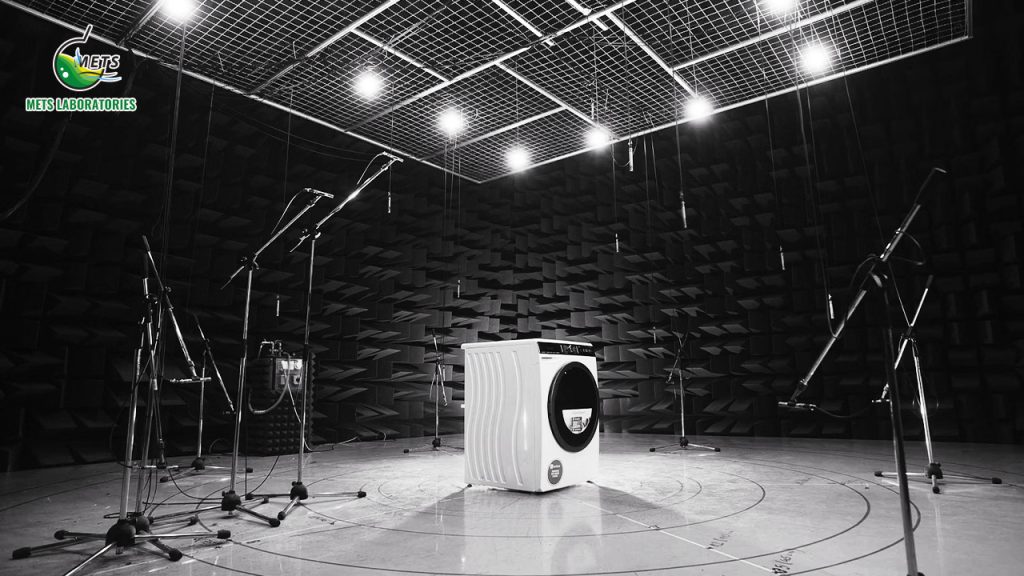
- Laboratory Testing: Conducted in controlled environments like anechoic chambersand hemi-anechoic chambers, using standardized methods to measure specific acoustic parameters.
- On-site Testing: Performed in real-world settings to assess the performance of installed materials and systems, like in buildings or industrial facilities.
Our Advanced Acoustic and Soundproofing Materials Testing Services
- Building Acoustics: Testing materials for walls, floors, ceilings, windows, and doors to improve sound insulation and reduce noise pollution.
- Industrial Acoustics: Evaluating noise control solutions for machinery, equipment, and industrial facilities.
- Product Design: Optimizing the acoustic performance of products like vehicles, aircraft, and consumer electronics.
- Recording Studios and Performance Spaces: Ensuring optimal sound quality and minimizing unwanted noise in critical acoustic environments.
- Traffic Noise Barriers: Testing materials for their ability to reduce noise pollution from roads and highways
- Residential Range Hood Program Testing: We offer comprehensive testing to meet requirements for California Energy Commission title 20 as well as sound, airflow and capture efficiency to meet program requirements.
- Product Development Assistance: We can conduct testing characterizing the sound and airflow performance of alternate components and designs.
- Field Tests and Verifications: We perform many types of field tests and verifications, including: FIIC, ASTC, NIC, NNIC, Sound Power, Sound Pressure, and Sound Intensity.
- Enclosures and Office Spaces: We offer the latest acoustic testing for isolated booths becoming more common in office and public spaces. Testing in accordance with ASTM E596 and ISO 23351-1 “Acoustics — Measurement of speech level reduction of furniture ensembles and enclosures”
- Life Safety Acoustics Testing: We offer a comprehensive set of acoustics and electroacoustics testing related to fire alarm systems and emergency phones.
- Medical Devices and Handheld Tools: Sound power level testing and hand transmitted vibration testing for many IEC and ISO standard
Common Structural Testing Methods and Standards
Measurement of sound absorption in a reverberation room, identical to ISO 354:1985.
Statistical methods for determining and verifying stated noise emission values of machinery and equipment (identical to ISO 7574/2:1985).
Power Transformers, Part 10: Sound Levels (includes sound pressure and sound intensity measurements).
Sound systems equipment, Part 5: Loudspeakers.
Recommended Practice for Acoustic Emission Inspection During Hydrostatic Pressure Testing of Systems.
Determines the effectiveness of materials in absorbing sound waves, often using techniques like reverberation room methods (e.g., EN ISO 354).
Evaluates the performance of partitions, walls, doors, and other building elements in reducing sound transmission (e.g., EN ISO 10140, EN 1793).
Assesses materials for their ability to resist deformation and airflow (e.g., EN 29053, EN ISO 10534-2).
Why Choose METS Laboratories for Acoustic and Soundproofing Materials Testing Services?
METS Laboratories India provides all facets of acoustical testing, helping you meet third-party acoustical and airflow performance requirements defined by specifiers, buyers, and regulatory authorities. Our turnaround times for the many of tests are less within 5 -working days from receipt of sample to issuing of test report.
Our Material & Acoustic testing division offer a wide range of acoustical, airflow, and leakage testing services on products like air conditioners, dishwashers, windows and doors etc. Our Material & Acoustic testing division is one of the most extensive and diversified facilities of its kind.
NABL accredited, METS LABORTORIES INDIA PVT.LTD can test to a variety of the established methods (e.g., ISO, ASTMD, AOAC, APHA, FSSAI, BIS,)
- Reliability: They have a good reputation for providing reliable and timely results.
- Customer Support: They offer excellent customer support and are always available to answer questions and provide assistance.
- Quality Assurance: They maintain high standards of quality control and accuracy in their testing procedures.
- Maintaining customer confidentiality by considering it proprietary information.
- Product evaluation for appearance, quality and performance.
- Our laboratory conducts testing on a wide range of products, materials, and components to verify compliance with standards, specifications, and regulatory requirements. Our team is happy to provide expert advice and guidance to ensure the appropriate water testing is carried out for your needs.
- Our dedicated, experienced, and friendly team is here to help—providing expert knowledge, guidance, and access to cutting-edge water testing capabilities and technologies in our laboratory.
- We conduct comprehensive product evaluations for appearance, quality, and performance. Our technical support network provides expert guidance—answering questions, interpreting results, and assisting with quality assurance program management.
- We participate in inter-laboratory proficiency testing and comparative analyses to ensure accuracy, reliability, and compliance with industry standards.
- We implement and maintain rigorous ISO/IEC 17025:2017 accreditation, ensuring internationally recognized standards for testing competence, measurement accuracy, and operational excellence in every analysis.
- We maintain strict customer confidentiality by treating all data as proprietary information.
What Our Advanced Acoustic Performance Workflows Ensure
- Data Integrity: Every result is generated and verified under strict quality assurance.
- Compliance: All tests conform to the latest regulatory and industry-specific guidelines.
- Transparency: Clear, easy-to-understand reports and consultation support.
- Confidentiality: Your data remains secure, private, and protected.
- Environmental Stewardship: Our labs follow eco-friendly practices and aim to minimize testing-related waste and emissions.
Who Our Specialized Acoustic and Soundproofing Materials Testing Services Are For
- Manufacturers, importers, and distributors of EEE products (e.g., electronics, cables, circuit boards, batteries).
- Industrial Facilities: To monitor effluents, emissions, and workplace safety
- Construction and Real Estate: For soil contamination, water logging, and indoor air quality
- Municipal Corporations: To assess urban air and water quality
- Schools, Hospitals & Hotels: For ensuring safe indoor environments
- Agricultural Communities: To test irrigation water and soil health
- NGOs & Research Institutions: For pollution studies and policy advocacy
- Citizens & RWAs: For local monitoring and complaint-based testing
Protect Consumers. Satisfy Authorities. Boost Market Confidence.
In today’s sustainability-driven world, material processors and acoustic product brands are held strictly accountable by structural engineers, building safety boards, and corporate developers alike. METS Laboratories empowers your enterprise to:
- Protect your corporate workforce, residential tenants, and surrounding communities from hazardous industrial noise exposure or substandard structural sound leaks.
- Achieve complete market compliance by executing analytical protocols that conform cleanly to current ASTM International building acoustics and environmental sound isolation standard committees frameworks, Indian Standard (IS) codes, National Building Code guidelines, and ISO quality management systems.
- Build a premium brand reputation rooted in scientifically validated decibel reduction, high noise reduction capabilities, and dependable impact damping safety.
- Avoid costly construction hand-over delays, product recall campaigns, and severe brand reputational damages due to substandard or unverified soundproofing material batches.
- Earn long-term stakeholder and investor trust with verified material performance data and transparent safety compliance reporting.
Acoustic and soundproofing materials testing services aren’t just a regulatory formality—they are a vital strategic asset for structural durability and engineering excellence.
Frequently Asked Questions
How do I book a test?
You can contact METS Laboratories via phone, email, or our website to schedule sampling or drop off a sample at our facility.
Is your lab accredited?
Yes, METS Laboratories is accredited under ISO/IEC 17025:2017.
How long does it take to get results?
Turnaround time depends on the parameters, but standard reports are typically delivered within 3–7 working days.
Do you provide on-site sampling?
Yes, we have trained field teams who follow strict SOPs for on-site sample collection.
Can I get help understanding the report?
Absolutely. We offer report interpretation and guidance on corrective actions or next steps.
What locations do you serve?
We serve clients across India and can coordinate with international partners when required.
Can you help with regulatory approvals?
Yes, our test reports are accepted by government authorities, and we can assist in documentation for environmental clearances.