


- Mets Admin
- August 21, 2026
- Testing Insights
- 0 Comments
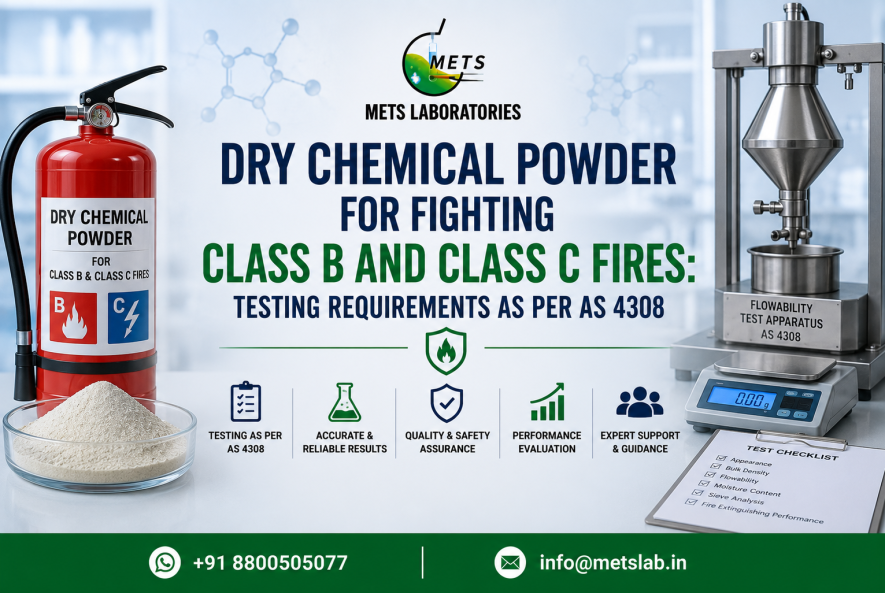
Introduction to Dry Chemical Powder Testing as per AS 4308
Fire protection is a critical aspect of industrial safety, particularly in environments where flammable liquids and electrical equipment are present. Utilizing certified dry chemical powder testing as per AS 4308 is essential to ensure that Dry Chemical Powder (DCP) fire extinguishers remain effective for combating Class B (flammable liquids) and Class C (energised electrical equipment) fires. Their rapid flame knockdown capability, ease of operation, and versatility make them an essential component of fire safety programmes across industrial, commercial, and residential facilities.
To ensure reliable performance during emergencies, dry chemical extinguishing powders must meet stringent quality and performance requirements. In Australia, AS 4308 – Dry Chemical Powder for Fighting Class B and Class C Fires specifies the performance, quality, and testing requirements for dry chemical extinguishing agents.
This blog explains the importance of Dry Chemical Powder testing, sample preparation, major test parameters, testing methods, and compliance requirements under AS 4308.
What Is Dry Chemical Powder (DCP)?
Dry Chemical Powder (DCP) is a finely divided extinguishing agent designed to interrupt the chemical chain reaction of fire. Unlike water-based extinguishing agents, dry chemical powder rapidly suppresses flames without conducting electricity, making it suitable for electrical fires.
Common dry chemical extinguishing agents include:
- Monoammonium Phosphate (ABC Powder)
- Sodium Bicarbonate (BC Powder)
- Potassium Bicarbonate (Purple-K)
- Potassium-based special extinguishing powders
AS 4308 mainly addresses powders intended for Class B and Class C fire applications.

Why Is Dry Chemical Powder Testing as per AS 4308 Important?
Testing is essential to:
- Verify extinguishing performance.
- Ensure consistent powder quality.
- Confirm compliance with AS 4308 requirements.
- Prevent caking and moisture absorption.
- Ensure proper flow characteristics.
- Improve extinguisher reliability.
- Support product certification and market acceptance.
Routine testing helps manufacturers maintain product quality and ensure dependable performance during fire emergencies.
Industrial Applications of Class B and C Fire Suppression Powder
Dry chemical powder is widely used in:
- Petrol stations
- Chemical plants
- Oil and gas facilities
- Electrical substations
- Manufacturing industries
- Warehouses
- Marine applications
- Commercial buildings
- Aircraft hangars
- Power generation facilities
- Automotive workshops
These locations often present fire hazards involving flammable liquids and energised electrical equipment.
Sample Preparation and Laboratory Handling
Proper sample preparation is necessary to obtain accurate and repeatable test results.
Before testing:
- Samples are collected from representative production batches.
- Powder is mixed thoroughly to ensure uniformity.
- Samples are protected from moisture during handling.
- Test specimens are conditioned according to laboratory requirements.
- Appropriate quantities are prepared for each performance and physical test.
Correct sampling minimises variability and improves test reliability.
Major Tests Performed Under AS 4308 Standards
Moisture Content
Moisture affects powder flowability and storage stability.
Excessive moisture may cause:
- Powder caking
- Reduced discharge performance
- Poor extinguishing efficiency
Routine moisture testing ensures product stability during storage.
Particle Size Distribution
Particle size significantly influences extinguishing efficiency and discharge performance.
Testing verifies that the powder contains the appropriate particle size distribution specified by the standard.
Bulk Density
Bulk density determines the mass of powder occupying a given volume.
It affects:
- Extinguisher filling
- Discharge characteristics
- Storage efficiency
Flowability
The powder must flow freely through the extinguisher without blockage.
Flowability testing evaluates resistance to caking and discharge problems.
Water Repellency
Dry chemical powder should resist moisture absorption during storage.
Water repellency testing verifies that the powder maintains its free-flowing characteristics under humid conditions.
Chemical Composition
The active extinguishing ingredients are analysed to verify compliance with formulation specifications.
Common analytical techniques include:
- X-Ray Fluorescence (XRF)
- ICP-OES
- ICP-MS
- Wet chemical analysis
Thermal Stability
Thermal stability testing confirms that the powder maintains its performance under elevated storage temperatures.
Fire Performance Test
The most important evaluation is the extinguishing performance test.
The powder is discharged onto controlled Class B fire scenarios to verify:
- Rapid flame knockdown
- Complete extinguishment
- Consistent fire suppression performance
Only powders meeting the required fire performance criteria comply with AS 4308.


Typical Laboratory Testing Equipment Used
Testing commonly requires:
- Moisture Analyser
- Particle Size Analyser
- Sieve Shaker
- Bulk Density Apparatus
- Flowability Tester
- Environmental Chamber
- ICP-OES / ICP-MS
- XRF Spectrometer
- Fire Test Facility
- Analytical Balance
Specific Requirements of the AS 4308 Standard
AS 4308 specifies requirements for:
- Powder composition
- Physical properties
- Moisture resistance
- Flow characteristics
- Storage stability
- Fire extinguishing performance
- Product quality consistency
Compliance with these requirements helps ensure reliable performance during emergency situations.
Why ISO/IEC 17025 Accredited Laboratory Testing Matters
Testing by an ISO/IEC 17025 accredited laboratory provides assurance that:
- Validated test methods are followed.
- Instruments are calibrated and maintained.
- Laboratory personnel are technically competent.
- Test results are accurate and traceable.
- Reports are accepted by certification bodies and regulatory authorities.
Accredited testing strengthens confidence in product quality and supports certification.
Quality Control Best Practices for Manufacturers
Manufacturers can maintain consistent product quality by:
- Using high-purity raw materials.
- Controlling moisture during production.
- Monitoring particle size distribution.
- Performing routine batch testing.
- Storing powders in dry environments.
- Maintaining quality management systems.
- Conducting periodic fire performance verification.
Preventive quality control improves extinguisher reliability and reduces product failures.
Future Trends in Fire Suppression Testing
The fire protection industry continues to develop environmentally friendly extinguishing agents with improved fire suppression efficiency and reduced environmental impact. Research is focused on advanced powder formulations, enhanced flow additives, longer storage stability, and improved compatibility with modern fire protection systems. As industrial safety regulations evolve, regular testing in accordance with AS 4308 will remain essential for ensuring reliable extinguisher performance and protecting life and property.
Conclusion: Ensuring Fire Safety Through Compliance
Dry Chemical Powder plays a vital role in protecting people, property, and industrial facilities from Class B and Class C fires. Conducting routine dry chemical powder testing as per AS 4308 ensures that extinguishing powders possess the necessary physical properties, chemical composition, and fire suppression performance required for reliable operation.
Through proper sample preparation, routine quality control, fire performance testing, and evaluation by accredited facilities, manufacturers can deliver high-quality extinguishing agents that meet strict regulatory requirements. Explore our complete range of industrial chemical testing services or Contact METS Laboratories today to schedule compliance evaluation for your fire protection products.
Frequently Asked Questions (FAQs)
What types of fires are covered by AS 4308?
Why is moisture testing important?
What is the most critical test under AS 4308?
Why is particle size important?
Why should testing be performed by an ISO/IEC 17025 accredited laboratory?
Manufacturers and Exporters Recommend Us
Dedicated professionals committed to providing you with accurate and reliable testing services. Get METS Lab services today from the best lab experts & get the accurate reports from our laboratory.