


- Mets Admin
- September 25, 2026
- Testing Insights
- 0 Comments
Introduction to TGA Testing in Polymers
What is TGA testing in polymers?
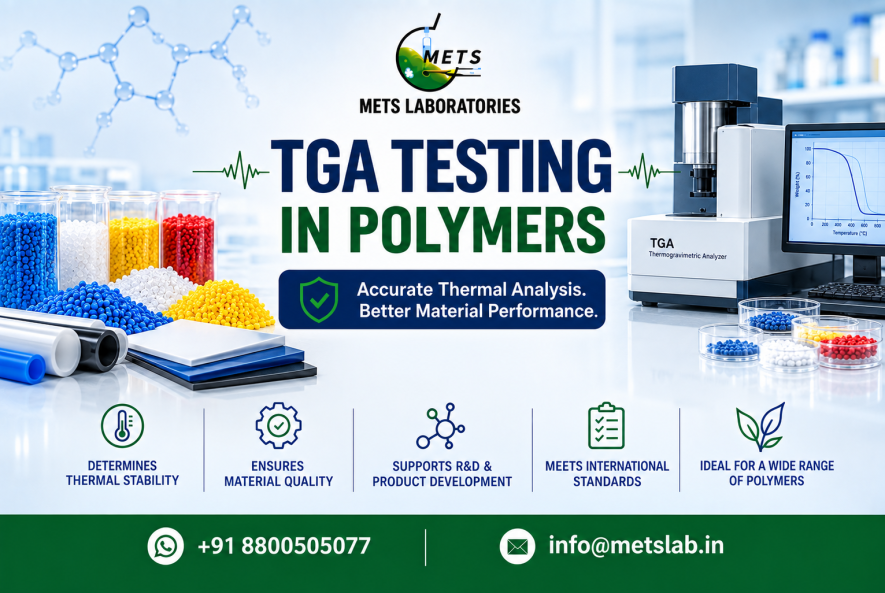
TGA testing in polymers (Thermogravimetric Analysis) is a crucial thermal analysis technique that measures mass changes in a polymer sample as a function of temperature or time under a controlled atmosphere. Performing routine TGA testing in polymers evaluates how raw resins, masterbatches, and finished components respond to thermal stress—revealing critical decomposition behavior including decomposition temperature, weight loss percentage, residual ash content, filler content, volatile content, and overall thermal stability. Standards like ASTM E1131, ASTM D3850, ASTM E2550, ISO 11358, and ASTM D6370 govern this compositional testing across automotive, aerospace, medical, packaging, and electronics applications.
Why Is TGA Testing in Polymers Important for Quality Control?
TGA testing in polymers is critical because materials that appear identical in composition and appearance may exhibit dramatically different thermal decomposition behavior due to variations in molecular weight, additives, fillers, moisture content, or contamination. Untested or improperly characterized polymers contribute to premature failure, processing defects, reduced service life, and safety hazards. Rigorous TGA testing ensures materials meet specifications, provides verifiable thermal stability data for risk assessments, and supports safer, more reliable product design decisions. Beyond compliance, TGA testing protects products by identifying incorrect polymer grades, detecting contamination or excessive filler loading, and predicting performance under elevated service temperatures. It also safeguards investments by reducing scrap rates, preventing field failures and recalls, lowers liability exposure for manufacturers and brand owners, and enables informed material selection that balances thermal stability, mechanical performance, processability, and cost throughout a product’s lifecycle.

Key Parameters Evaluated During TGA Testing
TGA testing in polymers evaluates several critical thermal decomposition parameters that determine material safety and compliance:
- Decomposition Temperature (Td) (ASTM E1131 / ISO 11358)— Measures the temperature at which a polymer begins to lose mass due to thermal breakdown, indicating upper service temperature limits.
- Weight Loss Percentage (ASTM E1131 / ISO 11358)— Quantifies the amount of material lost at specific temperature intervals, indicating volatile content, moisture, and degradation extent.
- Residual Ash Content (ASTM E1131 / ASTM D5630)— Determines the inorganic residue remaining after complete combustion, indicating filler, glass fiber, or mineral content.
- Filler Content (ASTM D6370 / ISO 11358)— Evaluates the percentage of inorganic fillers or reinforcements present in the polymer matrix, critical for quality control and material verification.
- Volatile Content and Moisture (ASTM D6980 / ISO 11358)— Measures the mass loss at low temperatures, indicating absorbed moisture or residual solvents that can affect processing and performance.
- Thermal Stability (ASTM E2550 / ISO 11358)— Assesses the temperature range over which a polymer maintains its properties without significant degradation, critical for high-temperature applications.
- Oxidative Induction Temperature (ASTM E2008 / ISO 11358)— Determines the temperature at which rapid oxidative degradation begins in an air atmosphere, indicating stabilizer effectiveness.
- Compositional Analysis (ASTM E1131 / ASTM D6370)— Quantifies the percentage of individual components in polymer blends, copolymers, and rubber compounds, including polymer, carbon black, and ash content.
These parameters collectively provide a comprehensive thermal decomposition profile, enabling informed material selection and regulatory compliance verification.
Types of Polymeric Materials Commonly Tested
- TGA testing in polymers applies to a diverse range of polymeric materials, each presenting unique thermal decomposition characteristics:
- Thermoplastics:PE, PP, PET, PVC, PS, ABS, PC, PA (nylon), POM, and PBT used in injection molding, extrusion, and blow molding.
- Thermosetting plastics:Epoxy, phenolic, polyester, and polyurethane resins requiring decomposition temperature and filler content evaluation.
- Elastomers and rubbers:Natural rubber, SBR, EPDM, silicone, and thermoplastic elastomers (TPEs) requiring carbon black and ash content analysis.
- Engineering plastics:PEEK, PEI, PPS, PSU, and LCP used in high-performance automotive, aerospace, and electronics applications.
- Biodegradable and bio-based plastics:PLA, PHA, PBS, and starch-based polymers requiring thermal stability and decomposition characterization.
- Medical-grade plastics:PC, PP, PE, PVC, and PEEK used in syringes, catheters, implants, and sterile packaging requiring thermal stability evaluation.
- Packaging plastics:PET, HDPE, LDPE, PP, and multilayer films requiring volatile content and thermal stability analysis for processing and barrier performance.
- Recycled and reprocessed plastics:Post-industrial and post-consumer resins requiring thermal fingerprinting to verify grade consistency, contamination levels, and filler content.
- Polymer composites:Glass fiber, carbon fiber, and mineral-filled composites requiring fiber content, resin content, and decomposition analysis.
- Wire and cable insulation: PVC, XLPE, and EPDM compounds requiring thermal stability and filler content verification.
Operational Risks of Using Untested Polymeric Materials
Using untested polymers in product applications introduces serious safety, legal, and financial risks that can compromise entire product lines:
- Premature failure during servicedue to unknown decomposition temperature, causing thermal degradation, embrittlement, or loss of mechanical properties.
- Processing defectswithout verified thermal stability, leading to degradation during extrusion, injection molding, or compounding, causing discoloration, odor, or reduced properties.
- Regulatory non-complianceleading to product rejection, costly recalls, or legal liability for responsible parties.
- Contamination and toxicityfrom unidentified fillers, additives, or polymer blends, endangering consumer health in food, medical, and pharmaceutical applications.
- Accelerated deterioration and high replacement costsfrom substandard materials that fail prematurely under thermal cycling.
- Insurance and liability exposurefrom unverified performance claims, potentially voiding coverage and exposing stakeholders to litigation.
- Brand reputation damagefrom repeated product failures and negative customer experiences.
- Inability to verify material grade or compositionleading to counterfeit or off-spec resin acceptance and downstream processing failures.
- Excessive filler contentreducing mechanical performance and causing unexpected weight or cost implications.
These cumulative risks make certified TGA testing essential for responsible material selection.
Relevant Standards for TGA Testing in Polymers (ASTM E1131, ISO 11358)
ASTM E1131 provides the standard test method for compositional analysis by thermogravimetry. ASTM D3850 covers rapid thermal degradation of solid electrical insulating materials by TGA. ASTM E2550 addresses thermal stability by TGA. ISO 11358 specifies general principles for TGA of polymers. ASTM D6370 covers rubber composition analysis by TGA. ASTM D5630 addresses ash content determination. ASTM D6980 covers moisture determination in plastics by TGA. ASTM E2008 addresses oxidative induction temperature by TGA. FDA 21 CFR and EU 10/2011 govern food-contact plastics and require thermal characterization in addition to migration testing. USP <661> and ISO 10993 apply to pharmaceutical and medical device plastics, ensuring thermal stability and biocompatibility. Both ASTM and ISO standards provide comparative thermal decomposition data under specific test conditions and should not be extrapolated to actual service environments without engineering evaluation. National and international regulatory bodies frequently reference these standards for compliance.


How METS Laboratories Supports Polymer Thermal Analysis
METS Laboratories provides comprehensive TGA testing services covering decomposition temperature, weight loss analysis, residual ash content, filler content, volatile and moisture content, thermal stability, oxidative induction temperature, and compositional analysis for thermoplastics, thermosets, elastomers, engineering plastics, composites, and bio-based polymers. Their capabilities include testing for Td, weight loss percentage, ash content, filler content, volatile content, thermal stability, and compositional analysis. The laboratory supports TGA testing to ASTM E1131, ASTM D3850, ASTM E2550, ASTM D6370, ASTM D5630, ASTM D6980, ASTM E2008, ISO 11358, and international standards including FDA, EU, USP, and ISO requirements. METS Laboratories delivers independently verified test data suitable for regulatory submissions, risk assessments, and product certification. With accredited facilities and experienced technical teams, they ensure accurate, reproducible results aligned with global standards. Their end-to-end support helps manufacturers, brand owners, and project teams demonstrate compliance, reduce liability, and deliver safer, more durable polymer products with confidence.
Conclusion: Ensuring Material Safety with TGA Testing
TGA testing in polymers is not merely a regulatory checkbox—it is a fundamental safety and performance requirement for modern polymeric materials. Standards like ASTM E1131 and ISO 11358 provide structured frameworks for evaluating how polymers behave under controlled thermal conditions, generating essential data for material selection, risk assessment, and code compliance. Untested polymers introduce unacceptable risks to product safety, including premature failure, processing defects, contamination, and legal liability.
To expand your quality control protocols beyond thermal stability, explore our complete chemical resistance testing of plastics guide or review our comprehensive range of accredited chemical testing services. Partner with METS Laboratories today to ensure your polymer products meet verified performance standards.
Frequently Asked Questions (FAQs)
What is the difference between TGA and DSC?
What does a pass result in TGA testing mean?
Can short-term TGA tests predict long-term thermal performance?
How long does TGA testing take?
Which polymers are most prone to thermal degradation?
What is the difference between TGA in nitrogen and TGA in air?
Manufacturers and Exporters Recommend Us
Dedicated professionals committed to providing you with accurate and reliable testing services. Get METS Lab services today from the best lab experts & get the accurate reports from our laboratory.