Mon - Fri 8am - 8pm
336 Utah City Centre
Globe Icon
Globe Icon

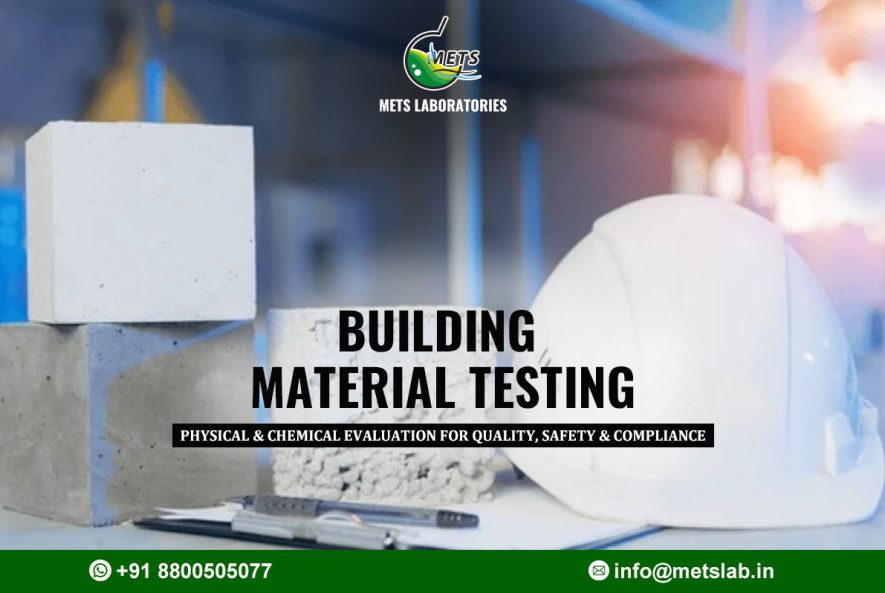
Building Material Testing: Physical & Chemical Evaluation for Quality, Safety & Compliance

  • Home
  • Uncategorized
  • Building Material Testing: Physical & Chemical Evaluation for Quality, Safety & Compliance
Building Material Testing

Introduction – Why Building Material Testing Matters

Building materials form the backbone of any construction project. From concrete and cement to steel, bricks, tiles, and coatings—every material must meet strict quality and safety requirements.

Poor-quality materials can lead to structural failure, cracks, corrosion, water leakage, and safety hazards, making testing essential for durability and long-term performance.

What is Building Material Testing?

Building material testing is a systematic evaluation of construction materials to determine their:

  • Physical strength and durability
  • Chemical composition and safety
  • Resistance to environmental conditions
  • Compliance with national and international standards

It ensures materials are suitable for safe and long-lasting construction.

Why is This Testing Important?

Key Reasons:

  • Ensure structural safety and stability
  • Improve durability and lifespan of buildings
  • Detect material defects early
  • Meet construction codes and regulations
  • Ensure environmental and chemical safety

Risks of Non-Compliance:

  • Structural collapse or failure
  • High maintenance and repair costs
  • Water leakage and corrosion
  • Legal and regulatory penalties

Applicable Standards & Guidelines

Building material testing is governed by several international organizations:

  • ASTM International – Construction material test standards
  • ISO – Global building material quality standards
  • IS (Indian Standards – BIS) – Cement, concrete, steel, bricks standards
  • EN Standards – European construction material specifications

Key Categories of Building Material Testing

1. Physical Testing of Building Materials

Compressive Strength Test

  • Determines load-bearing capacity of concrete, bricks, and blocks
  • Ensures material can withstand structural pressure

Tensile Strength Test

  • Measures resistance to pulling forces
  • Important for steel, reinforcement bars, and composites

Flexural Strength Test

  • Evaluates bending resistance
  • Used for beams, slabs, tiles, and concrete structures

Water Absorption Test

  • Measures porosity of bricks, tiles, and concrete
  • High absorption indicates poor durability

Density & Bulk Density

  • Determines compactness of material
  • Affects strength and structural performance

Abrasion Resistance Test

  • Evaluates surface wear resistance
  • Important for flooring materials, tiles, and pavements

Impact Resistance Test

  • Measures ability to withstand sudden loads or shocks
  • Critical for flooring and structural components
2. Chemical Testing of Building Materials

Chemical Composition Analysis

  • Determines elemental composition of cement, steel, and aggregates
  • Ensures correct material formulation

pH Test

  • Measures acidity or alkalinity of cement and water
  • Helps prevent corrosion of reinforcement steel

Chloride Content Test

  • Detects chloride ions in concrete and water
  • High chloride leads to steel corrosion

Sulphate Content Test

  • Evaluates sulphate levels in soil, cement, and water
  • Excess sulphates cause cracking and expansion

Alkali Content Test

  • Measures alkali levels in cement
  • Prevents alkali-silica reaction (ASR) in concrete

Heavy Metals Analysis

  • Detects toxic metals such as lead, chromium, and arsenic
  • Ensures environmental and occupational safety

Key Parameters Evaluated

  • Strength and load capacity
  • Durability and wear resistance
  • Water permeability and absorption
  • Chemical stability
  • Corrosion resistance
  • Environmental safety

Test Methods Overview

  • Compression and tensile testing machines
  • Chemical titration and wet analysis
  • XRF / ICP-based elemental analysis
  • pH meters and conductivity testing
  • Environmental conditioning tests

Who Needs This Testing?

  • Construction companies
  • Civil engineering contractors
  • Cement manufacturers
  • Real estate developers
  • Infrastructure projects (roads, bridges, buildings)
  • Government quality control agencies

Conclusion

Building material testing ensures safe, durable, and high-performance construction. By evaluating both physical strength and chemical composition, it helps prevent structural failures and ensures compliance with international standards set by organizations like ASTM and ISO.

Frequently Asked Questions

Q. Which test is most important in construction materials?

  • Compressive strength test is the most critical for structural safety.

Q. Why is chemical testing required?

  • To prevent corrosion, cracking, and long-term material degradation.

Q. Which materials are commonly tested?

  • Concrete, cement, steel, bricks, aggregates, and water.

Manufacturers and Exporters Recommend Us

Dedicated professionals committed to providing you with accurate and reliable testing services. Get METS Lab services today from the best lab experts & get the accurate reports from our laboratory.


Leave A Comment

Your email address will not be published *

Select the fields to be shown. Others will be hidden. Drag and drop to rearrange the order.
  • Image
  • SKU
  • Rating
  • Price
  • Stock
  • Availability
  • Add to cart
  • Description
  • Content
  • Weight
  • Dimensions
  • Additional information
Click outside to hide the comparison bar
Compare