

- Mets Admin
- May 29, 2026
- Testing Insights
- 0 Comments
Introduction
Noida has rapidly emerged as a pivotal hub for garment manufacturing and textile exports in the Delhi NCR region. With hundreds of export houses supplying to global brands, the pressure to maintain impeccable quality standards has never been higher. International buyers, particularly from the USA and Europe, demand rigorous quality checks before accepting shipments. One of the most common reasons for export rejection is poor color retention, leading to fading, bleeding, or staining. To avoid costly returns and protect brand reputation, Noida manufacturers must prioritize color fastness testing as a non-negotiable step in production. This testing ensures that dyed and printed textiles retain their original hue under various environmental conditions. Without it, even high-quality garments can fail buyer specifications. In this comprehensive guide, we will explore why color fastness testing is critical for exporters, the different types of tests required, common failure points, and how partnering with a reliable laboratory can safeguard your export business.
What Is Color Fastness Testing in Textiles?
Color fastness testing refers to the process of evaluating how well a textile material retains its color when subjected to various external factors such as washing, rubbing, sweating, light exposure, or chemical treatments. In simple terms, it measures the resistance of color against fading or bleeding onto other materials.
For garments, this is crucial because everyday use involves contact with water, detergents, perspiration, and sunlight. If a shirt loses its vibrancy after two washes or stains a white handbag, the product is considered defective.
Similarly, for fabrics and home textiles like bedsheets, curtains, and upholstery, poor color fastness can lead to unattractive blotches or transfer of dyes onto skin or furniture. Even fashion products such as scarves, ties, and handbags undergo these tests to ensure they meet consumer expectations.
In essence, color fastness testing quantifies a textile’s durability in terms of color stability, giving exporters a reliable metric to present to buyers.

Why Color Fastness Testing Is Important for Garment Exporters
For garment manufacturers in Noida targeting global markets, color fastness testing is not just a technical formality—it is a business imperative. Here is why:
✅ Export Compliance – Most international trade agreements and import regulations require textile shipments to meet specified color fastness levels. Without certified test reports, customs clearance can be delayed or denied.
✅ Buyer Approvals – Reputed brands like Walmart, Zara, H&M, and Next mandate third-party test reports before issuing purchase orders. Failing to provide these can result in lost contracts.
✅ Product Durability – Good color fastness means longer product life. Garments that retain color after multiple washes receive better reviews and repeat purchases.
✅ Customer Satisfaction – No consumer wants a new black t-shirt that turns grey after one wash or a red cushion that stains their sofa. Testing prevents such disappointments.
✅ Prevention of Complaints & Returns – Returns due to color bleeding or fading are expensive. They incur shipping costs, damage brand image, and often lead to penalty clauses from buyers.
In short, international buyers view color fastness as a measure of overall manufacturing quality. Noida exporters who ignore this do so at their own peril.
Common Types of Color Fastness Testing Used in Textile Industry
Depending on the end use of the textile, different tests are conducted. Here are the most common types of color fastness testing that every Noida exporter should know:
- Washing Fastness – Measures color loss or transfer when the fabric is washed under specific temperature, detergent, and time conditions. Essential for everyday apparel and linens.
- Rubbing/Crocking Fastness – Checks color transfer from the fabric surface to another material (like a white cloth) through dry and wet rubbing. Critical for denims, printed fabrics, and dark-colored garments.
- Perspiration Fastness – Simulates human sweat (acidic and alkaline) to see if dyes bleed onto skin or other layers. Mandatory for innerwear, sportswear, and summer clothing.
- Light Fastness – Evaluates resistance to fading when exposed to artificial sunlight. Vital for outdoor textiles, curtains, automotive fabrics, and uniforms.
- Water Fastness – Tests color change after immersion in water. Important for swimwear, beachwear, and rainwear.
- Dry Cleaning Fastness – For garments labeled “dry clean only,” this test ensures colors do not bleed or fade during professional dry cleaning processes.
Each test follows strict parameters (time, temperature, pressure) and yields a rating (usually 1 to 5, where 5 is excellent). Exporters must know which tests apply to their product category.


Export Markets That Commonly Require Color Fastness Testing
Different regions have varying standards and expectations. Noida garment manufacturers supplying to these markets should be aware of specific requirements:
- USA – Buyers like Target, Gap, and Nike follow AATCC (American Association of Textile Chemists and Colorists) methods. Light fastness and crocking fastness are heavily scrutinized.
- Europe – European brands (Adidas, C&A, Inditex) adhere to ISO standards. Perspiration fastness (ISO 105-E04) is mandatory for all garments in direct skin contact.
- UK – Post-Brexit, UK retailers maintain similar ISO-based requirements but often add their own appendices for high-street durability.
- Middle East – Due to hot, humid climates and intense sunlight, light fastness and perspiration fastness are top priorities. Buyers from UAE, Saudi Arabia, and Qatar demand ratings of 4 or above.
In all these markets, failing a single color fastness parameter can lead to shipment rejection or costly re-processing. Exporters must obtain region-specific test reports from accredited labs.
Common Problems Found During Color Fastness Testing
Even experienced manufacturers encounter failures. The most frequent issues revealed during color fastness testing include:
- Color Bleeding – Excess unfixed dye migrates into adjacent areas or attached fabrics (e.g., white collar turning pink from a red body).
- Fading – Loss of original shade intensity after washing or light exposure, making the product look old and worn.
- Staining – Color transfers onto multifiber adjacent fabric (often wool, cotton, or nylon) during wet tests, failing crocking or washing fastness.
- Dye Transfer – Similar to staining but occurs during storage or packing, especially in high-humidity conditions.
- Uneven Coloration – Patchy or streaky appearance after testing, indicating poor dye penetration or incorrect dyeing parameters.
These problems often stem from using low-quality dyes, insufficient washing-off after dyeing, improper fixing agents, or incorrect curing temperatures. Identifying these through early testing allows manufacturers to correct processes before bulk production.
Why Noida Garment Manufacturers Should Work with a Reliable Textile Testing Laboratory
The textile export landscape is fiercely competitive. Noida and the broader Delhi NCR region house thousands of apparel manufacturers vying for international orders. In this environment, quality differentiation is key. Here is why partnering with a trusted lab is essential:
- Export Competition – Buyers compare test reports from multiple suppliers. A clean report from an accredited lab gives you an edge.
- Compliance Pressure – Retailers like Amazon, Decathlon, and M&S enforce strict “Acceptable Quality Limit” (AQL) norms. One failed lot can suspend your vendor status.
- Retailer Standards – Many brands now require annual re-certification. A reliable lab helps you maintain ongoing compliance.
- Reducing Shipment Rejection Risk – Rejected containers mean storage costs, re-dyeing expenses, and delayed payments. Testing before shipment eliminates these surprises.
A good laboratory does more than just test; it advises on corrective actions, offers root-cause analysis, and helps you improve your dyeing process. For Noida manufacturers exporting globally, this support is invaluable.
Relevant Standards Used for Color Fastness Testing
To ensure results are accepted worldwide, laboratories follow either ISO standards (more common in Europe, Asia, and Middle East) or AATCC methods (standard in the USA). Occasionally, buyer-specific protocols override these standards.
Commonly referenced standards include:
- ISO 105-C06 – Color fastness to domestic and commercial laundering
- ISO 105-X12 – Rubbing / Crocking fastness
- ISO 105-E04 – Perspiration fastness
- AATCC 61 – Washing fastness
- AATCC 8 – Crocking fastness
- AATCC 15 – Perspiration fastness
- ISO 105-B02 / AATCC 16 – Light fastness (Xenon arc lamp method)
Buyer-specific protocols (e.g., Walmart’s “Colorfastness to Laundering” or Zara’s “Internal Wet Crocking Test”) are often variations of these core methods. An experienced testing lab will help you interpret and comply with each buyer’s technical data sheet.
How METS Laboratories Supports Textile & Garment Testing Requirements
METS Laboratories stands as a premier testing partner for Noida’s textile and garment export community. With deep expertise in textile testing services, we help manufacturers navigate complex compliance landscapes with confidence.
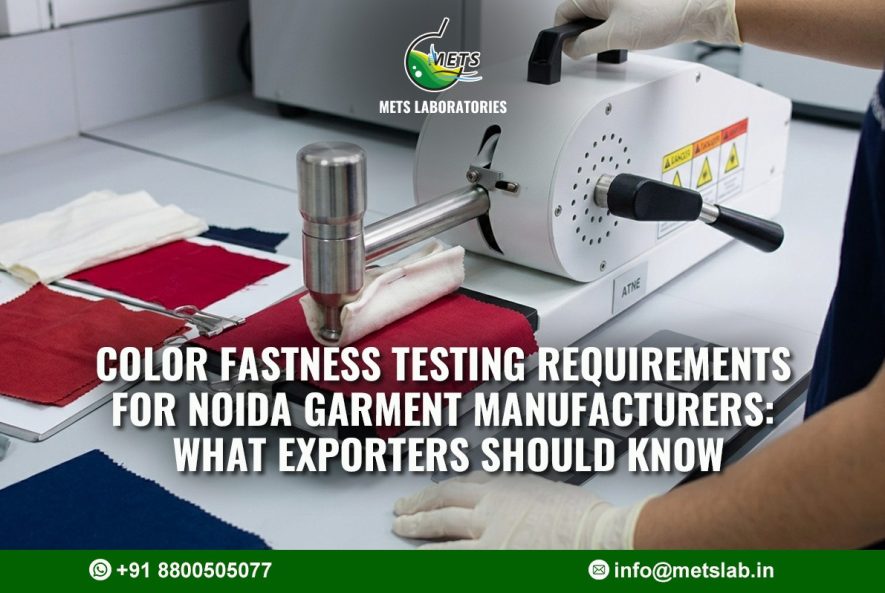
Our team of experienced analysts understands the nuances of color fastness testing—from sample preparation to rating under standardized lighting. We use modern equipment including Launder-Ometers, Crockmeters, Perspirometers, and Xenon Arc test chambers, all calibrated to international specifications.
For exporters, we offer end-to-end support:
- Pre-bulk production screening tests to catch issues early
- Buyer-specific test packages (USA, Europe, Middle East)
- Fast turnaround times tailored to shipping schedules
- Detailed, auditable reports with photographic evidence
- Corrective action recommendations for failed samples
We also test physical parameters (tensile strength, seam slippage, pilling), chemical restrictions (REACH, OEKO-TEX, restricted substances), and flammability. By partnering with METS, Noida garment manufacturers gain a single-window solution for all testing accuracy requirements, reducing risk and accelerating market access.
Conclusion
For Noida garment manufacturers eyeing profitable export markets, color fastness testing is not a bottleneck—it is a competitive advantage. It protects your brand from returns, satisfies stringent buyer requirements, and ensures that your products perform as promised from first wash to last.
Whether you manufacture t-shirts, denim, activewear, or home textiles, investing in proper testing today saves costly rejection tomorrow. METS Laboratories is ready to support your journey with precise, reliable, and buyer-aligned textile testing solutions.
Frequently Asked Questions
What is the minimum acceptable color fastness rating for garment exports?
How many samples are needed for color fastness testing?
Can color fastness be improved after testing fails?
How long does color fastness testing take?
Is color fastness testing mandatory for all textile exports?
Manufacturers and Exporters Recommend Us
Dedicated professionals committed to providing you with accurate and reliable testing services. Get METS Lab services today from the best lab experts & get the accurate reports from our laboratory.