


- Mets Admin
- June 2, 2026
- Testing Insights
- 0 Comments
Introduction
Global demand for Indian leather products—especially from Delhi NCR, Gurugram, and Manesar—is rising. However, international buyers and regulators now enforce stricter chemical safety norms. For leather exporters, leather chemical testing is no longer optional—it is a gateway to global markets.
From Europe’s REACH to US CPSIA, non-compliance leads to shipment rejection, financial loss, and brand damage. Buyers demand proof that leather goods like shoes, bags, belts, jackets, and upholstery are free from harmful substances. This guide explains why leather chemical testing is critical, what tests are required, common failures, and how Delhi NCR manufacturers can stay compliant and competitive.
- Indian leather exports grew by over 15% in recent years, but chemical non-compliance remains a top reason for border rejections.
- Major international brands now conduct random lab testing on finished goods before issuing final payment.
- Even small batch exports to markets like Japan or South Korea require accredited chemical test reports.
- Delhi NCR manufacturers face added pressure due to proximity to export hubs and high-volume orders.
What Is Leather Chemical Testing?
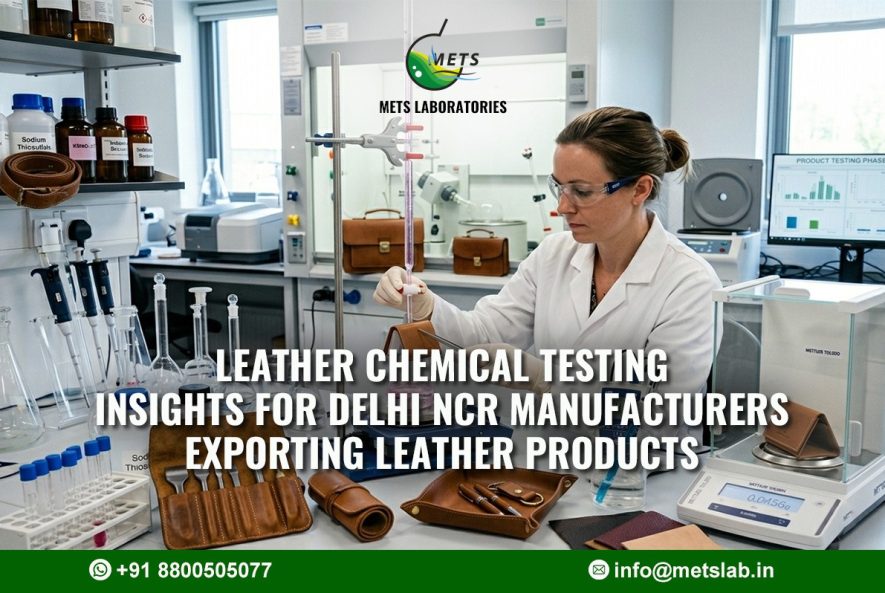
Leather chemical testing is the scientific analysis of leather materials and finished products to detect hazardous chemicals, ensure safety compliance, and verify conformance with international regulations.
It evaluates:
- Presence of restricted substances
- Chemical residue levels
- pH balance and material stability
- Dye safety and heavy metal content
Products typically tested include:
- Shoes and sandals
- Bags and wallets
- Belts and straps
- Leather jackets and garments
- Automotive upholstery
- Furniture leather
- Fashion accessories (watch straps, gloves, etc.)
Without leather chemical testing, exporters cannot legally or safely supply to developed markets.
- Testing applies to raw hides, semi-processed leather, and finished products.
- Chemical testing also detects banned biocides, pesticides, and solvents used during preservation.
- It helps verify labeling claims like “eco-leather” or “chromium-free.”
- Testing is mandatory for government tenders and defense supply contracts.
- Many e-commerce platforms now require test reports before seller registration.

Why Leather Chemical Testing Is Important for Exporters
- ✅ Export compliance – Mandatory for EU, USA, UK, Japan, and Middle East markets
- ✅ Buyer approvals – Major brands require test reports before purchase orders
- ✅ Consumer safety – Prevents skin allergies, cancers, and toxic exposure
- ✅ Avoiding shipment rejection – Failing a random inspection means container holds at ports
- ✅ International regulations – REACH, CPSIA, Prop 65, ZDHC, and more
For Delhi NCR exporters, ignoring leather chemical testing means losing contracts to compliant competitors in Bangladesh, Vietnam, and China.
- Chemical testing also protects brand reputation – one failed batch can trigger global recall orders.
- Many insurers now require test reports to cover export shipment risks.
- Testing reduces legal liability in case of consumer health complaints abroad.
- It helps manufacturers identify costly chemical substitutions before bulk production.
- Regular testing allows you to maintain a “green supplier” status, attracting premium buyers.
Chemical Tests Conducted on Leather Products
🧪Chrome VI (Hexavalent Chromium) Testing
- Detects carcinogenic Cr(VI), often formed during poor tanning or storage.
- Limit: <3 ppm (REACH).
- Cr(VI) can form even in compliant leather if exposed to high humidity or UV light – re-testing before shipment is advised.
🧪 Azo Dye Testing
- Identifies azo compounds that release cancer-causing amines.
- Prohibited in EU and USA.
- Over 20 specific aromatic amines are banned; testing covers all major ones.
🧪 Formaldehyde Testing
- Used in finishing agents. Excess causes skin irritation.
- Limits vary (baby products: 20 ppm; outerwear: 75–300 ppm).
- Formaldehyde is also tested in adhesives, linings, and stitching threads.
🧪 pH Testing
- Leather should be slightly acidic (pH 3.5–5.5) to prevent degradation and skin irritation.
- Unstable pH can also cause metal fittings to corrode or dyes to bleed.
🧪 Heavy Metal Testing
- Lead, cadmium, nickel, mercury, arsenic – all strictly regulated.
- Nickel release from buckles and zippers is a common failure point.
🧪 PCP (Pentachlorophenol) & Restricted Substances
- PCP, SCCP, chromium, and other SVHCs (Substances of Very High Concern) are tested under REACH.
- Over 240 SVHCs are now monitored; labs screen for the most relevant ones for leather.
Each of these tests is a pillar of leather chemical testing for export readiness.


International Regulations & Buyer Requirements for Leather Products
- REACH (EU) – Bans or restricts over 200 chemicals in leather goods.
- CPSIA (USA) – Strict lead and phthalate limits for children’s leather products.
- California Prop 65 – Requires warnings if certain chemicals exceed safe levels.
- ZDHC (Zero Discharge of Hazardous Chemicals) – Supply chain standard for brands like Adidas, Nike.
- Global buyer standards – Walmart, Target, H&M, Zara, IKEA each have Restricted Substances Lists (RSL).
Without leather chemical testing, you cannot produce an RSL-compliant declaration—and buyers will reject your documentation.
- UK REACH remains active post-Brexit with similar limits.
- China GB standards for leather are becoming stricter for imported goods.
- India’s own BIS standards for leather chemicals are also evolving.
- Many buyers now demand ZDHC MRSL (Manufacturing Restricted Substances List) conformance, not just product limits.
- Some retailers require quarterly or batch-wise testing as part of supplier scorecards.
Common Problems Found During Leather Chemical Testing
- ❌ Excessive Chromium VI – Often due to poor leather aging, high temperature, or incorrect storage.
- ❌ Restricted azo dyes – Still found in low-cost colored leathers.
- ❌ Formaldehyde > legal limits – From cheap resins and finishing chemicals.
- ❌ Heavy metal residues – Lead in zippers, buckles, or coating.
- ❌ Unsafe pH levels – Causes skin burns or material rot.
- ❌ Odor issues – Indicates volatile organic compounds (VOCs) or biocides.
These failures show why leather chemical testing must be done before bulk production—not after.
- Excess fatliquoring agents can sometimes cause VOC failures.
- Nonylphenol ethoxylates (NPEs) – found in some degreasing agents – are increasingly banned.
- Phthalates from plastic linings or synthetic components often go undetected if only leather is tested.
- APEOs (alkylphenol ethoxylates) are another common hidden failure in finished leather.
- Storage in contaminated warehouses (e.g., near pesticides) can introduce PCP residues.
Why Delhi NCR Leather Manufacturers Should Prioritize Chemical Testing
Delhi NCR—including Gurugram, Manesar, Noida, Faridabad, and Bawal—is India’s leather export hub. But:
- Rising compliance pressure from EU and US buyers
- Frequent retailer audits (BSCI, Sedex, ISO)
- High cost of shipment rejection (₹20–50 lakhs per container)
- Loss of export competitiveness if test reports fail
Manufacturers who invest in leather chemical testing gain:
- ✅ Faster buyer approvals
- ✅ Higher order values
- ✅ Fewer audit non-conformities
- ✅ Long-term export stability
Without testing, Delhi NCR exporters risk being delisted by global sourcing agents.
- NCR manufacturers often share common CETPs and chemical suppliers – one factory’s failure can affect the entire cluster’s reputation.
- Many NCR units supply to footwear giants like Bata, Relaxo, and foreign brands – all require regular testing.
- Proactive testing helps NCR exporters bypass the need for costly third-party inspections at destination ports.
- It also opens doors to private label contracts with European and American fashion houses.
- With rising air and sea freight costs, a rejection now is more expensive than ever.
Industries That Commonly Require Leather Chemical Testing
- Footwear manufacturers – Safety shoes, casuals, children’s footwear
- Leather accessories brands – Bags, belts, wallets, gloves
- Automotive upholstery suppliers – Car seat covers, steering wheel covers
- Fashion exporters – Leather jackets, trousers, skirts
- Furniture manufacturers – Leather sofas, recliners, office chairs
- E-commerce sellers – Amazon, Flipkart, Myntra require test reports
Every industry above relies on leather chemical testing to avoid legal and reputational risks.
Additional points:
- Pet accessories (leather collars, leashes) are now being tested under child safety norms.
- Military and police leather goods require additional chemical resistance testing.
- Luxury hotels sourcing leather amenities demand ZDHC-level compliance.
- Handicraft exporters using leather trims must also test small components.
- Even leather repair chemicals and edge paints are being scrutinized.
How METS Laboratories Supports Leather Chemical Testing Requirements
METS Laboratories provides end-to-end leather chemical testing solutions for Delhi NCR exporters.
- ✅ Advanced equipment – LC-MS/MS, GC-MS, ICP-OES for trace-level detection
- ✅ Experienced analysts – Trained in ISO 17025 and international methods
- ✅ Export-oriented support – REACH, CPSIA, Prop 65, ZDHC, RSL testing
- ✅ Accurate reporting – Fast turnaround with digital reports
- ✅ Delhi NCR coverage – Sample pickup from Gurugram, Manesar, Noida, Faridabad
With METS, manufacturers reduce rejection risk and accelerate market access.
- METS provides pre-shipment screening tests at lower cost to catch failures early.
- They offer root-cause analysis for failed samples – helping you fix the production stage.
- Digital dashboard access allows buyers and sellers to view reports securely.
- METS also offers training sessions for factory QC teams on chemical safety.
- Emergency testing for urgent export consignments available with 24-hour reporting.
Conclusion
For leather manufacturers in Delhi NCR, leather chemical testing is not just compliance—it’s a competitive advantage. Regulations are tightening. Buyer demands are rising. Shipment rejections are costly.
Don’t wait for an audit failure or a container hold at port.
📞 Contact METS Laboratories today for reliable, fast, and export-ready leather chemical testing.
📍 Serving Gurugram, Manesar, Noida, Faridabad, and all Delhi NCR leather hubs
Book a free consultation to understand which tests apply to your specific export destination. One test today can save you crores tomorrow.
Frequently Asked Questions
What is the cost of leather chemical testing in Delhi NCR?
How long does leather chemical testing take?
Can leather chemical testing failure be corrected?
Do small leather exporters need chemical testing?
Is METS Laboratories accredited for leather chemical testing?
Manufacturers and Exporters Recommend Us
Dedicated professionals committed to providing you with accurate and reliable testing services. Get METS Lab services today from the best lab experts & get the accurate reports from our laboratory.