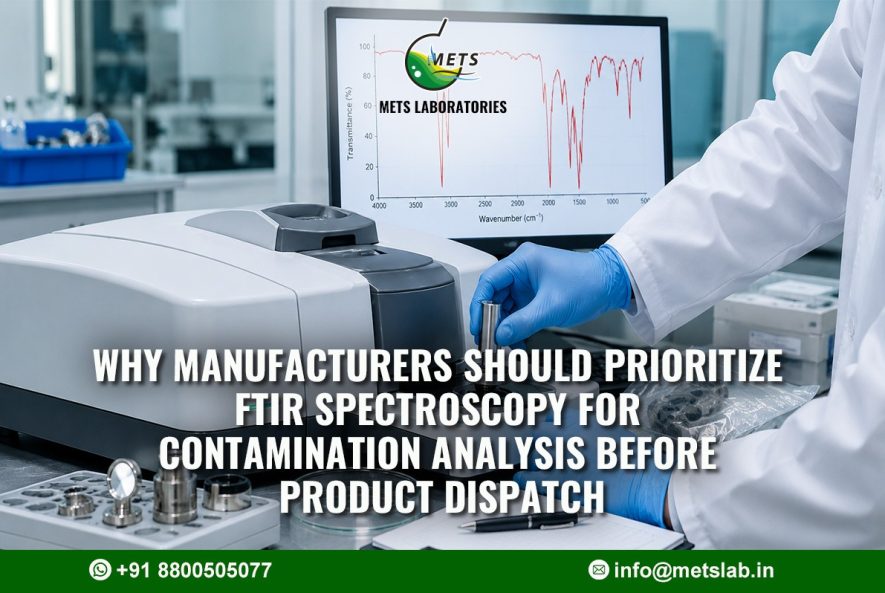
In industrial manufacturing, product performance and reliability are directly tied to material purity and strict process control. Even a small, unknown contaminant can lead to catastrophic product failure, costly recalls, or non-compliance with industry standards. Therefore, utilizing professional FTIR spectroscopy for contamination analysis is a vital diagnostic workflow. It offers a quick, non-destructive way to identify unknown substances and isolate chemical impurities in a wide range of materials.
What Is FTIR Spectroscopy and How Does It Work?
FTIR is an analytical technique that detects molecular vibrations when a sample is exposed to infrared light. Each chemical compound absorbs IR radiation at specific frequencies, creating a unique “fingerprint” spectrum that can be compared to a reference library. This makes FTIR ideal for identifying organic, polymeric, and some inorganic contaminants in solids, liquids, and gases.
Why Contaminants Matter in Industry
Contamination can occur at any stage—raw material sourcing, manufacturing, packaging, or even storage. The consequences include:
Product failure in the field
Reduced shelf life
Compromised safety or compliance
Customer complaints and reputational damage
Identifying the contaminant quickly and accurately helps isolate the root cause, correct the process, and prevent recurrence.
How We Use FTIR Spectroscopy for Contamination Analysis
Sample Collection and Preparation
FTIR can work with a minimal amount of material—whether it’s a black speck on plastic, an oily residue, a discolored patch, or a foreign fiber. The sample is placed on the spectrometer directly or via an accessory like an ATR (Attenuated Total Reflectance) crystal.
Spectral Scanning
The instrument scans the sample and produces an IR spectrum based on how the material absorbs light at different wavelengths.
Library Comparison
The generated spectrum is automatically matched against extensive spectral libraries to identify the substance or closest known material.
Expert Analysis
If the contaminant isn’t a perfect match, a trained chemist analyzes the peak patterns to determine its likely chemical family (e.g., silicone, hydrocarbon, cellulose, etc.).
Industrial Benefits of FTIR Spectroscopy for Contamination Analysis
🔹 Plastic and Polymer Manufacturing
Identifying black specks or burnt particles in molded products
Analyzing surface residues or white powders on final goods
🔹 Automotive Components
Tracing unknown deposits on electrical connectors or gaskets
Investigating failure due to grease incompatibility or seal degradation
🔹 Pharmaceuticals and Packaging
Identifying foreign fibers in blister packs or vials
Detecting contamination in raw materials or excipients
🔹 Construction Materials
Evaluating chemical changes in coatings, adhesives, and sealants
Identifying incompatible additives in composite materials
Benefits of Using FTIR for Contamination Analysis
Quick and accurate– Results available within hours
Minimal sample requirement– Microscopic traces can be analyzed
Non-destructive– Sample integrity is often preserved
Wide compatibility– Works across materials: rubber, plastics, fluids, films, and more
Cost-effective– Reduces downtime and long-term failure costs
How METS Laboratory Supports Your FTIR Spectroscopy for Contamination Analysis Requirements
At METS Laboratory, our chemical testing experts use state-of-the-art FTIR spectrometers combined with advanced spectral libraries and domain knowledge to:
Rapidly identify unknown contaminants
Assist in root cause analysis and failure investigations
Support compliance with BIS, ASTM, and international standards
Guide corrective actions in manufacturing processes
Whether you’re troubleshooting a batch issue or ensuring final product purity, FTIR gives you the clarity and confidence needed to act decisively.
Conclusion
Contaminants are often small in size but big in impact. By leveraging the speed and precision of FTIR spectroscopy, industries can maintain product integrity, avoid quality issues, and keep their production lines moving. Don’t let unknowns hold you back—know what’s in your product, and ensure it meets the highest standards.
Frequently Asked Questions (FAQs)
What materials can be analyzed using FTIR contamination analysis?
It effectively identifies organic materials, polymers, plastics, elastomers, rubbers, and organic residues (like oils and lubricants). It can analyze these substances in solid, liquid, or gas forms.
How small of a sample is required for an FTIR test?
The required sample size is minimal. Using advanced ATR crystals or microscopy, a microscopic particle, a single fiber strand, or a tiny droplet (less than 1 millimeter) is sufficient for a clear reading.
Is FTIR spectroscopy a destructive testing method?
No, FTIR is a non-destructive testing method. The structural and chemical integrity of the sample is fully preserved during testing, allowing you to use the exact same specimen for further downstream analysis if required.
How long does it take to get results from an industrial FTIR test?
While the instrument scan takes only a few minutes, data verification and root-cause mapping by a chemist typically take 24 to 48 hours to generate a complete, legally compliant engineering report.
Can FTIR differentiate between similar oils or plastics?
Yes. Because every chemical compound leaves a unique molecular "fingerprint" spectrum, FTIR easily distinguishes between very similar materials, such as separating silicone grease from hydrocarbon oil, or HDPE from polypropylene.
Manufacturers and Exporters Recommend Us
Dedicated professionals committed to providing you with accurate and reliable testing services. Get METS Lab services today from the best lab experts & get the accurate reports from our laboratory.