


- Mets Admin
- June 19, 2026
- Testing Insights
- 0 Comments
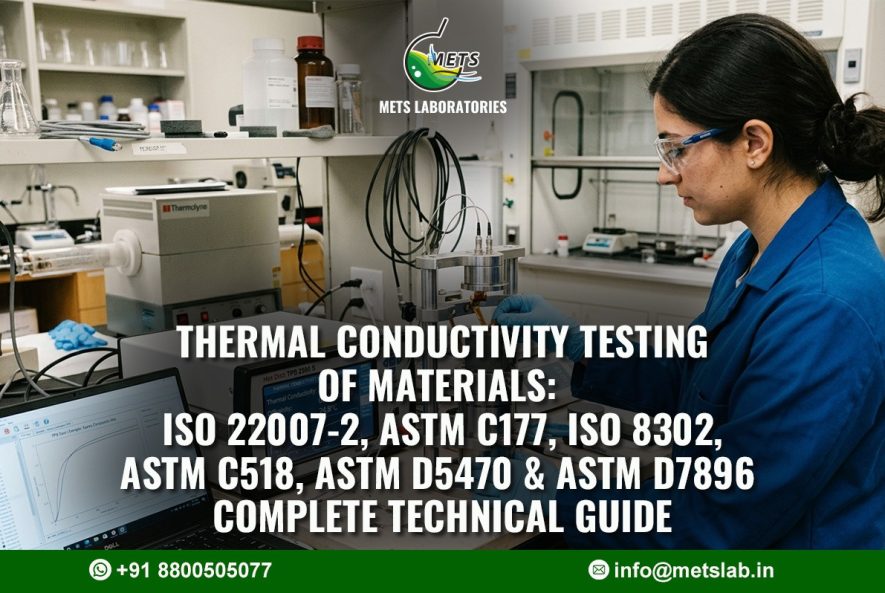
Introduction – Why Thermal Conductivity Testing Matters
Thermal conductivity is one of the most important thermal properties used in engineering, science, and industrial material development. It defines how efficiently heat energy moves through a material. This property is critical in determining whether a material behaves as a thermal insulator or thermal conductor. Consequently, professional thermal conductivity testing has become a vital requirement to verify material behavior under real-world operational gradients. Accurately profiling these heat-transfer dynamics allows engineers to design safer, highly efficient systems across aerospace, electronics, and construction sectors
In real-world applications, thermal conductivity affects:
- Energy efficiency of buildings
- Performance of electronic devices
- Cooling of automotive systems
- Thermal stability of aerospace structures
- Heat transfer in industrial systems
- Reliability of thermal interface materials
Because of its importance, standardized testing methods are required to ensure accurate, repeatable, and globally accepted results.
International standards such as ISO 22007-2, ASTM C177, ISO 8302, ASTM C518, ASTM D5470, and ASTM D7896 provide scientifically validated procedures for measuring thermal conductivity in solids, liquids, insulation materials, and thermal interface materials.
This blog provides a complete technical explanation of these methods, their principles, applications, advantages, and industrial importance.
What is Thermal Conductivity Testing?
Thermal conductivity (k-value) is defined as:
The ability of a material to transfer heat energy through itself due to temperature difference.
Unit:
- W/m·K (Watts per meter-Kelvin)
Interpretation:
- Low thermal conductivity → good insulation
- High thermal conductivity → good heat conduction
Examples:
- Aerogel → extremely low
- Foam → low
- Wood → moderate
- Aluminum → high
- Copper → very high

Technical Importance of Thermal Conductivity Testing
Thermal conductivity testing is essential for:
- Energy Efficiency: Helps reduce heat loss in buildings and systems.
- Thermal Design: Used in electronics, automotive, and aerospace systems.
- Material Selection: Ensures correct material for insulation or heat transfer.
- Product Safety: Prevents overheating and thermal failure.
- R&D Innovation: Used in nanomaterials and advanced composites.
- Regulatory Compliance: Required for construction and industrial standards.
ISO 22007-2: Plastics Thermal Conductivity Testing via Transient Plane Source Method
Overview
ISO 22007-2 is used to measure thermal conductivity of plastics and polymer materials using the Transient Plane Source (TPS) method.
Principle
A flat sensor acts as both:
- Heat source
- Temperature sensor
Heat is applied and temperature response is recorded over time.
Materials Tested
- Plastics
- Polymers
- Composites
- Rubber materials
- Thin films
Advantages
- Fast measurement
- Suitable for small samples
- Works for anisotropic materials
- High accuracy for polymers
Applications
- Polymer industry
- Plastic packaging
- Automotive plastics
- Electronics housings


ASTM C177: Guarded Hot Plate Method for Thermal Conductivity Testing
Overview
ASTM C177 is a primary reference method used for measuring thermal conductivity of insulation materials under steady-state conditions.
Principle
A sample is placed between:
- Hot plate
- Cold plate
Heat flow is measured once steady state is achieved.
Materials Tested
- Insulation boards
- Fiberglass
- Mineral wool
- Foam insulation
- Construction panels
Advantages
- Very high accuracy
- Standard reference method
- Stable steady-state results
Limitations
- Long testing time
- Expensive setup
- Requires controlled environment
Applications
- Building insulation certification
- HVAC system design
- Energy efficiency testing
ISO 8302: Thermal Insulation Thermal Conductivity Testing (Guarded Hot Plate)
Overview
ISO 8302 is the international equivalent of ASTM C177 and also uses the guarded hot plate method.
Principle
Steady-state heat flow through material between:
- Hot surface
- Cold surface
Thermal conductivity is calculated from heat transfer rate.
Materials Tested
- Building insulation
- Thermal panels
- Foam boards
- Composite insulation systems
Advantages
- Globally recognized
- High accuracy
- Suitable for certification
Applications
- International building standards
- Energy rating systems
- Construction material approval
ASTM C518: Heat Flow Meter Method for Thermal Conductivity Testing
Overview
ASTM C518 is a widely used method for measuring thermal conductivity using a Heat Flow Meter (HFM).
Principle
A sample is placed between:
- Heated plate
- Cooled plate
Heat flow sensors measure energy passing through material.
Materials Tested
- Foam insulation
- Plastic foams
- Fiberglass
- Building insulation boards
Advantages
- Faster than ASTM C177
- Automated system
- Good repeatability
- Suitable for production testing
Limitations
- Less accurate than guarded hot plate
- Requires calibration
Applications
- Construction industry
- Insulation manufacturing
- Quality control labs
ASTM D5470: Thermal Conductivity Testing of Thermal Interface Materials (TIMs)
Overview
ASTM D5470 is used for measuring thermal conductivity of thermal interface materials used in electronics and heat transfer systems.
Principle
A material is placed between:
- Heated surface
- Cooled surface
Heat transfer resistance is measured under controlled pressure.
Materials Tested
- Thermal greases
- Thermal pads
- Interface films
- Conductive adhesives
- Phase change materials
Advantages
- Highly relevant for electronics
- Measures real contact resistance
- Simulates actual operating conditions
Applications
- CPU cooling systems
- EV battery thermal management
- LED cooling systems
- Semiconductor packaging
ASTM D7896: Transient Plane Source Method for Liquid and Polymer Thermal Conductivity Testing
Overview
ASTM D7896 is used for measuring thermal conductivity using Transient Plane Source technology, mainly for liquids and soft materials.
Principle
A sensor generates heat pulse and measures temperature response over time.
Materials Tested
- Liquids
- Oils
- Polymers
- Nanofluids
- Soft gels
Advantages
- Fast measurement
- Small sample size
- High accuracy for fluids
- Works for research applications
Applications
- Chemical industry
- Lubricant testing
- Nanotechnology research
- Heat transfer fluids
Technical Comparison of Standard Testing Methods
Standard | Material Type | Method | Application |
ISO 22007-2 | Plastics & polymers | TPS method | Polymer R&D |
ASTM C177 | Insulation materials | Guarded hot plate | Building insulation |
ISO 8302 | Insulation materials | Guarded hot plate | International certification |
ASTM C518 | Foams & insulation | Heat flow meter | Industrial QC |
ASTM D5470 | TIM materials | Steady-state contact | Electronics cooling |
ASTM D7896 | Liquids & polymers | TPS transient method | R&D & fluids |
Key Parameters Measured in Thermal Conductivity Testing
- Thermal conductivity (k-value)
- Thermal resistance (R-value)
- Heat flux
- Temperature gradient
- Thermal contact resistance
- Steady-state heat flow
- Transient heat response
Industries That Need Thermal Conductivity Testing (VERY IMPORTANT)
Thermal conductivity testing is required across multiple industries:
- Construction & Building Industry
Users:
- Builders
- Architects
- Insulation manufacturers
Purpose:
- Energy-efficient building design
- Insulation material selection
- Compliance with building codes
- Electronics Industry
Users:
- Semiconductor companies
- PCB manufacturers
- Device designers
Purpose:
- Heat dissipation
- Device cooling
- Prevent overheating
- Automotive Industry
Users:
- EV manufacturers
- Engine designers
Purpose:
- Battery thermal management
- Engine cooling systems
- Cabin temperature control
- Aerospace Industry
Users:
- Aircraft engineers
- Space agencies
Purpose:
- Heat shield design
- High-temperature resistance materials
- Polymer & Plastic Industry
Users:
- Plastic manufacturers
- R&D labs
Purpose:
- Material selection
- Product development
- Packaging design
- Thermal Interface Material Industry
Users:
- Electronics cooling companies
- CPU/GPU manufacturers
Purpose:
- Thermal grease evaluation
- Heat sink optimization
- Chemical & Fluid Industry
Users:
- Lubricant manufacturers
- Nanofluid researchers
Purpose:
- Heat transfer fluid optimization
- Process engineering
- Construction Insulation Industry
Users:
- Foam manufacturers
- Insulation suppliers
Purpose:
- Product certification
- Energy rating compliance
Core Business Advantages of Thermal Conductivity Testing
- Improves energy efficiency
- Ensures product safety
- Supports innovation
- Enables material comparison
- Reduces failure risk
- Ensures global compliance
Testing Limitations and Material Boundary Conditions
- High equipment cost
- Requires controlled environment
- Some methods are time-consuming
- Sample preparation critical
Conclusion
Thermal conductivity testing is a fundamental requirement in modern engineering and material science. Standards such as ISO 22007-2, ASTM C177, ISO 8302, ASTM C518, ASTM D5470, and ASTM D7896 provide reliable, accurate, and globally accepted methods for evaluating heat transfer properties across solids, fluids, polymers, insulation materials, and electronic interface systems.
As industries continue to focus on energy efficiency, thermal management, and advanced material innovation, thermal conductivity testing will remain essential for research, development, quality control, and regulatory compliance worldwide. To thoroughly evaluate your production raw materials and align with holistic structural parameters, discover our accredited mechanical and physical testing services for comprehensive material characterization.
Frequently Asked Questions (FAQs)
What is thermal conductivity?
Which method is best for insulation materials?
What is ASTM C518 used for?
What is ISO 22007-2 used for?
What is ASTM D5470 used for?
What is ASTM D7896 used for?
What industries use thermal conductivity testing?
What is the unit of thermal conductivity?
Which material has the lowest thermal conductivity?
Why is thermal conductivity important?
Manufacturers and Exporters Recommend Us
Dedicated professionals committed to providing you with accurate and reliable testing services. Get METS Lab services today from the best lab experts & get the accurate reports from our laboratory.