


- Mets Admin
- October 20, 2026
- Testing Insights
- 0 Comments
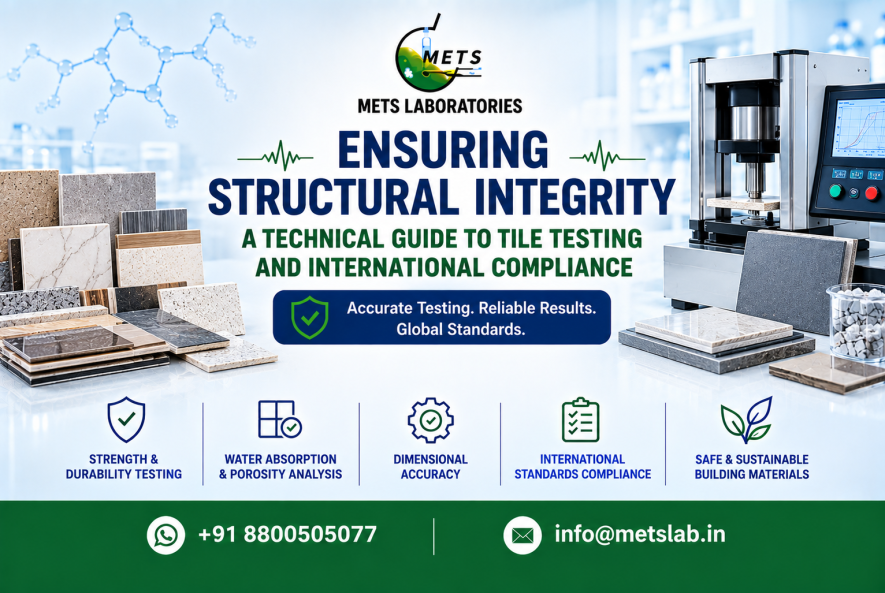
Introduction to Tile Testing and International Compliance
In today’s global construction and interior design sectors, the demand for durable, high-quality, and safe surface solutions continues to rise. Driven by rigorous architectural standards, structural safety requirements, and growing aesthetic expectations, tile performance is under greater scrutiny than ever. Achieving certified tile testing and international compliance is essential for ceramic manufacturers, real estate developers, and exporters to scientifically verify flexural strength, prevent surface degradation, and satisfy global building codes before distribution.
To meet these requirements, comprehensive physical, mechanical, and chemical testing is essential. Comprehensive laboratory testing provides exact, reproducible identification of raw material defects, dimensional inconsistencies, and chemical vulnerabilities, safeguarding quality from initial manufacturing through to final installation.
The Strategic Importance of Tile Testing and International Compliance
Certifying tiles for regulatory compliance protects brand reputation, minimizes commercial risk, and builds stakeholder trust. Independent laboratory evaluations empower manufacturers, exporters, and developers through key strategic advantages:
- Mitigating Supply Chain & Quality Risks: Verifies raw materials and monitors kiln consistency, preventing batch failures, job-site rejections, and costly retrofits.
- Guaranteeing Regulatory Compliance: Provides defensible, scientific validation required to satisfy national building codes and international quality benchmarks.
- Facilitating Global Market Access: Delivers accredited test reports necessary to obtain CE marking, comply with regional import guidelines, and access commercial supply chains.
- Enhancing End-User Safety: Reduces slip-and-fall hazards, structural spalling, and material degradation in public, commercial, and residential spaces.
Risk Mitigation Insight: Research indicates that a notable percentage of uncertified imported tiles exceed permissible water absorption limits. In cold climates, trapped moisture leads to internal expansion, freeze-thaw cracking, and immediate structural failure.

Core Quality Parameters & Laboratory Evaluations
To deliver total quality assurance, accredited testing facilities execute a multi-dimensional matrix of physical, mechanical, chemical, and optical analyses:
Evaluation Parameter | Primary Standard Test Methods | Significance & Key Metrics |
Water Absorption & Porosity | ISO 10545-3 / ASTM C373 | Measures internal density via boiling/vacuum method. Distinguishes porcelain (<=0.5%) from ceramic (>3%). |
Breaking Strength & Modulus of Rupture (MOR) | ISO 10545-4 / ASTM C648 | Determines flexural load-bearing capacity under simulated structural stress. |
Surface & Deep Abrasion Resistance | ISO 10545-6 (Unglazed) / ISO 10545-7 (PEI Glazed) | Evaluates wear depth and surface endurance under heavy foot traffic. |
Chemical & Stain Durability | ISO 10545-13 / ISO 10545-14 | Assesses resistance to household chemicals, swimming pool salts, acids, and alkalis. |
Dimensional Precision & Surface Flatness | ISO 10545-2 | Verifies length, width, thickness, edge straightness, rectangularity, and warpage. |
Thermal Shock & Frost Resistance | ISO 10545-9 / ISO 10545-12 | Tests structural resistance to extreme freeze-thaw cycles (typically 100 cycles) without cracking or spalling. |
Slip Resistance & Safety | BS EN 16165 / ASTM C1028 | Measures static and dynamic Coefficient of Friction (CoF / Pendulum Value) under wet and dry conditions. |
Color Consistency & Gloss | ISO 10545-16 / Spectrophotometry | Quantifies batch-to-batch color deviations (E<=1.0) under standardized light sources. |
Tile Products Tested Across the Supply Chain
Accredited testing schemes apply across a comprehensive range of interior and exterior surfacing materials:
- Ceramic Tiles: Wall tiles, floor tiles, glazed, unglazed, and semi-vitrified options.
- Porcelain & Fully Vitrified Tiles: Heavy-duty, ultra-low porosity tiles designed for commercial and high-traffic applications.
- Natural Stone Slabs & Tiles: Marble, granite, limestone, slate, travertine, and sandstone.
- Specialty & Decorative Materials: Glass mosaics, terrazzo, digitally printed glazed tiles, and acoustic panels.
- Exterior & Landscape Surfacing: Heavy-duty pavers, roof tiles, ventilated facade claddings, and raised access flooring.
Commercial Risks of Non-Compliant & Untested Tiles
Deploying unverified surfacing materials introduces critical technical and financial risks for manufacturers, contractors, and asset owners:
- Legal Exposure & Project Rejections: Non-compliant materials fail municipal site inspections, leading to project delays, contractual penalties, and litigation.
- High Failure Costs: Replacing failed or delaminated flooring in live commercial environments incurs significant logistical, material, and labor expenses.
- Safety & Premises Liability: Substandard slip resistance increases public fall hazards, leaving facility owners open to liability claims.
- Brand & Reputation Damage: Product failures like surface crazing, staining, or structural cracking erode consumer trust and market credibility.


Conclusion: Guaranteeing Structural Safety Through Testing
Tile testing and international compliance is a fundamental requirement for modern building materials and architectural surface installations. Operating advanced analytical and mechanical testing equipment, METS Laboratories supports manufacturers, exporters, and real estate developers with independent, defensible test reports under ISO/IEC 17025 standards.
To discover how material verification extends to structural substrates, explore our comprehensive guide on concrete testing standards or review our technical analysis on fire propagation testing. Contact METS Laboratories today to request testing services for your ceramic, porcelain, and stone tile products.
By partnering with METS Laboratories, industry stakeholders can confidently verify compliance with ISO, ASTM, EN, and BIS standards, protect end-user safety, and streamline domestic and international market access.
For detailed inquiries regarding tile testing protocols, scope of accreditation, or custom testing schemes, contact the engineering team at METS Laboratories today.
Frequently Asked Questions (FAQs)
What differentiates ceramic tiles from porcelain tiles during laboratory testing?
How is frost resistance evaluated?
What is the acceptable water absorption limit for exterior tiles?
Why is dynamic slip resistance testing critical for commercial installations?
How are color variations between production batches quantified?
Manufacturers and Exporters Recommend Us
Dedicated professionals committed to providing you with accurate and reliable testing services. Get METS Lab services today from the best lab experts & get the accurate reports from our laboratory.