

- Mets Admin
- July 17, 2026
- Testing Insights
- 0 Comments
Introduction to the Bacterial and Fungal Efficacy Test for Cosmetics
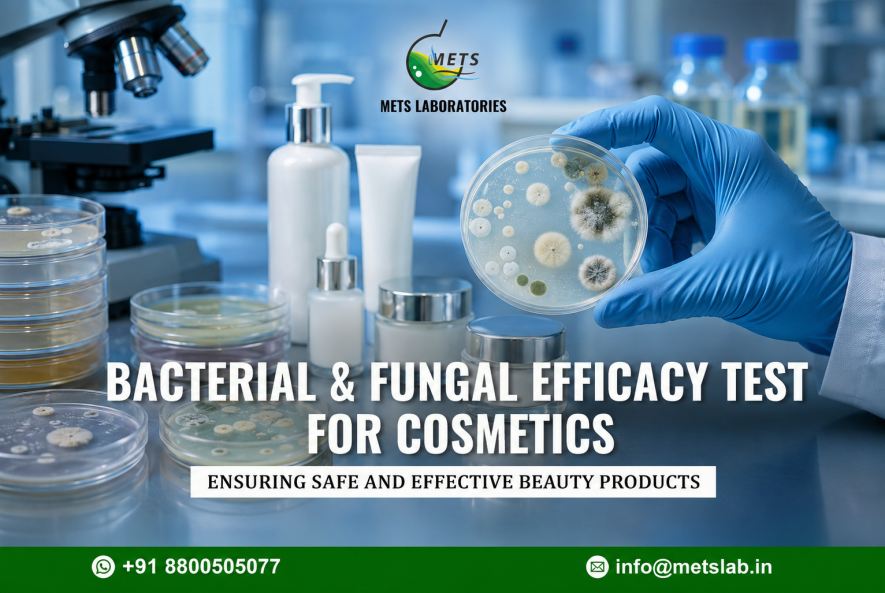
The global cosmetics industry is built on the promise of beauty, but behind every elegant jar or sleek tube lies a critical question: is this product safe? Cosmetics are nutrient-rich environments that provide an ideal breeding ground for harmful microorganisms like bacteria, yeast, and mold. Conducting a rigorous bacterial and fungal efficacy test for cosmetics—also known as Preservative Efficacy Testing (PET) or Challenge Testing—is the essential scientific process that validates whether a product’s preservative system effectively controls microbial growth throughout its shelf life. This testing is not merely a regulatory formality; it is a fundamental pillar of product development, quality assurance, and consumer safety that protects both brand reputation and public health.
What Is Preservative Efficacy Testing (PET)?
Preservative Efficacy Testing is a laboratory procedure designed to evaluate how effectively a cosmetic product’s preservative system inhibits the growth of microorganisms introduced during manufacturing and consumer use . The test simulates real-world contamination scenarios—such as repeated finger-dipping, exposure to bathroom humidity, and the opening and closing of containers—to determine whether the product remains microbiologically safe throughout its intended lifespan.
During the test, the product is deliberately inoculated with a known concentration of challenge organisms, typically including bacteria, yeast, and mold species. The inoculated samples are incubated under controlled conditions, and microbial counts are measured at predetermined intervals—commonly at Day 0, Day 7, Day 14, and Day 28 . The results are expressed as “log reduction” values, which quantify how many microorganisms have been killed over time. A product passes when the log reduction meets the acceptance criteria defined by recognized standards . The outcome is not simply a pass or fail; it is a time-based log reduction curve that reveals how quickly and thoroughly the preservative system suppresses microbial proliferation.

Why the Bacterial and Fungal Efficacy Test for Cosmetics Is Essential
The importance of PET extends far beyond regulatory boxes to be checked. At its core, this test is about consumer safety, product integrity, and brand responsibility.
Consumer Safety is the paramount concern. Contaminated cosmetics can cause skin infections, eye irritation, and systemic adverse reactions . Studies have demonstrated that contaminated cosmetics used by multiple people exhibit significantly higher microbial loads than those used by a single individual, underscoring the risk of cross-contamination during use . Without an effective preservative system, products can become vehicles for pathogens like Pseudomonas aeruginosa, Staphylococcus aureus, and E. coli.
Shelf Life Stability is another critical factor. Preservative efficacy ensures that the product maintains its intended texture, odor, appearance, and performance over time . A product that spoils prematurely due to microbial degradation is not only a regulatory concern but also a financial liability and a brand-damaging experience for consumers.
Brand Protection cannot be overstated. Product recalls due to microbial contamination can destroy consumer trust, lead to costly litigation, and invite regulatory scrutiny that harms long-term market viability. PET is a proactive measure that helps brands avoid such outcomes.
Formulation Validation during product development is equally vital. Identifying a weak preservative system before commercial launch allows formulators to optimize the preservative blend, adjust pH, or incorporate synergistic boosters like chelating agents—all while the product is still in the development phase.
Common Formulation Problems Faced in Cosmetics Projects
Formulators and manufacturers frequently encounter challenges when validating preservative systems. One common problem is selecting the correct preservative combination for the specific product matrix. Different formulations—emulsions, surfactant-based products, anhydrous systems—each present unique preservation challenges . Factors such as pH, water activity, and ingredient compatibility significantly influence preservative performance. For instance, phenoxyethanol works optimally below pH 5, while parabens are effective across a broader pH range.
Another issue is balancing efficacy with safety and regulatory requirements. Some preservatives, while effective, may face restrictions in certain markets or trigger skin sensitivity in consumers. Manufacturers must navigate these constraints while still achieving robust microbial control.
Contamination during production is a persistent concern. Even with a well-designed preservative system, poor manufacturing practices can introduce contamination that the preservative system cannot overcome. This highlights the importance of integrating PET data with Good Manufacturing Practices (GMP) per ISO 22716 and environmental monitoring strategies.


Key Parameters Evaluated During Efficacy Testing
Preservative Efficacy Testing evaluates several critical parameters to provide a comprehensive picture of the product’s microbial protection:
- Log Reduction in Bacteria– Measures the decrease in bacterial populations at specific time points (e.g., Day 7, Day 14, Day 28). Higher log reduction indicates more rapid and effective killing of bacteria.
- Log Reduction in Fungi (Yeast and Mold)– Assesses the product’s ability to control fungal contamination, which can cause visible spoilage and produce mycotoxins.
- No Increase Criteria– Requires that microbial counts do not increase between designated time points, indicating sustained preservative activity over time.
- Recovery and Resurgence– Monitoring whether surviving organisms regrow after an initial reduction is a crucial indicator of preservative system adequacy or insufficiency.
In-Use Simulation Testing – An optional, more rigorous assessment that mimics actual consumer behavior, such as repeated opening and exposure to moisture, to evaluate preservative performance under real-world conditions.
Types of Cosmetic Products Commonly Tested
Any cosmetic or personal care product containing water or plant-derived ingredients should undergo preservative efficacy testing . Commonly tested products include:
- Facial cleansers, toners, and moisturizers
- Body lotions, butters, and massage oils
- Shampoos, conditioners, and hair masks
- Lip balms, glosses, and tinted lip products
- Sunscreens and SPF moisturizers
- Liquid and cream foundations, concealers, and mascaras
- Serums, gels, facial mists, and sheet mask solutions
Importantly, products marketed as “preservative-free” are not exempt. Natural and organic formulations that rely on alternative preservation strategies—such as pH adjustment, chelation, low water activity, or airless packaging—must still demonstrate microbial stability through testing to prove that these alternatives actually work.
Why Gurugram Beauty Brands Need Reliable Testing Support
Gurugram has emerged as a significant hub for beauty and personal care manufacturing, with a growing ecosystem of contract manufacturers, private-label producers, and export-oriented brands serving both domestic and international markets. The need for reliable testing support in this region is critical.
Risks of Using Untested Materials are magnified in a cost-competitive market. Untested ingredients and finished products can harbor microbial contamination, leading to quality failures that result in product recalls, regulatory penalties, and loss of consumer confidence. In extreme cases, products contaminated with pathogens can cause serious health issues, exposing manufacturers to litigation and reputational damage.
Relevant Standards & Compliance Considerations are paramount for market access. Brands in Gurugram intending to sell in domestic or export markets must ensure their products meet applicable standards. In the EU, cosmetic products must comply with Regulation (EC) No. 1223/2009, which requires preservative efficacy test results per ISO 11930 to be included in the Product Information File (PIF) . In the U.S., while the FDA does not require pre-market approval for cosmetics, the Modernization of Cosmetics Regulation Act (MoCRA) and the Federal Food, Drug, and Cosmetic Act mandate that products be safe and properly labeled, with PET data supporting safety substantiation . International markets, including ASEAN and Canada, similarly expect robust preservative testing. Partnering with an accredited laboratory familiar with these diverse regulatory landscapes is essential for brands seeking seamless market entry.
How METS Laboratories Supports Comprehensive Cosmetic Efficacy Testing
METS Laboratories provides comprehensive microbiology testing services that help cosmetics brands ensure product safety, regulatory compliance, and consumer trust. While the search results primarily highlight METS’ capabilities in materials testing—including fibres and filaments, textiles and fabrics, and finished leather —these competencies underscore the laboratory’s broad technical expertise, ISO/IEC 17025 accreditation, and commitment to quality assurance.
For cosmetics brands in Gurugram, METS Laboratories is well-positioned to support preservative efficacy testing and other microbiology assessments required for regulatory compliance . By leveraging ISO/IEC 17025:2017 accredited methods and internationally recognized standards, METS helps brands deliver safe, high-quality products to consumers while building trust with authorities and global markets. Their rigorous testing programs contribute to safer, non-toxic consumer products, regulatory compliance for domestic and international markets, enhanced product quality, and reduced risk of costly recalls.
Conclusion: Securing Brand Integrity Through Testing
Bacterial and Fungal Efficacy Testing is the cornerstone of cosmetic product safety and regulatory compliance. By validating that your preservative system effectively controls microbial growth, you protect consumers from health risks, ensure product stability, and safeguard your brand reputation. For brands in Gurugram and across India, partnering with an accredited facility offering specialized cosmetics testing services like METS Laboratories provides the technical expertise, regulatory knowledge, and quality assurance needed to navigate the complex landscape of cosmetics safety and market access.
Ready to ensure your cosmetics are safe, compliant, and market-ready? Contact METS Laboratories today to discuss your preservative efficacy testing needs and take the next step toward building consumer trust and global market success.
Frequently Asked Questions (FAQs)
What is the difference between Preservative Efficacy Testing (PET) and routine microbial limit testing?
Which products require preservative efficacy testing?
How long does the testing process take?
What happens if my product fails the test?
Which standard should I choose—USP <51> or ISO 11930?
Manufacturers and Exporters Recommend Us
Dedicated professionals committed to providing you with accurate and reliable testing services. Get METS Lab services today from the best lab experts & get the accurate reports from our laboratory.