

- Mets Admin
- July 21, 2026
- Testing Insights
- 0 Comments
Introduction
The textile and leather industries use a wide range of chemicals during manufacturing to enhance product performance, durability, and appearance. Among these chemicals, organotin compounds have historically been used as stabilizers, catalysts, biocides, and antifungal agents in various industrial applications. While they offer several technical advantages, certain organotin compounds have been identified as hazardous to human health and the environment, leading to strict regulations in many countries.
Today, manufacturers, exporters, brands, and retailers must ensure that textile and leather products comply with international chemical safety requirements. Organotin compounds testing has become an essential part of Restricted Substances List (RSL) compliance, helping businesses verify that their products meet legal and customer-specific limits before entering global markets.
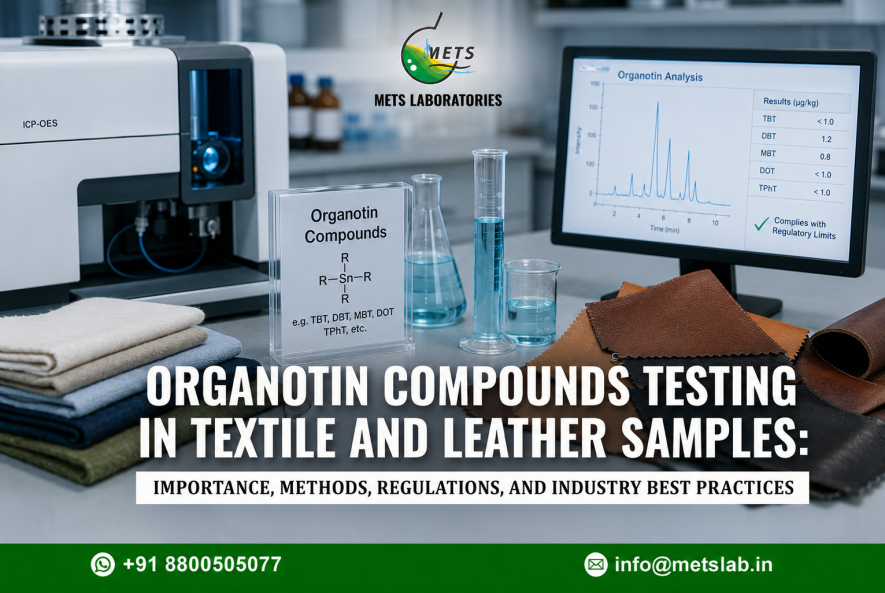
This article discusses organotin compounds, their applications in textiles and leather, associated health risks, international regulations, laboratory testing methods, analytical techniques, and best practices for compliance.
What Are Organotin Compounds?
Organotin compounds are organometallic chemicals containing one or more carbon–tin (Sn–C) bonds. They are classified based on the number of organic groups attached to the tin atom, including mono-, di-, tri-, and tetra-organotin compounds.
These compounds have been widely used in industrial manufacturing because of their effectiveness as:
- PVC stabilizers
- Heat stabilizers
- Catalysts
- Biocides
- Antifungal agents
- Antimicrobial treatments
- Preservatives
- Silicone curing catalysts
Although useful in manufacturing, several organotin compounds are toxic and persistent, making their use highly regulated worldwide.

Common Organotin Compounds Tested
Testing laboratories commonly analyze the following organotin compounds:
- Tributyltin (TBT)
- Triphenyltin (TPhT)
- Dibutyltin (DBT)
- Dioctyltin (DOT)
- Monobutyltin (MBT)
- Monooctyltin (MOT)
- Diphenyltin (DPhT)
- Monophenyltin (MPhT)
- Trioctyltin (TOT)
Among these, Tributyltin (TBT) and Triphenyltin (TPhT) receive the greatest regulatory attention due to their toxicity.
Sources of Organotin Compounds in Textile and Leather Products
Organotin compounds may be introduced during various stages of manufacturing.
PVC-Coated Fabrics
Organotin stabilizers are commonly used during PVC processing to improve heat resistance and product durability.
Synthetic Leather
Artificial leather and coated fabrics may contain organotin stabilizers in polymer coatings.
Leather Processing
Certain leather finishing agents, preservatives, and fungicides have historically contained organotin compounds.
Textile Finishing
Some antimicrobial and antifungal textile treatments have used organotin-based chemicals.
Footwear Manufacturing
PVC soles, synthetic uppers, adhesives, and coated materials may contain organotin residues.


Why Are Organotin Compounds a Concern?
Several organotin compounds are highly toxic, even at low concentrations.
Potential health concerns include:
- Skin irritation
- Eye irritation
- Endocrine disruption
- Reproductive toxicity
- Immune system effects
- Neurotoxicity
- Developmental toxicity
- Organ damage following prolonged exposure
Workers handling untreated chemicals and consumers exposed to contaminated products may be at risk if regulatory limits are exceeded.
Environmental Impact
Organotin compounds are considered hazardous environmental pollutants.
They may:
- Persist in soil and sediments
- Contaminate rivers and oceans
- Accumulate in aquatic organisms
- Disrupt marine ecosystems
- Affect fish, shellfish, and other aquatic species
- Bioaccumulate through the food chain
Tributyltin was once widely used in marine antifouling paints but has since been restricted due to its severe ecological effects.
Why Is Organotin Testing Important?
Testing helps manufacturers and brands ensure compliance with chemical safety regulations while protecting consumers and the environment.
Key benefits include:
- Regulatory compliance
- Consumer safety
- Environmental protection
- Product quality assurance
- Brand reputation
- Reduced recall risk
- Export acceptance
- Supplier qualification
International Regulations
European Union REACH
The European Union REACH Regulation restricts the use of several organotin compounds in consumer products, including textiles and leather articles. Certain compounds, such as tributyltin (TBT) and triphenyltin (TPhT), are subject to stringent concentration limits.
OEKO-TEX® STANDARD 100
Products certified under OEKO-TEX® STANDARD 100 must comply with strict limits for organotin compounds to ensure they are safe for human use.
ZDHC Manufacturing Restricted Substances List (MRSL)
The ZDHC MRSL restricts the intentional use of hazardous organotin compounds in chemical formulations used during textile, apparel, and footwear manufacturing.
Brand Restricted Substance Lists (RSL)
Many global apparel and footwear brands include organotin compounds in their Restricted Substance Lists, requiring suppliers to demonstrate compliance through accredited laboratory testing.
Products Commonly Tested
Organotin testing is commonly performed on:
- Textile fabrics
- Natural leather
- Synthetic leather
- Artificial leather
- Footwear
- Bags
- Belts
- Wallets
- Gloves
- Upholstery
- PVC-coated textiles
- Children’s products
- Fashion accessories
- Protective clothing
Sample Preparation
Proper sample preparation is essential for obtaining reliable analytical results.
Typical laboratory procedures include:
Sample Cutting
The product is cut into small representative pieces.
Homogenization
Samples are ground or shredded to obtain a uniform test portion.
Solvent Extraction
Organotin compounds are extracted using suitable organic solvents under controlled laboratory conditions.
Derivatization
Many analytical methods convert organotin compounds into more volatile derivatives before instrumental analysis, improving detection and quantification.
Analytical Methods
Testing laboratories generally follow validated methods based on international standards and regulatory requirements.
Common approaches include:
- ISO methods
- EN methods
- CEN technical specifications
- Laboratory-validated methods
- Customer-specific testing protocols
Instrumental Analysis
Gas Chromatography-Mass Spectrometry (GC-MS)
GC-MS is one of the most widely used techniques for organotin analysis. It provides excellent sensitivity, selectivity, and accurate identification of individual compounds.
Gas Chromatography-Tandem Mass Spectrometry (GC-MS/MS)
GC-MS/MS offers enhanced selectivity and lower detection limits, making it suitable for trace-level analysis in complex textile and leather matrices.
Inductively Coupled Plasma-Mass Spectrometry (ICP-MS)
ICP-MS may be used in specialized laboratories to determine total tin content or support advanced organotin investigations when required.
Quality Assurance
Accurate testing depends on a robust quality management system.
Laboratories typically use:
- Method blanks
- Calibration standards
- Internal standards
- Duplicate analyses
- Matrix spike recoveries
- Certified reference materials
- Instrument performance checks
These measures ensure reliable and reproducible results.
Reporting Units
Organotin concentrations are generally reported as:
- mg/kg
- ppm
- μg/g
Many customer specifications define compliance limits in mg/kg.
Factors Affecting Test Results
Several factors can influence analytical accuracy, including:
- Sample homogeneity
- Extraction efficiency
- Instrument calibration
- Matrix interference
- Cross-contamination
- Storage conditions
- Laboratory handling procedures
Proper quality control minimizes these potential sources of error.
Laboratory Accreditation
Organotin testing should be conducted by laboratories accredited to ISO/IEC 17025. Accreditation demonstrates technical competence, validated methods, calibrated equipment, and effective quality management systems.
Benefits of Organotin Testing
Routine testing offers several advantages:
- Compliance with international regulations
- Improved product safety
- Increased customer confidence
- Better export opportunities
- Reduced regulatory risk
- Stronger supplier management
- Enhanced brand reputation
- Support for sustainable manufacturing practices
Best Practices for Manufacturers
Manufacturers can reduce organotin-related risks by implementing effective chemical management systems.
Recommended practices include:
- Source raw materials from approved suppliers.
- Request chemical compliance declarations from vendors.
- Screen incoming materials through laboratory testing.
- Maintain an up-to-date chemical inventory.
- Train employees on hazardous substance management.
- Replace restricted organotin compounds with safer alternatives.
- Conduct periodic compliance testing to verify ongoing conformity.
Challenges in Organotin Testing
Laboratories and manufacturers may encounter several challenges, such as:
- Complex product compositions
- Low concentration detection requirements
- Matrix interferences
- Evolving regulatory limits
- Diverse customer specifications
- Cross-contamination during production
Validated analytical methods and experienced laboratory personnel help address these challenges.
Future Trends
The textile and leather industries are moving toward safer and more sustainable chemical management practices.
Emerging trends include:
- Organotin-free stabilizers
- Eco-friendly polymer additives
- Green chemistry initiatives
- Enhanced supply chain transparency
- Digital chemical traceability
- Increased regulatory harmonization
- Adoption of safer alternative technologies
As sustainability expectations continue to grow, manufacturers are increasingly replacing hazardous organotin compounds with less toxic alternatives.
Conclusion
Organotin compounds testing is a critical component of chemical compliance programs in the textile and leather industries. As global regulations become more stringent and brands place greater emphasis on product safety and sustainability, manufacturers must proactively monitor and control the presence of these hazardous substances.
By implementing comprehensive chemical management practices, sourcing compliant raw materials, partnering with accredited laboratories, and performing routine organotin testing using validated analytical methods such as GC-MS or GC-MS/MS, businesses can ensure regulatory compliance, protect consumer health, minimize environmental impact, and strengthen their position in international markets.
Frequently Asked Questions (FAQs)
What are organotin compounds?
Why is organotin testing required?
Which products are commonly tested?
Which organotin compounds are most commonly regulated?
Which analytical method is used for organotin testing?
What units are used to report results?
Why should manufacturers conduct routine testing?
Can organotin compounds be replaced?
Manufacturers and Exporters Recommend Us
Dedicated professionals committed to providing you with accurate and reliable testing services. Get METS Lab services today from the best lab experts & get the accurate reports from our laboratory.