

- Mets Admin
- November 4, 2026
- Testing Insights
- 0 Comments
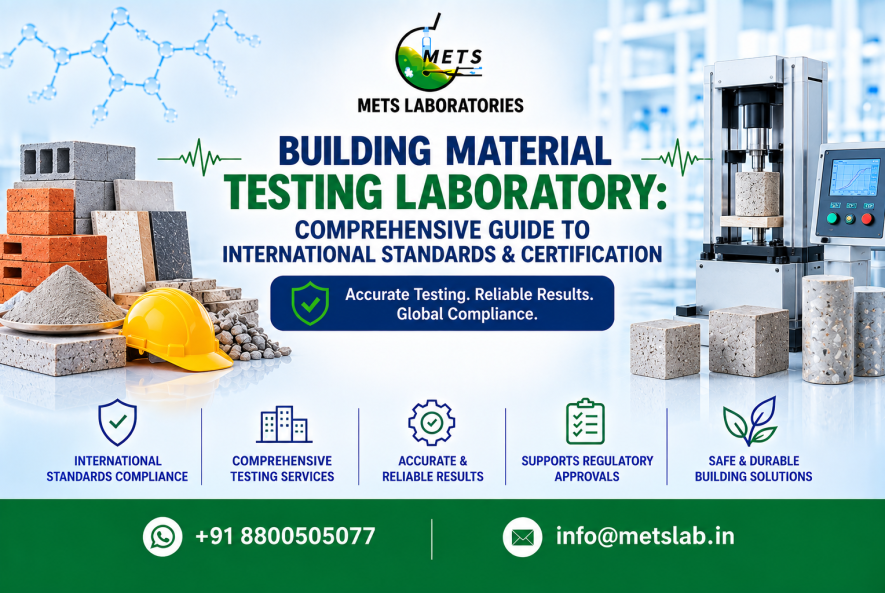
A building material testing laboratory evaluates the mechanical, physical, chemical, and fire performance of structural components to ensure compliance with ASTM, ISO, EN, and IS codes. Operating under ISO/IEC 17025 accreditation, third-party testing verifies load capacity, durability, moisture resistance, and safety parameters across concrete, steel, aggregates, soils, and architectural coatings before project deployment.
Plastic, concrete, steel, and masonry form the structural backbone of modern infrastructure projects worldwide. However, their physical performance can degrade significantly when exposed to environmental stress, mechanical fatigue, chemical exposure, or improper batch mixing. Partnering with an ISO/IEC 17025 accredited building material testing laboratory is essential for structural engineers, project developers, and export manufacturers. Independent verification guarantees material quality, validates compliance with international building codes, and prevents catastrophic structural failure.
What Is a Building Material Testing Laboratory?
A building material testing laboratory is a specialized analytical facility equipped to perform destructive and non-destructive evaluations on civil engineering materials. These facilities analyze raw substances and finished structural components—including cement, rebar, aggregates, tiles, waterproofing membranes, and structural glass—to determine whether they meet specified engineering tolerances.
By subjecting samples to controlled stress, thermal degradation, chemical immersion, and environmental weathering, testing facilities provide defensible data that verifies structural safety before materials enter supply chains.

Why Is Construction Material Testing Vital for Modern Projects?
Executing routine construction material testing is not merely a statutory step; it is a critical safeguard for human life, investment capital, and corporate reputation.
- Preventing Catastrophic Failure: Unverified concrete mixes or substandard reinforcement steel can lead to micro-fractures, spalling, and sudden structural collapse.
- Global Regulatory Acceptance: Projects across India, the GCC, Europe, and North America require strict adherence to regulatory standards such as IS, ASTM, BS EN, and GSO specifications.
- Mitigating Commercial Risk: Defective materials cause expensive site delays, failed audits, structural retrofitting, and legal exposure. Third-party testing provides legal protection through certified test reports.
- Verifying Supply Chain Integrity: Independent analysis confirms that raw materials delivered by suppliers match structural engineering designs.
Core Civil Material Testing Parameters & Methodologies
Comprehensive civil material testing spans multiple scientific disciplines to assess material integrity across distinct phase transitions:
Mechanical & Structural Testing
- Compressive Strength: Evaluates the maximum load-bearing capability of concrete cubes, masonry units, and soil-cement stabilization.
- Tensile & Flexural Yield: Determines elongation, yield point, and breaking strength of structural steel rebar, structural polymers, and ceramic tiles.
- Impact & Hardness: Measures resistance to mechanical shock and surface wear using Charpy and Brinell testing setups.
Chemical & Environmental Testing
- Sulfate & Chloride Content: Identifies corrosive chemical levels in soil, water, and concrete that accelerate internal steel rebar oxidation.
- Efflorescence & Water Absorption: Measures liquid absorption rates in bricks, AAC blocks, and tiles to prevent freeze-thaw cracking and moisture damage.
- Chemical Resistance: Assesses structural polymer and coating stability when exposed to aggressive industrial reagents and environmental acids.
International Standards Governing Building Product Certification
Achieving international building product certification requires testing in accordance with standardized international methodologies:
Testing Standard | Governing Body | Scope & Application |
ASTM C39 / ASTM C109 | ASTM International | Compressive strength of cylindrical concrete and hydraulic cement mortars. |
ISO 10545 Series | International Organization for Standardization | Physical, mechanical, and chemical evaluation of ceramic and porcelain tiles. |
BS EN 12390 | European Standards | Testing hardened concrete specimens for density, strength, and depth of penetration. |
IS 456 / IS 1786 | Bureau of Indian Standards | Plain and reinforced concrete code of practice and high-strength deformed steel bars. |
ASTM E119 / BS 476 | ASTM / British Standards | Fire propagation, surface flame spread, and fire endurance of structural assemblies. |


Global Sample Testing via an Accredited Building Materials Lab in India
With rapid supply chain globalization, EPC contractors, project managers, and material exporters across the Middle East, Southeast Asia, Europe, and North America rely on a accredited building materials lab in India to support international compliance.
Laboratories operating in major industrial corridors like IMT Manesar provide an ideal combination of ISO/IEC 17025 technical accreditation, state-of-the-art analytical equipment (such as GC-MS, TGA, Universal Testing Machines, and XRF analysis), and rapid turnaround times. International clients regularly ship material samples directly to these hubs for independent evaluation before dispatching bulk shipments overseas.
Conclusion: Securing Infrastructure Through Defensible Testing
Investing in qualified material analysis protects infrastructure investments, ensures human safety, and guarantees smooth regulatory approval. Choosing a certified testing partner allows project managers and manufacturers to make confident, data-backed decisions.
To learn how specialized surface evaluations protect structural integrity, read our detailed guide on tile testing and international compliance, review our comprehensive analysis on fire propagation testing, or explore our primary concrete testing services. Contact METS Laboratories today to schedule certified testing for your structural materials.
Frequently Asked Questions (FAQs)
Why is ISO/IEC 17025 accreditation necessary for a building material testing laboratory?
How are samples delivered to the lab for international projects?
What is the difference between destructive and non-destructive material testing?
How long does standard construction material testing take?
Manufacturers and Exporters Recommend Us
Dedicated professionals committed to providing you with accurate and reliable testing services. Get METS Lab services today from the best lab experts & get the accurate reports from our laboratory.