

- Mets Admin
- November 4, 2026
- Testing Insights
- 0 Comments
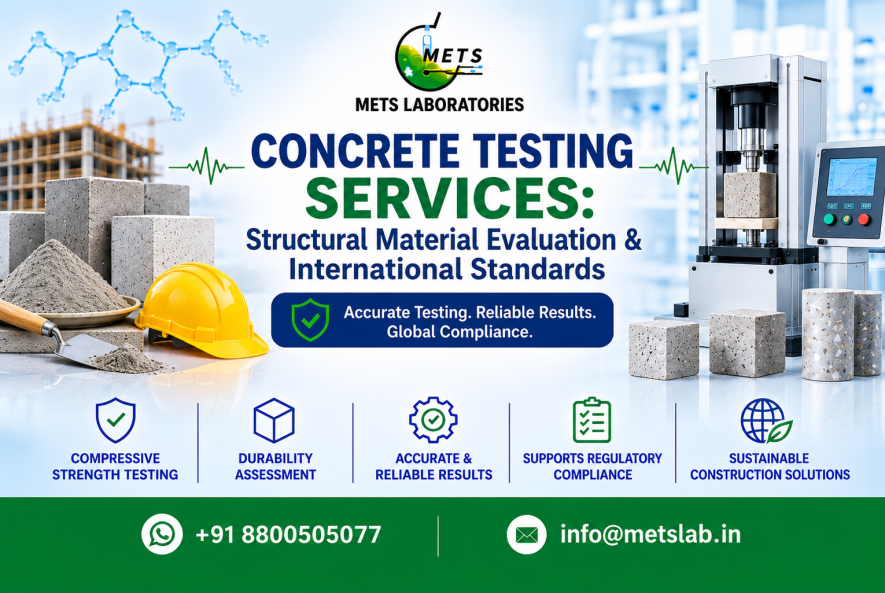
Professional concrete testing services evaluate the mechanical, physical, and chemical durability of concrete mixes, cement, reinforcement steel, and foundational subgrades. Operating under ISO/IEC 17025 accreditation, testing measures compressive cube strength, tensile yield, workability, chloride penetration, and bearing capacity in accordance with ASTM C39, IS 456, IS 1786, and BS EN 12390 standards to ensure structural safety and prevent catastrophic failure.
Reinforced concrete, structural steel rebar, hydraulic cement, and supporting subgrade soils form the primary load-bearing matrix of modern high-rises, industrial bridges, and commercial infrastructure. However, variations in batch mixing, aggregate grading, site curing conditions, or soil compaction can compromise load capacity. Engaging accredited concrete testing services is a fundamental requirement for civil engineers, EPC contractors, and structural auditors. Independent laboratory analysis verifies material performance, confirms compliance with statutory building codes, and ensures long-term structural resilience.
Introduction to Comprehensive Concrete Testing Services
Third-party concrete testing services encompass a systematic suite of destructive and non-destructive evaluations performed on fresh concrete, cured specimens, and structural members. Testing analyzes critical performance indicators—including compressive load capacity, flexural strength, water permeability, and chemical resistance.
By evaluating concrete across various curing intervals (such as 7-day, 14-day, and 28-day thresholds), analytical laboratories provide verifiable data that confirms structural safety before loading framing elements on construction sites.

Why Are Concrete Testing Services Vital for Structural Safety?
Relying on unverified material batches introduces severe technical, legal, and economic vulnerabilities to civil projects.
- Preventing Micro-Fractures and Spalling: Substandard cement hydration or incorrect water-cement ratios lead to internal micro-cracking, honeycombing, and sudden load failure.
- Corrosion Mitigation in Rebar: High chloride concentrations in mixing water or aggregates accelerate reinforcement bar oxidation, leading to spalling and loss of bond strength.
- Regulatory Compliance: Building authorities across India, the Middle East, Europe, and North America mandate verified laboratory test certificates before issuing structural completion approvals.
- Protecting Capital Investment: Early detection of weak concrete batches prevents costly retrofitting, structural demolition, or legal liability.
Integrated Structural Material Testing Protocols
A complete structural assessment evaluates the entire load-bearing system, extending beyond hardened concrete to incorporate cement, reinforcement rebar, and foundational subgrade soils:
A. Cement & Binder Verification
Before mixing, samples sent to a certified cement testing laboratory undergo physical and chemical testing. Key parameters include fineness (via Blaine air permeability), initial and final setting times, soundness (Le Chatelier method), and compressive strength of standard mortar cubes under ASTM C109 and IS 4031.
B. Steel Rebar Mechanics
Testing conducted at a specialized steel testing laboratory evaluates high-strength deformed (TMD/SD) bars and structural steel sections. Mechanical evaluations measure yield strength, ultimate tensile strength (UTS), percentage elongation, and 180-degree bend/re-bend performance in compliance with IS 1786 and ASTM A615.
C. Soil & Subgrade Bearing Capacity
Foundational stability relies on comprehensive soil testing for construction. Field and laboratory soil testing measures Optimum Moisture Content (OMC), Maximum Dry Density (Proctor compaction), California Bearing Ratio (CBR), direct shear parameters, and Atterberg limits to prevent differential settlement.
International Standards Governing Structural Evaluations
Executing compliance testing requires strict adherence to international and national standards:
Material Scope | International Standard | Governing Code & Focus |
Hardened Concrete | ASTM C39 / BS EN 12390 | Compressive strength of cylindrical and cubic concrete specimens. |
Reinforced Concrete Code | IS 456 / ACI 318 | Plain and reinforced concrete code of practice for design and testing limits. |
Steel Reinforcement | ASTM A615 / IS 1786 | Deformed and plain carbon-steel bars for concrete reinforcement. |
Hydraulic Cement | ASTM C150 / IS 269 | Specifications for Ordinary Portland Cement (OPC) physical parameters. |
Subgrade Soil | ASTM D1883 / IS 2720 | CBR testing and laboratory compaction characteristics of soil. |


Global Sample Evaluation at an Accredited Structural Testing Laboratory
Infrastructure projects, material exporters, and EPC contractors globally require defensible verification from an ISO/IEC 17025 accredited structural testing laboratory.
Equipped with high-capacity Universal Testing Machines (UTM), automated compression testing frames, and advanced chemical analysis setups, central laboratories operating in industrial hubs like IMT Manesar provide an ideal combination of international compliance and rapid turnaround times. Project teams regularly dispatch steel coupons, core cuts, cement samples, and soil samples via international freight for certified laboratory verification.
Conclusion: Securing Load-Bearing Infrastructure Through Testing
Comprehensive material evaluation safeguards civil infrastructure against premature degradation and structural failure. Partnering with an accredited testing laboratory provides engineers and developers with defensible data to proceed with confidence.
To explore how testing extends to structural envelopes and architectural surfaces, read our master guide on building material testing laboratory standards, review our analysis on tile testing and international compliance, or examine our guide on fire propagation testing. Contact METS Laboratories today to schedule certified concrete and structural material testing.
Frequently Asked Questions (FAQs)
What is the standard curing period for concrete compressive strength testing?
Why is chemical analysis performed on concrete mixing water and aggregates?
What is the difference between destructive and non-destructive material testing?
Why is soil testing required before designing concrete footings?
Manufacturers and Exporters Recommend Us
Dedicated professionals committed to providing you with accurate and reliable testing services. Get METS Lab services today from the best lab experts & get the accurate reports from our laboratory.