


- Mets Admin
- June 5, 2026
- Testing Insights
- 0 Comments
Introduction
Fire safety is one of the most critical aspects of building design, construction, and material selection. To address these hazards, performing an ASTM E84 fire test is essential to analyze how individual components react under heat pressure. Every year, building fires cause significant loss of life and property across residential, commercial, and industrial sectors. Therefore, understanding the behavior of building materials when exposed to fire or flame is a core regulatory requirement.
Different construction materials such as wall panels, insulation, ceiling boards, flooring systems, paints, coatings, plastics, and composite materials respond differently to fire exposure. Some materials ignite quickly and allow flames to spread rapidly, while others resist ignition and slow down fire propagation.
To evaluate and classify this behavior, the ASTM E84 standard—also known as the Steiner Tunnel Test—is widely used in the United States and many international building codes. This test measures the surface burning characteristics of building materials, specifically focusing on flame spread and smoke development.
ASTM E84 plays a crucial role in ensuring that building materials meet fire safety requirements, reduce fire hazards, and comply with regulatory building codes.
What is ASTM E84?
ASTM E84 is a standardized fire test method developed by ASTM International titled:
“Standard Test Method for Surface Burning Characteristics of Building Materials”
It evaluates how a material behaves when exposed to fire in a controlled tunnel environment.
The test primarily measures two key parameters:
- Flame Spread Index (FSI)
- Smoke Developed Index (SDI)
These parameters help classify materials based on their fire performance and suitability for use in buildings.

Purpose of ASTM E84 Testing
The main objective of ASTM E84 is to:
- Determine how quickly flames spread across the surface of materials
- Measure the amount of smoke produced during combustion
- Classify building materials based on fire hazard level
- Ensure compliance with building codes (IBC, NFPA requirements)
- Improve fire safety in residential, commercial, and industrial structures
The test is essential for materials used in:
- Wall and ceiling systems
- Insulation materials
- Decorative panels
- Flooring systems
- HVAC ducts
- Composite building products
- Coatings and finishes
Principle of ASTM E84 (Steiner Tunnel Test)
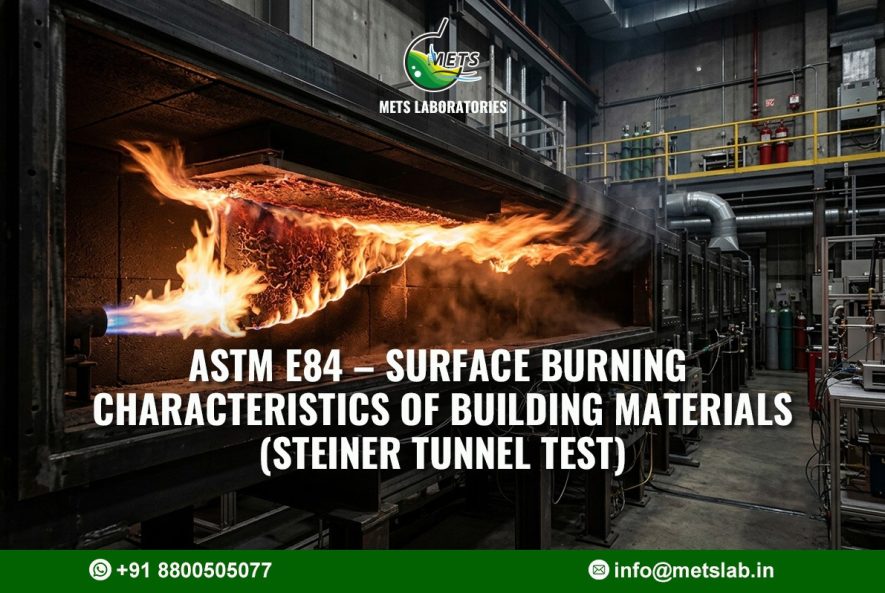
The ASTM E84 test is conducted in a Steiner tunnel, which is a horizontal furnace approximately 7.3 meters (25 feet) long.
Test Setup:
- A sample material is mounted on the ceiling of the tunnel
- A gas burner produces a controlled flame at one end
- Airflow is maintained through the tunnel
- Flame spreads across the material surface
- Optical sensors measure smoke density
The material is exposed to flame for a defined time (typically 10 minutes), and its behavior is recorded.


Key Parameters Measured in ASTM E84
- Flame Spread Index (FSI)
FSI measures how fast flame spreads across the surface of a material.
- A reference scale is used:
- Red Oak = 100 (standard reference material)
- Asbestos Cement Board = 0
Classification:
Class | Flame Spread Index | Fire Performance |
Class A | 0–25 | Best fire resistance |
Class B | 26–75 | Moderate fire resistance |
Class C | 76–200 | Limited fire resistance |
Lower FSI = better fire safety.
- Smoke Developed Index (SDI)
SDI measures the amount of smoke generated during combustion.
- Smoke is a major hazard in fires because it:
- Reduces visibility
- Causes suffocation
- Increases panic and evacuation difficulty
Classification:
SDI Value | Smoke Behavior |
0–450 | Acceptable range |
>450 | High smoke development (undesirable) |
Importance of ASTM E84 in Building Safety
ASTM E84 is widely used in building codes because it provides reliable fire performance data.
Key benefits include:
- Improves occupant safety during fire incidents
- Helps in safe evacuation planning
- Reduces flame spread within buildings
- Minimizes smoke inhalation risks
- Supports fire-resistant construction design
- Ensures compliance with regulatory authorities
Fire does not just spread through ignition—it spreads through surfaces. Therefore, surface burning behavior is critical.
Applications of ASTM E84 Testing
ASTM E84 is required for a wide range of construction and building materials.
- Wall and Ceiling Materials
- Gypsum boards
- Wood panels
- PVC panels
- Decorative laminates
- Acoustic tiles
- Insulation Materials
- Foam insulation
- Fiberglass insulation
- Mineral wool
- Polyurethane foams
- Flooring Systems
- Vinyl flooring
- Laminate flooring
- Carpet backing materials
- HVAC and Duct Materials
- Air duct liners
- Flexible ducts
- Composite duct boards
- Coatings and Finishes
- Fire-resistant paints
- Protective coatings
- Decorative finishes
Factors Affecting ASTM E84 Results
Several factors influence fire performance results:
- Material composition
- Thickness of sample
- Surface coatings
- Moisture content
- Density and porosity
- Additives and flame retardants
- Manufacturing process
Even small variations in formulation can significantly affect results.
Advantages of ASTM E84 Testing
- Standardized and globally recognized method
- Reliable comparison between materials
- Widely accepted in building codes
- Helps in product certification
- Ensures fire safety compliance
- Reduces liability risks
Limitations of ASTM E84
While widely used, ASTM E84 has some limitations:
- Tests only surface burning behavior
- Does not simulate real building fire conditions fully
- Horizontal tunnel may not reflect vertical fire spread
- Results may vary for complex composite materials
- Does not measure structural collapse or heat release
Despite these limitations, it remains a fundamental fire classification method.
Industry Requirements and Compliance
ASTM E84 is required by:
- International Building Code (IBC)
- NFPA regulations
- Fire safety authorities
- Construction certification bodies
- Insurance compliance standards
Manufacturers must ensure compliance before product commercialization.
Who Needs ASTM E84 Testing?
- Building material manufacturers
- Construction companies
- Architects and designers
- Fire safety consultants
- Insulation producers
- Panel and laminate manufacturers
- Exporters of building materials
- Government infrastructure projects
Conclusion
ASTM E84 is one of the most important fire safety standards used in the construction and building materials industry. It evaluates the surface burning characteristics of materials through flame spread and smoke development measurements using the Steiner tunnel test.
By classifying materials into fire performance classes (Class A, B, and C), ASTM E84 helps architects, engineers, and regulators select safer materials for building design. Although it has certain limitations, it remains a globally accepted benchmark for fire safety evaluation.
As modern construction continues to evolve with new composite materials, polymers, and engineered products, ASTM E84 testing will remain essential for ensuring fire safety, regulatory compliance, and occupant protection in buildings worldwide.
Frequently Asked Questions (FAQs) – ASTM E84 Surface Burning Characteristics Test
What is ASTM E84 test used for?
What does ASTM E84 measure?
What is Flame Spread Index (FSI)?
What is Smoke Developed Index (SDI)?
What are Class A, B, and C materials in ASTM E84?
Why is ASTM E84 important in construction?
Which materials are tested under ASTM E84?
What is the Steiner Tunnel Test?
Is ASTM E84 a full fire safety test?
What factors affect ASTM E84 results?
Who requires ASTM E84 testing?
What is the main goal of ASTM E84 testing?
Is ASTM E84 mandatory?
What happens if a material fails ASTM E84?
Manufacturers and Exporters Recommend Us
Dedicated professionals committed to providing you with accurate and reliable testing services. Get METS Lab services today from the best lab experts & get the accurate reports from our laboratory.