


- Mets Admin
- July 7, 2026
- Testing Insights
- 0 Comments
Introduction to the Compressive Strength of Concrete Cube
Concrete is a fundamental construction material whose performance is primarily evaluated based on its ability to withstand axial loads. This report presents the standard method for determining the compressive strength of concrete cube specimens as per Indian Standards. Understanding this mechanical characteristic is essential to ensure structural safety, longevity, and overall adherence to quality criteria.
The compressive strength of any material is defined as its resistance to failure under the action of compressive forces. In the case of concrete, compressive strength is a critical parameter used to assess its performance under service conditions. Concrete mixes can be designed or proportioned to achieve the required engineering and durability properties as specified by the design engineer.
In addition to compressive strength, hardened concrete exhibits several other important engineering properties, including modulus of elasticity, tensile strength, creep coefficient, density, and coefficient of thermal expansion.
Why Does Concrete Specimen Testing Matter?
A concrete mix design on paper is one thing, but what actually arrives at the site can be quite different. Variations in water content, aggregate quality, mixing duration, and temperature can push the actual strength away from the target. This is why compressive strength testing exists—it bridges the gap between design intent and site reality.
As you know, concrete is a mixture of cement, sand, aggregates, and water. The strength of concrete depends on many factors, such as the individual compressive strength of the materials used in manufacturing concrete (cement, sand, and aggregates), the quality of materials used, air entrainment, mix proportions, water-cement (w/c) ratio, curing methods, and temperature effects.
In India, where conditions vary dramatically from humid coastal regions to zones of extreme heat, site variables are not minor. A batch mixed at 42°C behaves very differently from one mixed in a controlled environment. Without testing, there is no way to verify that the concrete in your columns and beams meets the engineer’s specifications.

How Is the Compressive Strength of Concrete Cube Tested?
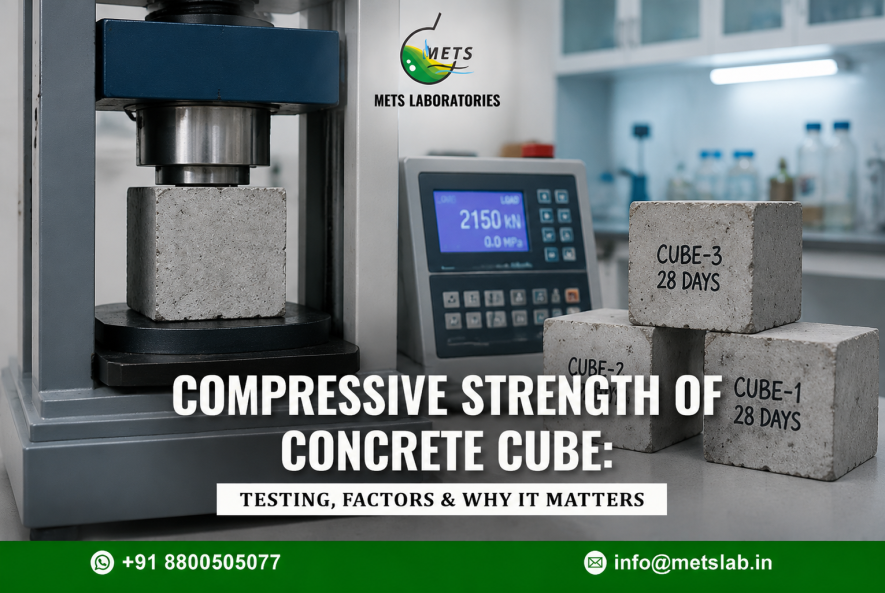
The standard test method in India follows IS 516. Fresh concrete is poured into cube moulds, typically 150 mm × 150 mm × 150 mm, properly compacted, and cured in water at a controlled temperature. At 7 days and 28 days, the cubes are placed in a compression testing machine and loaded until failure. The maximum load divided by the cross-sectional area gives the compressive strength.
The results are not treated as a single number. IS 456 requires that no individual result falls below the specified grade by more than a defined margin, and that the average of any group of four consecutive results exceeds the target strength. This statistical approach accounts for natural variation while ensuring structural safety.
The testing procedure and acceptance criteria are based on the following standards:
• IS 516:1959 – Methods of Tests for Strength of Concrete
• IS 456:2000 – Plain and Reinforced Concrete – Code of Practice
Common Concrete Grades and Their Structural Applications
Different structural elements require different strength levels. The table below shows commonly used concrete grades in Indian construction:
Concrete Grade | Compressive Strength (MPa) | Typical Application |
M15 | 15 | Levelling courses, non-structural work |
M20 | 20 | Residential slabs, foundations for light structures |
M25 | 25 | Standard residential and commercial RCC work |
M30 | 30 | Multi-storey buildings, bridges, heavy-load columns |
M35 | 35 | Prestressed elements, high-rise structures |
M40 and above | 40+ | Infrastructure projects, marine structures, dams |


Materials & Ratios That Influence Compressive Strength
Several variables determine whether concrete achieves its target strength. The water-cement ratio is the single most influential factor; more water leads to more pores after evaporation, resulting in lower density and strength. Aggregate quality and grading also play a significant role, as well-graded aggregates pack more tightly and leave fewer voids. Cement quality is equally critical—its fineness, chemical composition, and consistency directly affect the formation of C-S-H gel during hydration.
Curing is another essential factor. Concrete that dries out too quickly—common on hot and windy construction sites across India—loses moisture before hydration is complete, resulting in reduced final strength. Proper curing methods, such as water ponding, wet hessian, or curing compounds, ensure that the concrete reaches its design strength.
Coarse Aggregate:
Concrete is a homogeneous mixture of aggregates, cement, sand, water, and various admixtures. However, even with proper mixing, microcracks may develop due to differences in the thermal and mechanical properties of coarse aggregates and cement paste, which can lead to failure.
Earlier theories suggested that larger aggregate size significantly increases compressive strength. While larger aggregates may show higher strength in the initial stages, experimental studies have demonstrated that strength can reduce over time. This reduction is primarily due to the decreased surface area available for bonding between the cement paste and aggregates, as well as a weaker interfacial transition zone.
Air Entrainment:
Air entrainment in concrete was originally developed in cold regions to prevent damage caused by the freezing and thawing of water within the pores. Further research has shown that air entrainment improves workability, allowing for lower water-cement ratios.
Improved workability at lower water-cement ratios helps achieve higher compressive strength. Additionally, it can produce relatively lighter concrete while maintaining adequate strength.
Water-Cement Ratio:
It is well known that excess water adversely affects the strength of concrete. While water is essential for the hydration of cement, it should be added within limits (typically about 20% to 25% of the cement content by weight). Excess water not only affects workability and finishing but also reduces strength.
When excess water evaporates, it leaves behind large interstitial voids between aggregate particles and cement paste. These voids weaken the structure and may lead to cracking during compressive strength testing.
Additional Environmental Factors Affecting Compressive Strength
- Compaction of Concrete:
Proper compaction removes entrapped air and ensures maximum density. Poor compaction leads to voids and honeycombing, significantly reducing strength. - Mixing Quality and Time:
Uniform and adequate mixing ensures proper distribution of cement paste and aggregates. Insufficient or excessive mixing can adversely affect strength. - Type of Cement:
Different types of cement (e.g., OPC, PPC, PSC) have varying hydration rates and strength development characteristics, which directly influence compressive strength. - Admixtures:
Chemical admixtures such as superplasticizers, accelerators, and retarders can modify workability, setting time, and strength development of concrete. - Age of Concrete:
Concrete gains strength over time. While 28-day strength is standard, strength continues to develop beyond this period under proper curing conditions. - Temperature During Placement and Curing:
Extreme temperatures (both high and low) affect hydration. High temperatures can cause rapid evaporation, while low temperatures slow down strength gain. - Shape and Size of Specimen:
The size and geometry of test specimens (cube vs. cylinder) influence measured strength due to differences in stress distribution. - Loading Rate During Testing:
The rate at which load is applied in a compression testing machine affects the test result. Faster loading rates may give slightly higher strength values. - Moisture Condition at Testing:
Dry and wet specimens may show different strength values. Standard testing requires controlled moisture conditions for consistency. - Quality Control at Site:
Handling, transportation, and placement practices at the construction site play a crucial role in achieving the desired strength.
Why Do We Test the Compressive Strength of Concrete Cube at 7, 14, and 28 Days?
As we know, concrete gains maximum strength at 28 days. In the construction sector, a great amount of capital is at stake. Due to this reason, instead of waiting to check strength at 28 days, we test the concrete strength at 7 and 14 days (in psi) to predict the target strength of the construction work.
From the reference of the table given below, it is clear that concrete gains about 16% of its strength within 24 hours, whereas it gains about 60% of the target strength by 7 days after casting.
At 14 days, the concrete gains about 90% of the target strength. Thereafter, the rate of strength gain slows down, and it takes up to 28 days to achieve approximately 99% of its strength.
Expected Strength Gain of Concrete Over Time
Time After Casting | Approximate Strength Gain (%) | Description |
24 Hours | ~16% | Initial strength gained; concrete is still very weak and not suitable for load-bearing. |
7 Days | ~60–70% | Early strength stage; used to predict 28-day strength and assess quality. |
14 Days | ~90% | Most of the strength is achieved; rate of gain starts slowing down. |
28 Days | ~99% | Standard design strength achieved; considered full strength for practical purposes. |
Key Purpose of Material Testing at Different Ages
Test Age | Purpose |
7 Days | Early quality check and prediction of target strength |
14 Days | Intermediate confirmation of strength development |
28 Days | Final acceptance and compliance with design requirements |
Quality Assurance Beyond the Core Cube Test
While the cube compressive strength test is the cornerstone of concrete quality control, it does not always represent the actual in-situ condition of the structure. To overcome this limitation, non-destructive testing (NDT) methods such as the rebound hammer test and ultrasonic pulse velocity (UPV) test are widely used. These techniques allow engineers to assess the strength and integrity of concrete without causing damage. The rebound hammer test provides a quick estimate of surface hardness, while the UPV test evaluates internal quality by detecting cracks, voids, or inconsistencies within the concrete. These methods are particularly useful for assessing existing structures or verifying concrete quality when cube test results are uncertain.
In addition to NDT methods, core testing provides a more direct and reliable measure of in-place concrete strength. This method involves extracting cylindrical samples from the actual structure and testing them under controlled conditions. Although it is partially destructive, it offers the most accurate representation of the concrete’s performance. Together, plastic polymer testing services, non-destructive methods, and core testing form a comprehensive quality assurance framework that helps engineers ensure structural safety, identify potential weaknesses, and maintain long-term durability.
How METS Laboratories Ensures Compressive Strength at Every Stage
Achieving the desired compressive strength starts with high-quality materials Concrete cement range is designed for consistent strength, durability, and resistance to chemical attack. For projects requiring early strength gain, Concrete enables faster setting and earlier formwork removal without compromising long-term performance.
Additionally, ready-mix concrete (RMX) solutions ensure quality through controlled batching, uniform mixing, and certified testing. Each batch is produced to a specified grade and delivered ready for use, reducing the variability associated with site-mixed concrete.
Frequently Asked Questions (FAQs)
What does M25 concrete mean?
Why is the 28-day test standard?
Can concrete fail the cube test but still be acceptable?
Does increasing cement content always increase strength?
How does climate affect concrete strength?
What is the minimum number of cubes required for testing?
What happens if one cube result is much lower than others?
Why is curing important before testing?
What is the difference between cube and cylinder strength?
What is characteristic strength of concrete?
Can compressive strength increase after 28 days?
What is the role of water in concrete strength?
Manufacturers and Exporters Recommend Us
Dedicated professionals committed to providing you with accurate and reliable testing services. Get METS Lab services today from the best lab experts & get the accurate reports from our laboratory.