

- Mets Admin
- May 15, 2026
- Testing Insights
- 0 Comments
Introduction – The Delhi NCR Food Business Reality
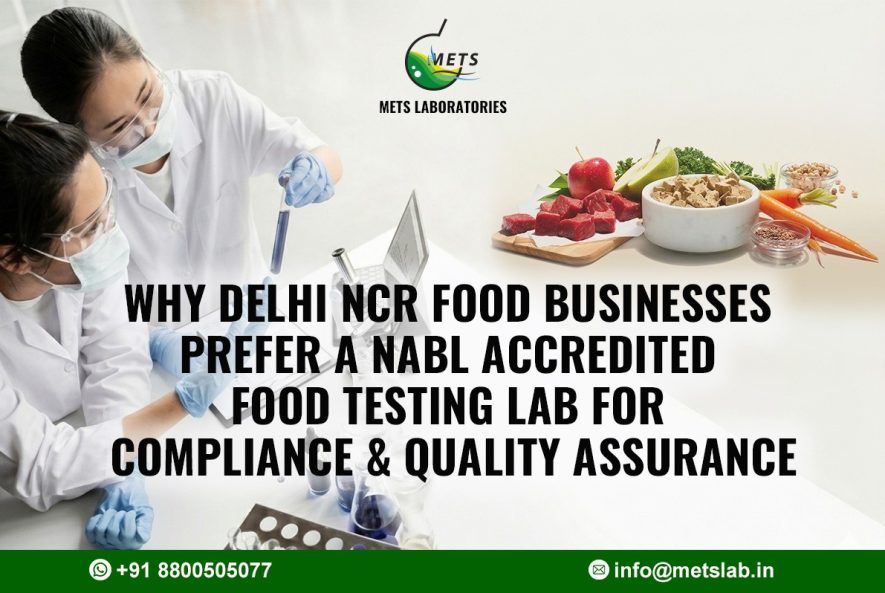
Delhi NCR is India’s largest and fastest-growing food market. From thousands of street food vendors and small-scale halwais to large packaged food manufacturers and major export houses in Noida and Gurugram, the region is a food commerce hub. However, with high density comes intense regulatory scrutiny, making it essential for businesses to work with a NABL accredited food testing lab in Delhi NCR to ensure food safety, compliance, and product quality assurance.
The Food Safety and Standards Authority of India (FSSAI) has repeatedly cracked down on non-compliant businesses in Delhi NCR—issuing fines, suspending licenses, and even shutting down units. For a food business in this region, a single failed audit or a consumer complaint can lead to viral news, legal action, and permanent brand damage.
This is why smart Delhi NCR food businesses—whether in Okhla, Kirti Nagar, Bawana, or Manesar—insist on a NABL-accredited (ISO/IEC 17025) food testing laboratory. For them, NABL accreditation is not just a technical checkbox; it is the only guarantee that their test reports will be accepted by FSSAI, courts, and export authorities.
What is NABL Accreditation & Why Does It Matter when Choosing a NABL Accredited Food Testing Lab in Delhi NCR
NABL (National Accreditation Board for Testing and Calibration Laboratories) accreditation under ISO/IEC 17025 is the highest national standard for technical competence of a laboratory. A NABL-accredited lab has proven:
- Validated test methods.
- Calibrated and maintained equipment.
- Trained and competent staff.
- Regular participation in proficiency testing.
For a Delhi NCR food business, this means:
- Legally valid reports for FSSAI licensing, renewal, or court cases.
- No rejection of your test results by regulators or buyers.
- Defensible data in case of a dispute.

Why Delhi NCR Businesses Specifically Prefer a NABL Accredited Food Testing Lab – 7 Key Reasons
Reason | Business Impact in Delhi NCR |
1. FSSAI Enforcement is Aggressive in NCR | Frequent raids, surprise sampling, and public naming & shaming. Only NABL + FSSAI recognized lab reports are accepted. |
2. High Density of Exporters (Noida, Gurugram) | Rice, spices, honey, frozen foods exported via ICD Tughlakabad or air cargo. APEDA/EIC requires NABL-accredited test reports. |
3. Large Hospitality & QSR Chains | Hotels, restaurants, cloud kitchens in Delhi NCR must prove raw material safety. NABL reports provide liability protection. |
4. Court & Consumer Forums Cases | Delhi’s consumer courts and NCDRC routinely dismiss reports from non-NABL labs. NABL accreditation ensures legal admissibility. |
5. E-commerce Platforms (Amazon, Flipkart, BigBasket) | These platforms now ask suppliers for NABL lab test reports before onboarding new food products. |
6. Brand Reputation in a Competitive Market | A NABL logo on your report builds trust with retailers (e.g., DMRC stations, malls) and modern trade. |
7. Avoiding Penalties & License Cancellation | FSSAI can suspend or cancel a license if compliance is based on unreliable testing. NABL labs minimize that risk. |
Non-Negotiable Accreditations for Delhi NCR Food Businesses
Before choosing a lab, verify these three things:
Accreditation | Issuing Body | Why It’s Mandatory for NCR |
NABL (ISO/IEC 17025) | NABL India | Legal validity, court acceptance, regulatory compliance. |
FSSAI Recognition | FSSAI | Required for all FSSAI license-related testing (Form B, product approval, renewal). |
APEDA / EIC Recognition | APEDA / Export Inspection Council | Essential for exporters in Noida, Gurugram, Faridabad sending goods abroad. |
Pro tip for Delhi NCR buyers: Do not trust a lab just because it has a “NABL certificate”. Always ask for their scope of accreditation (the specific test methods and food matrices they are approved for). Many labs are NABL only for water or environment, not for food.


Common Challenges Delhi NCR Businesses Face Without a NABL Accredited Food Testing Lab
Challenge | How It Hurts You | Solution |
Unaccredited lab offers lower price | Report gets rejected by FSSAI or buyer. | Insist on NABL + FSSAI recognition. |
Lab is NABL but not APEDA recognised | Export consignment stuck at ICD Tughlakabad. | For exports, ask for APEDA/EIC letter. |
Delayed reports (15+ days) | Missed tender or export shipment deadline. | Ask for TAT in writing; use rush services. |
Poor sample handling in summer | Micro results invalid due to broken cold chain. | Visit lab to check cold storage and sample receipt area. |
Lab cannot test specific parameter (e.g., pesticide in spices) | You have to send to another lab, wasting time and money. | Ask for their test method list and scope. |
How to verify a NABL Lab in Delhi NCR (Step by Step)
- Ask for their NABL certificate number (e.g., TC-xxxx).
- Visit www.nabl-india.org → “Accredited Laboratories” → Search by name or number.
- Check the scope of accreditation – Does it include your product category (e.g., dairy, spices, oils, ready-to-eat)?
- Ask for their FSSAI recognition letter – Not every NABL lab has FSSAI recognition.
- Request a sample test report – Look for traceability (sample ID, date, method reference, signature).
- Ask for recent proficiency testing (PT) results – A good NABL lab will share its PT performance.
Why Delhi NCR’s Food Businesses are shifting to Accredited Labs – A Trend
- Post-COVID awareness: Increased focus on hygiene and safety testing.
- E-commerce mandate: Major platforms now require third-party NABL reports.
- Export growth: NCR’s food exports are rising; APEDA scrutiny is tighter.
- FSSAI’s “BLISS” portal: Mandates that only recognized labs can upload reports directly.
Delhi NCR businesses that continue to use non-NABL labs are increasingly finding that their reports are:
- Rejected during FSSAI inspections.
- Questioned by buyers.
- Dismissed by courts.
How a Reliable NABL Accredited Food Testing Lab Supports Delhi NCR Food Businesses
A good NABL food testing lab in Delhi NCR (like the one described in this guide) offers:
- Full test menu: Pesticide residues (LC-MS/MS), heavy metals (ICP-MS), microbiology (pathogens), preservatives, aflatoxins, nutritional labeling.
- FSSAI license support: From initial application to renewal and product approval.
- Export-ready reports: APEDA/EIC recognized.
- Rush testing: Results in 24–72 hours for urgent shipment release from Tughlakabad or airport.
- Technical consultation: Help you interpret failures and take corrective action.
- Sample pickup: Many labs in Delhi NCR offer free or paid pick-up from your factory or warehouse.
Example: A namkeen manufacturer in Faridabad needing FSSAI renewal used a non-NABL lab last year – their report was rejected. This year, they switched to a NABL+FSSAI lab and got their license renewed in 10 days.
Conclusion
For any food business in Delhi NCR—whether a small bakery in Lajpat Nagar, a spice exporter in Kirti Nagar, a dairy processor in Ghaziabad, or a restaurant chain in Gurugram—choosing a NABL-accredited (ISO/IEC 17025) and FSSAI-recognized laboratory is the only way to ensure compliance, avoid legal trouble, and build consumer trust.
Price alone should never drive this decision. Verify accreditation, scope, turnaround time, and proficiency testing records. In a competitive and heavily regulated market like Delhi NCR, your lab partner is your first line of defense against recalls, penalties, and reputation loss.
Frequently Asked Questions
Is NABL accreditation mandatory for FSSAI compliance in Delhi NCR?
How do I check if a Delhi NCR food testing lab is NABL certified?
Do e-commerce platforms like Amazon or BigBasket require NABL lab reports?
What lab accreditations are required for food exporters in Noida and Gurugram?
What is the standard turnaround time (TAT) for a NABL food test report?
Manufacturers and Exporters Recommend Us
Dedicated professionals committed to providing you with accurate and reliable testing services. Get METS Lab services today from the best lab experts & get the accurate reports from our laboratory.