


- Mets Admin
- September 1, 2026
- Testing Insights
- 0 Comments
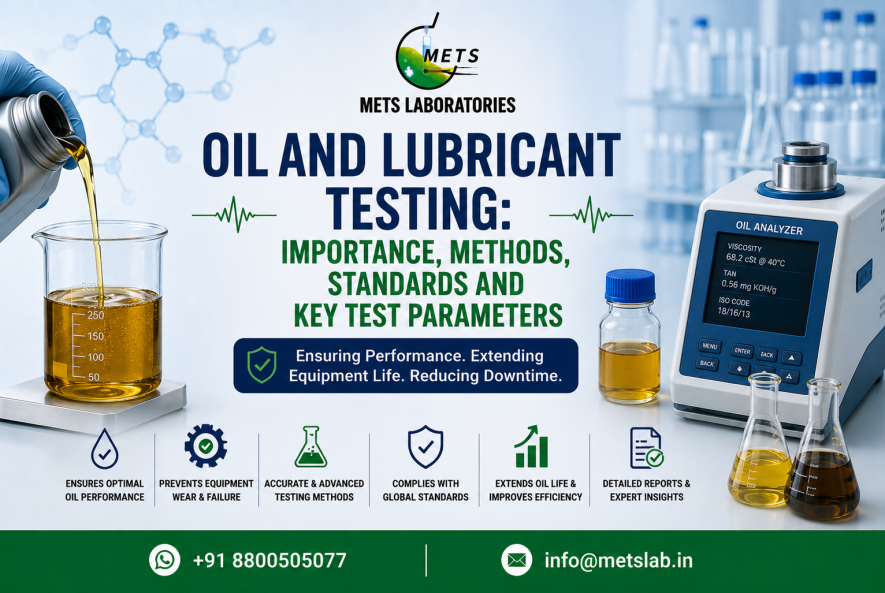
Introduction to Oil and Lubricant Testing
Oils and lubricants are essential for the efficient and reliable operation of automotive engines, gearboxes, hydraulic systems, turbines, compressors, industrial machinery, and other mechanical equipment. Conducting regular oil and lubricant testing is vital to assess fluid health, detect mechanical wear, prevent unexpected equipment breakdown, and ensure compliance with strict international quality standards.
They help reduce friction and wear, control operating temperatures, protect components from corrosion and support smooth equipment operation. However, lubricant quality can change due to formulation, storage, operating conditions, contamination and prolonged use.
Oil and lubricant testing helps manufacturers, suppliers and industrial users evaluate lubricant quality, verify product specifications, identify contamination and monitor changes in used oil.
At METS Laboratories, oil and lubricant testing can support quality control, product development, specification verification, contamination assessment and used-oil condition monitoring, depending on the product and applicable test requirements.
What Is Oil and Lubricant Testing?
Oil and lubricant testing involves laboratory analysis of the physical, chemical and performance characteristics of oils and lubricating products.
Testing can be performed on both new and used oils.
For new lubricants, testing can help verify whether the product meets the required specification.
For used lubricants, testing can provide information about:
- Lubricant degradation
- Contamination
- Additive condition
- Wear metals
- Changes in viscosity
- Water contamination
- Overall lubricant condition
The appropriate testing programme depends on the type of oil, intended application, manufacturer specification and applicable ASTM/ISO standard.

Types of Oils and Lubricants Tested
Oil and lubricant testing may be applicable to a wide range of products, including:
- Engine oils
- Gear oils
- Hydraulic oils
- Turbine oils
- Compressor oils
- Transformer oils
- Industrial lubricating oils
- Automotive lubricants
- Marine lubricants
- Base oils
- Used lubricating oils
- Greases, where applicable
Different lubricant types require different testing parameters because their performance requirements vary.
Why Is Oil and Lubricant Testing Important?
Laboratory testing helps businesses:Verify Product Quality.
- Support Product Development
- Monitor Used Oil Condition.
- Detect Contamination
- Identify Wear Trends
- Improve Equipment Reliability
- Reduce Unexpected Downtime
Major Oil and Lubricant Testing Parameters & Standards
1. Kinematic Viscosity
ASTM D445 – Kinematic Viscosity of Transparent and Opaque Liquids
Viscosity testing is commonly used for engine oils, gear oils, hydraulic oils and industrial lubricants.
2. Viscosity Index
The Viscosity Index (VI) indicates how significantly the viscosity of an oil changes with temperature.
It is an important characteristic for lubricants that operate across changing temperatures.
Common Standard
ASTM D2270 – Calculating Viscosity Index from Kinematic Viscosity at 40°C and 100°C
3. Flash Point
Flash point is an important physical and safety-related characteristic of petroleum-based products.
Common Methods
- ASTM D92 – Cleveland Open Cup
- ASTM D93 – Pensky-Martens Closed Cup
The appropriate method depends on the type and characteristics of the sample.
4. Pour Point
Pour point provides an indication of the low-temperature flow characteristics of an oil.
It is particularly important for lubricants used in cold environments.
Applications
- Engine oils
- Hydraulic oils
- Gear oils
- Industrial lubricants
Common Standard
ASTM D97 – Pour Point of Petroleum Products
5. Water Content
Water contamination can adversely affect lubricant and equipment performance.
Water may contribute to:
- Corrosion
- Oxidation
- Additive degradation
- Reduced lubrication
- Rust formation
- Equipment damage
Common Standard
ASTM D6304 – Determination of Water in Petroleum Products, Lubricating Oils, and Additives by Coulometric Karl Fischer Titration
The appropriate procedure depends on the expected water concentration and sample characteristics.
6. Total Acid Number (TAN)
Total Acid Number (TAN) indicates the acidic constituents present in an oil.
TAN is particularly useful for monitoring certain lubricants during service.
An increasing TAN may be associated with:
- Oxidation
- Lubricant degradation
- Acid formation
- Contamination
Common Standard
ASTM D664 – Acid Number of Petroleum Products by Potentiometric Titration
TAN results should be interpreted according to the lubricant type and applicable specification or historical trend.
7. Total Base Number (TBN)
Total Base Number (TBN) is particularly important for many engine oils.
It indicates the alkaline reserve available to neutralize acidic products generated during engine operation.
Monitoring TBN can help assess the condition and additive reserve of an engine oil.
Common Standard
ASTM D2896 – Base Number of Petroleum Products by Potentiometric Perchloric Acid Titration
8. Elemental and Wear Metal Analysis
Used lubricants can contain metals originating from equipment wear, lubricant additives or external contamination.
Commonly evaluated elements include:
Wear-Related Elements
- Iron
- Copper
- Chromium
- Aluminum
- Lead
- Tin
- Nickel
Additive-Related Elements
- Calcium
- Zinc
- Phosphorus
- Magnesium
- Boron
- Molybdenum
Common Standard
ASTM D5185 – Multielement Determination of Used and Unused Lubricating Oils and Base Oils by ICP-AES
Elemental analysis can be particularly valuable for used-oil condition monitoring.
9. Particle Contamination
Cleanliness is particularly important for hydraulic systems and precision machinery.
Particles in oil can contribute to:
- Abrasive wear
- Component damage
- Filter blockage
- Valve malfunction
- Reduced equipment life
Particle-counting and cleanliness testing can help evaluate the contamination level of suitable lubricants.
The applicable ISO or ASTM method should be selected according to the oil and equipment specification.
10. FTIR Analysis
Fourier Transform Infrared Spectroscopy (FTIR) is a useful analytical technique for lubricant characterization and condition monitoring.
Depending on the method, FTIR analysis can help assess changes associated with:
- Oxidation
- Nitration
- Sulphation
- Additive changes
- Certain forms of contamination
FTIR can provide rapid screening and trend information for used lubricants.
11. Density
Density is a useful physical property for lubricant characterization and quality control.
It can support:
- Product identification
- Batch comparison
- Formulation verification
- Detection of significant changes
The applicable method depends on the product and required measurement range.
12. Oxidation and Thermal Stability
Lubricant oxidation can result in:
- Increased viscosity
- Acid formation
- Sludge
- Deposits
- Varnish
- Additive depletion
Oxidation and thermal stability testing can be selected according to the specific lubricant type and intended application.
There is no single oxidation test applicable to every type of lubricant, so the appropriate standard should be selected according to the product specification.
Commercial Benefits of Oil and Lubricant Testing
Regular laboratory testing can help organizations:
- Maintain consistent lubricant quality
- Verify product specifications
- Detect contamination
- Monitor lubricant degradation
- Identify wear trends
- Support predictive maintenance
- Reduce unexpected equipment downtime
- Improve equipment reliability
- Support product development
- Make informed lubricant-management decisions


Conclusion: Enhancing Machinery Longevity
Oil and lubricant testing plays an important role in product quality control, specification verification, formulation development, and equipment condition monitoring. By routinely analyzing physical and chemical parameters, industries can reduce operational downtime, avoid costly component failures, and ensure peak performance across all mechanical systems.
To learn more about our accredited analytical capabilities, explore our petroleum and lubricant testing services or Contact METS Laboratories today to speak with an analytical fluid technician.
Key laboratory parameters such as kinematic viscosity, viscosity index, flash point, pour point, water content, TAN, TBN, elemental analysis, particle contamination and FTIR characteristics can provide valuable information about lubricant quality and condition.
For manufacturers, testing supports consistent product quality. For industrial users, used-oil analysis can support predictive maintenance and help identify potential contamination, degradation and wear trends.
Selecting the correct test method is essential. The applicable ASTM, ISO, customer or product-specific standard should be considered based on the lubricant type, intended application and target market.
METS Laboratories can support businesses with oil and lubricant testing requirements through appropriate laboratory analysis and testing services, subject to the applicable test method and laboratory scope.
Need Oil or Lubricant Testing?
Contact METS Laboratories with your product details and required parameters to discuss the appropriate testing programme, applicable standards and sample requirements.
Frequently Asked Questions (FAQs)
What is oil testing?
What is the most important test for lubricating oil?
What is used oil analysis?
Why is viscosity important?
What does TAN indicate?
What does TBN indicate?
Why is water contamination harmful?
What are wear metals?
Can oil testing detect equipment problems?
How often should used oil be tested?
Manufacturers and Exporters Recommend Us
Dedicated professionals committed to providing you with accurate and reliable testing services. Get METS Lab services today from the best lab experts & get the accurate reports from our laboratory.