

- Mets Admin
- May 22, 2026
- Uncategorized
- 0 Comments
Introduction – Why Phthalates Testing is Important
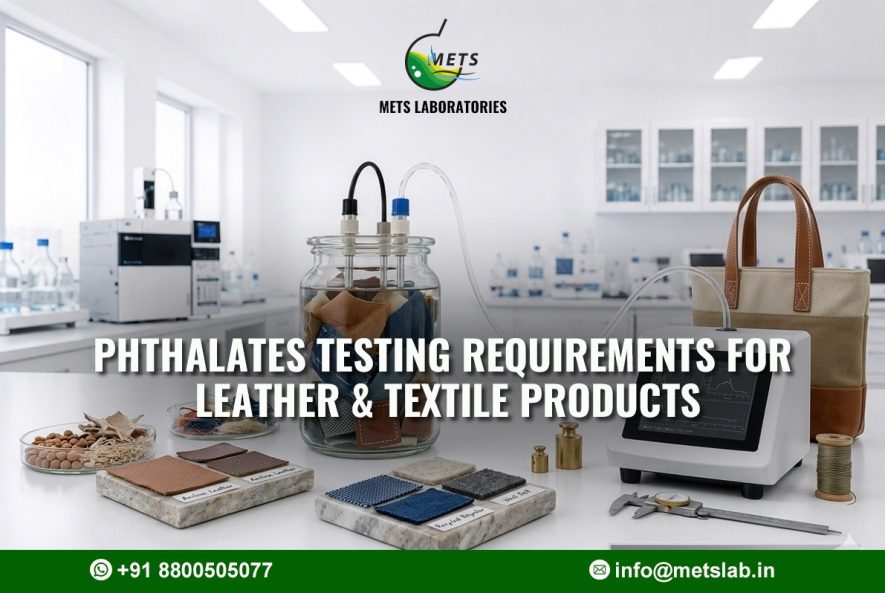
With the global leather and textile industry growing rapidly, phthalates testing has become a critical requirement for fashion manufacturing, retail expansion, and international trade. Today, manufacturers supply a wide range of products including garments, handbags, footwear, upholstery materials, synthetic leather, and fashion accessories that must meet strict chemical safety guidelines.
Many leather and textile products contain:
- PVC coatings
- Synthetic polymers
- Flexible plastics
- Artificial leather materials
- Rubber components
- Printed surfaces
These materials may contain phthalates, which are chemical plasticizers used to improve flexibility, softness, and durability.
However, excessive phthalate content may create health and environmental concerns, especially in products that come into direct skin contact.
Unsafe products may contain:
- Restricted phthalates
- Hazardous chemical additives
- Non-compliant plastic coatings
- Excessive plasticizer concentrations
Phthalates testing helps manufacturers, exporters, and importers ensure compliance with international chemical safety regulations.
What is Phthalates Testing?
Phthalates testing is a laboratory analysis used to determine the presence and concentration of restricted phthalate compounds in leather, textile, footwear testing, and polymer-based materials.
Phthalates are commonly used in:
- PVC materials
- Artificial leather
- Flexible plastics
- Rubber products
- Textile coatings
- Printing inks
- Synthetic fabrics
Testing helps evaluate whether products comply with international regulatory limits.
Phthalates testing is widely required for:
- Leather products
- Textile products
- Footwear
- Fashion accessories
- Consumer goods
- Children’s products
The testing supports chemical safety, export compliance, and product quality assurance.

Why Phthalates Testing is Important for Leather and Textile Manufacturers
Consumer Safety Protection
Leather and textile products often remain in prolonged contact with human skin.
Certain restricted phthalates may be associated with:
- Skin irritation
- Hormonal disruption
- Reproductive toxicity concerns
- Long-term health risks
Testing helps reduce exposure to hazardous substances.
International Regulatory Compliance
Global markets increasingly require strict chemical safety compliance for consumer products.
International buyers often require compliance with:
- REACH regulations
- CPSIA requirements
- European chemical safety directives
- Retail restricted substances lists (RSL)
Without proper testing:
- Export shipments may be rejected
- Buyer approvals may fail
- Customs clearance may be delayed
- Products may face recalls
Testing helps manufacturers meet international market requirements.
Brand Reputation and Buyer Confidence
Consumers and retailers are increasingly focused on product safety and sustainability.
Unsafe products may result in:
- Product recalls
- Buyer complaints
- Negative publicity
- Legal liabilities
- Loss of customer trust
Phthalates testing helps businesses improve product credibility and brand reputation.
Common Products Requiring Phthalates Testing
Leather Products
- Leather bags
- Wallets
- Belts
- Jackets
- Artificial leather products
- Footwear
- Gloves
- Upholstery leather
Textile Products
- Garments
- Children’s clothing
- Synthetic fabrics
- Printed textiles
- Upholstery fabrics
- Rainwear
- Curtains
- Industrial textiles
Fashion Accessories
- Handbags
- School bags
- Travel bags
- PVC-coated accessories
- Fashion belts
- Decorative plastic accessories
Products containing flexible polymers and synthetic coatings are especially important for evaluation.


Common Restricted Phthalates Tested
Several restricted phthalates are commonly evaluated during laboratory analysis.
These may include:
- DEHP (Di(2-ethylhexyl) phthalate)
- DBP (Dibutyl phthalate)
- BBP (Benzyl butyl phthalate)
- DINP (Diisononyl phthalate)
- DIDP (Diisodecyl phthalate)
- DNOP (Di-n-octyl phthalate)
These substances may be present in coated materials, synthetic leather, footwear components, and polymer accessories.
Standard Test Methods for Phthalates Testing
Several international standard methods are used for phthalates analysis in leather, textile, footwear, and consumer products.
Textile Testing Standards
ISO 14389:2022
Title: Textiles — Determination of phthalate content — Tetrahydrofuran method
This standard specifies a method for determining phthalate content in textile materials using tetrahydrofuran extraction techniques.
It is commonly used for:
- Textile fabrics
- Coated textiles
- Synthetic textile products
- Flexible polymer textiles
Footwear Testing Standards
ISO 16181-1:2021
Title: Footwear — Determination of phthalate with solvent extraction
This standard specifies solvent extraction procedures for determining phthalate content in footwear materials.
Commonly applied to:
- Shoe uppers
- Soles
- PVC footwear components
- Synthetic footwear materials
ISO 16181-2:2021
Title: Footwear — Determination of phthalate without solvent extraction
This method specifies analytical procedures for phthalates determination without solvent extraction.
It is suitable for:
- Footwear polymers
- Plastic shoe components
- Flexible synthetic materials
Leather Testing Standards
ISO 20137:2023
Title: Leather — Chemical tests — Guidelines for testing critical chemicals in leather
This standard provides guidelines for evaluating critical chemical substances, including phthalates, in leather materials and leather products.
It is commonly applied to:
- Leather garments
- Leather accessories
- Upholstery leather
- Footwear leather
Consumer Product Safety Methods
CPSC-CH-C1001-09.4
Title: Standard Operating Procedure for Determination of Phthalates
This method is widely used for determining regulated phthalates in consumer products and children’s products.
It is commonly referenced for:
- Consumer goods
- Toys
- Plastic accessories
- Flexible PVC materials
Toy and PVC Product Standards
GB/T 22048-2015
Title: Toys and children’s products — Determination of phthalate plasticizers in PVC
This Chinese standard specifies procedures for determining phthalate plasticizers in PVC materials used in toys and children’s products.
Applicable for:
- PVC products
- Flexible plastics
- Polymer-coated materials
ASTM Standard Methods
ASTM D8133-17
Title: Standard Test Method for Determination of Low-Level Phthalates in PVC
This ASTM method is used for low-level phthalate analysis in PVC materials and polymer products.
Common applications include:
- PVC coatings
- Synthetic leather
- Plastic accessories
- Flexible consumer products
Laboratory Techniques Used for Phthalates Analysis
Phthalates testing is commonly performed using advanced analytical instruments such as:
- GC-MS (Gas Chromatography Mass Spectrometry)
- GC-MS/MS
- Solvent extraction systems
These techniques help accurately identify and quantify restricted phthalate compounds in leather, textiles, coatings, and polymer materials.
Reliable analytical methods improve result accuracy and compliance confidence.
Why Businesses Need Accredited Laboratory Testing
Quality Council of India accredited laboratories provide reliable and technically competent testing services.
An accredited laboratory generally offers:
- Standardized testing procedures
- Qualified technical personnel
- Calibrated instruments
- Traceable analytical results
- Reliable documentation
- Controlled laboratory environments
Accredited reports improve confidence among:
- International buyers
- Retail chains
- Importers
- Regulatory authorities
- Fashion brands
Reliable laboratory support helps businesses maintain product quality and compliance.
Benefits of Phthalates Testing for Businesses
Phthalates testing provides several advantages for manufacturers and exporters.
Improved Product Safety
Testing helps identify hazardous chemical content before product release.
Better Export Opportunities
Compliant products are more easily accepted in international markets.
Reduced Recall Risks
Testing helps prevent costly recalls and shipment rejection.
Enhanced Customer Confidence
Consumers prefer products that demonstrate chemical safety compliance.
Stronger Supplier Quality Control
Testing helps monitor raw material quality and supplier performance.
Improved Regulatory Compliance
Laboratory testing supports compliance with international chemical safety standards.
Industries Benefiting from Phthalates Testing
Several industries benefit from phthalates testing services, including:
- Leather manufacturers
- Textile manufacturers
- Footwear companies
- Fashion brands
- Garment exporters
- Upholstery manufacturers
- Handbag manufacturers
- Retail brands
- E-commerce sellers
Chemical compliance testing has become increasingly important across consumer product industries.
Conclusion
Phthalates testing is an important chemical safety requirement for leather manufacturers, textile companies, footwear manufacturers, exporters, importers, and fashion product suppliers.
As global regulations become stricter and consumer awareness regarding chemical safety continues to grow, laboratory testing plays a major role in ensuring safe and compliant products.
Phthalates testing helps businesses:
- Improve consumer safety
- Meet international regulations
- Reduce product rejection risks
- Enhance export opportunities
- Build customer trust
- Strengthen brand reputation
Reliable laboratory testing supports both regulatory compliance and long-term business growth in the global leather and textile industry.
Frequently Asked Questions
What are phthalates?
Why is phthalates testing important for leather and textile products?
Which products commonly require phthalates testing?
Which phthalates are commonly tested?
Which instruments are used for phthalates testing?
Why choose an accredited laboratory?
Can phthalates testing help reduce export rejection risks?
Is phthalates testing important for exports?
Manufacturers and Exporters Recommend Us
Dedicated professionals committed to providing you with accurate and reliable testing services. Get METS Lab services today from the best lab experts & get the accurate reports from our laboratory.