Toys are directly used by children, making safety a critical requirement. Poorly designed toys may contain hazards such as choking risks, sharp edges, toxic materials, or small detachable parts. Because of these vulnerabilities, formal toys safety testing has become a mandatory legal requirement across global markets before retail distribution. Rigorous laboratory analysis ensures consumer goods completely mitigate mechanical risks and toxic chemical exposures.
Toys must comply with international safety standards to ensure they are safe for children of different age groups.
What is Certified Toys Safety Testing?
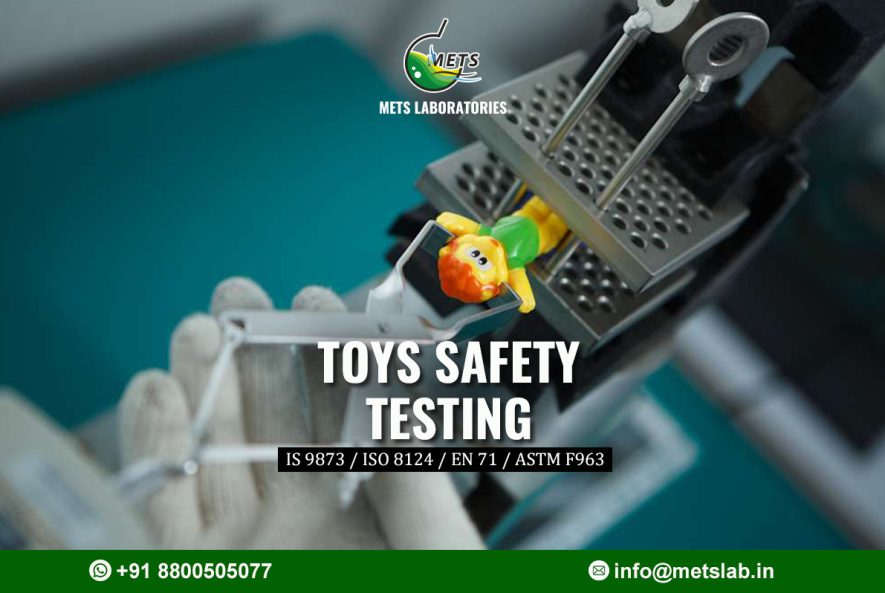
Toys safety testing is a series of physical, mechanical, and chemical evaluations performed to ensure that toys do not pose any risk during normal and foreseeable use.
It mainly focuses on: • Mechanical safety • Physical hazards • Chemical safety (restricted substances) • Age-appropriate design safety
Why is Toys Safety Testing Important for Manufacturers?
Key Reasons:
Prevent choking and injury hazards
Ensure compliance with global toy regulations
Protect children from toxic exposure
Enable international market access
Risks of Non-Compliance:
Product recalls
Import rejection (EU/USA markets)
Legal penalties
Loss of brand reputation
Applicable Standards & Regulations for Toys Safety Testing
IS 9873 (Part 1): 2019 – Indian Standard for Toy Safety (Mechanical & Physical Properties)
ISO 8124-1:2022 – International Toy Safety Standard
EN 71-1 – European Toy Safety Standard (Mechanical & Physical properties)
ASTM F963 – US Toy Safety Standard
Key Test Categories Covered in Toys Safety Testing
Small Parts Test (Cl. 5.2 – IS 9873 / ISO 8124-1 / EN 71-1 / ASTM F963)
This test determines whether detachable parts of a toy can cause choking hazards.
Uses small parts cylinder test
Checks detachable components after drop, torque, tension tests
Applicable for toys for children under 3 years
2. Expanding Materials Test
Evaluates toys that expand when exposed to water or moisture.
Measures expansion rate
Ensures no blockage hazard if swallowed
Prevents internal injury risk
3. Projectile Toys with Stored Energy
Assesses toys that launch objects (e.g., darts, arrows).
Measures kinetic energy of projectile
Checks impact force
Ensures safe distance and controlled release
4. Mouth-Actuated Toys
Applies to whistles, flutes, and blow toys.
Ensures hygiene and airflow safety
Prevents ingestion hazards
Checks detachable parts stability
5. Magnetic Toys Test
Evaluates toys containing magnets.
Measures magnetic strength
Ensures magnets cannot detach easily
Prevents ingestion of multiple magnets (serious internal injury risk)
Additional Mechanical Safety Tests for Toys Safety Testing
Use of standardized gauges (small parts cylinder, force gauges)
Measurement of physical properties
Classification based on age grading
Who Needs Professional Toys Safety Testing Services?
Toy manufacturers
Importers & exporters
Retail toy brands
E-commerce sellers
Compliance & certification bodies
Conclusion
Toys safety testing under IS 9873, ISO 8124, EN 71, and ASTM F963 ensures that toys are safe, durable, and free from hazards like choking, injury, or toxic exposure. Proper testing is essential for legal compliance and global market acceptance. To fully eliminate manufacturing risks and certify your product lines against phthalates and restricted heavy metals, partner with our accredited hazardous and restricted chemicals testing laboratory for seamless product validation.
Frequently Asked Questions(FAQs)
Which standard is most widely accepted?
ISO 8124 and EN 71 are globally accepted, while ASTM F963 is required in the USA.
What is the biggest risk in toy safety?
Choking hazard from small parts is the most critical risk.
Is toy testing mandatory?
Yes, for most export markets and BIS certification in India.
Manufacturers and Exporters Recommend Us
Dedicated professionals committed to providing you with accurate and reliable testing services. Get METS Lab services today from the best lab experts & get the accurate reports from our laboratory.