

- Mets Admin
- May 8, 2026
- Testing Insights
- 0 Comments
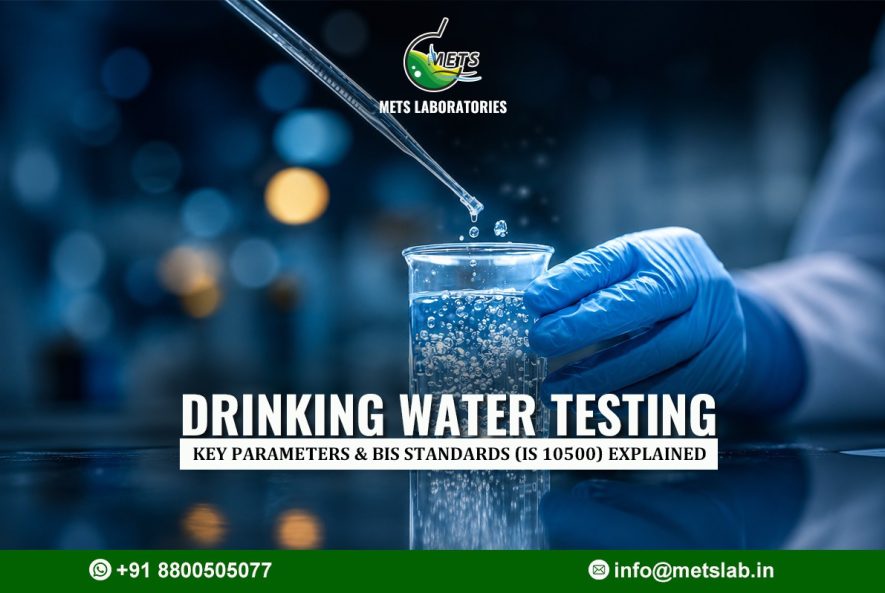
Introduction – Why Drinking Water Testing Matters
Access to clean and safe drinking water is fundamental for public health and well-being. Water can contain various contaminants, including heavy metals, chemical pollutants, and microorganisms, that are not visible to the naked eye but can cause severe health issues over time. According to the World Health Organization (WHO), a significant percentage of global diseases are directly or indirectly related to the contamination of water.
Water quality testing is essential to ensure that water from any source—whether municipal supply, borewell, or packaged bottle—is safe for consumption. For businesses, including water suppliers, packaged drinking water manufacturers, and food processing industries, regular testing is a legal requirement to meet Indian regulations, obtain necessary certifications, and maintain consumer trust.
Regulatory authorities such as the Bureau of Indian Standards (BIS), the central authority for setting quality standards in India, closely monitor water quality to ensure public safety.
What is Drinking Water Testing?
Water quality testing is a series of laboratory analyses performed on a water sample to determine its physical, chemical, and microbiological properties. The objective is to verify that the water meets the permissible limits for various parameters, ensuring it is potable (safe to drink). This testing applies to:
• Municipal/Tap Water: To check the effectiveness of public treatment systems.
• Packaged Drinking Water & Mineral Water: For product certification and compliance with BIS standards.
• Borewell/Well Water: For industries, housing societies, and individual households using groundwater.
• Water for Industrial Use: For food processing, pharmaceutical, and beverage industries where water quality directly impacts product safety.

Why is Drinking Water Testing Mandatory or Recommended?
Water quality testing is mandatory across India to protect public health and enforce legal standards.
Key reasons include:
- Consumer Safety: To control toxic exposure from heavy metals like lead and arsenic, and to prevent waterborne diseases from microbial contamination.
- Regulatory Compliance: To conform to the BIS IS 10500 standards, which is the benchmark for drinking water quality in India.
- Certification: To obtain an ISI mark or other mandatory certifications for packaged water products.
- Quality Assurance: For industries to ensure the consistency and safety of their products.
Applicable Standards, Guidelines & Regulations
- India (Primary): BIS IS 10500 (Drinking Water Specification). This is the legal standard enforced by state pollution control boards and other authorities.
- India (Packaged Water): BIS IS 13428 (Packaged Natural Mineral Water) and BIS IS 14543 (Packaged Drinking Water).
- International Reference: Guidelines for Drinking-water Quality published by the World Health Organization (WHO). BIS standards are often aligned with WHO guideline.


Key Test Parameters
BIS IS 10500 outlines a comprehensive list of parameters. These are grouped into three main categories: Organoleptic & Physical, General Chemical, and Toxic Substances. The table below shows the key parameters as per IS 10500 (based on the 2012 revision and other official summaries).
|
Parameter |
BIS Desirable Limit (mg/L) |
|
Physical |
|
|
pH Value |
6.5-8.5 |
|
Turbidity (NTU) |
5 |
|
TDS (Total Dissolved Solids) |
500 |
|
Color (Hazen units) |
5 |
|
Chemical |
|
|
Total Hardness (as CaCO₃) |
300 |
|
Chloride (as Cl) |
250 |
|
Sulphate (as SO₄) |
250 |
|
Iron (as Fe) |
0.3 |
|
Nitrate (as NO₃) |
45 |
|
Fluoride (as F) |
1.0-1.5 |
|
Calcium |
200 |
|
Magnesium |
200 |
|
Heavy metals |
|
|
Lead |
0.01 |
|
Arsenic |
0.01 |
|
Mercury |
0.001 |
|
Cadmium |
0.003 |
|
Chromium |
0.05 |
Who Needs This Testing?
Water quality testing is required by a wide range of entities:
- Packaged Drinking Water Brands: For BIS certification and product launch.
- Municipal Corporations: To monitor the quality of supplied tap water.
- Food & Beverage Industries: As part of their raw material quality control for production. Housing Societies & Commercial Buildings: To ensure the safety of their borewell or tanker water supply.
- Pharmaceutical Companies: For USP Purified Water or Water for Injection (WFI) compliance.
Common Challenges Faced by Manufacturers
- Contaminated Source: Raw water source being contaminated with heavy metals or agricultural runoff (nitrates).
- Treatment Inefficiency: Inadequate filtration or disinfection (e.g., Reverse Osmosis, UV) leading to non-compliant final water.
- Packaging Contamination: Leaching of contaminants (e.g., antimony from PET bottles) into the water from improper packaging materials.
- Regulatory Changes: Keeping up with revised, stricter limits (e.g., the reduction of lead limit from 0.05 to 0.01 mg/L).
How to Choose the Right Testing Laboratory
When selecting a water testing laboratory, consider the following:
- NABL Accreditation (ISO/IEC 17025):Essential for the lab’s technical competence and for test reports to be legally valid.
- Scope of Testing: The lab must be capable of testing all parameters under BIS IS 10500, including trace metals and microbiology.
- BIS Recognized: Some certifications require testing from a BIS-recognized laboratory.
How Our Laboratory Can Support This Testing
Our laboratory provides comprehensive water quality testing services to ensure compliance with BIS IS 10500 and other international standards. Our services include:
- Complete Parameter Analysis:From physical properties to trace heavy metals (using ICP-MS) and microbiology.
- Support for BIS Certification:We can provide test reports required for obtaining the ISI mark for packaged drinking water.
- Source & Treated Water Testing:For borewells, municipal supply, and after-treatment (RO, UV) systems.
- Regulatory Guidance: Technical support to help you interpret results and optimize your treatment process.
Conclusion
Testing drinking water against the BIS IS 10500 standard is not just a regulatory formality but a critical public health measure. It ensures that water is free from harmful levels of toxic substances like lead and arsenic, and pathogenic bacteria. For businesses, strict compliance with these standards through regular, NABL-accredited lab testing is fundamental to obtaining licenses, building consumer trust, and ensuring market access. By understanding the key parameters and their permissible limits, manufacturers and water suppliers can proactively manage water quality, mitigate health risks, and achieve full regulatory compliance.
Frequently Asked Questions
Is BIS IS 10500 mandatory for all water in India?
What is the maximum permissible limit for Arsenic (As) in drinking water as per BIS?
How long does water quality testing take?
What is the difference between BIS IS 10500 and BIS IS 14543?
Is a NABL accreditation necessary for a test report?
Manufacturers and Exporters Recommend Us
Dedicated professionals committed to providing you with accurate and reliable testing services. Get METS Lab services today from the best lab experts & get the accurate reports from our laboratory.