

Textile and Textile Products Testing – METS Laboratories
Textile testing starts with textile fibers and goes all the way through to the final product. The fiber test includes the length, strength, elongation, fineness, and maturity. The yarn test includes linear density, single yarn strength, yarn evenness, and yarn hairiness. The fabric test includes aerial density, weave type, and air permeability.
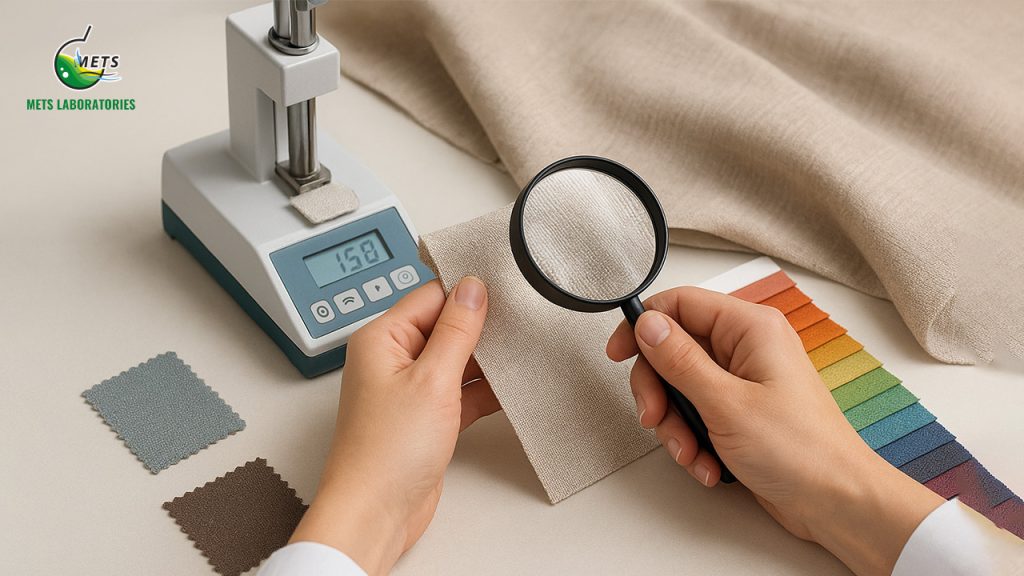
Textile Testing is one of the most important steps of fabric construction as it helps identify the quality of the textile as well as what it is best used for. Testing of textiles refers to numerous procedures for assessing myriad fiber, yarn and fabric characteristics such as fiber strength and fineness, yarn count and twist and fabric weight, thickness, strength, abrasion resistance, color fastness, wrinkle resistance and stiffness. It is the application of engineering knowledge and science to the measurement of the properties and characteristics of, and the conditions affecting, textile materials. It involves the use of techniques, tools, instruments and machines in the laboratory for the evaluation of the properties of the textiles. Textile testing has become more important in recent years as a result of the new demands placed upon the products of textile manufacturers.
Importance of Textile Testing
Testing is important, mainly for customer satisfaction of the textile product as well as to ensure product quality for the market in which the textile manufacturer competes. Testing is also important in order to control the manufacturing process and cost. In the textile industry, it is very important to use testing to control the manufacturing process for cost and other reasons. The importance of testing cannot be disregarded for product satisfaction and control of manufacturing cost….
Purpose of Textile Testing
- For development & research purpose; the test results and observations help decide the route of production to be followed.
- Selecting the appropriate raw material to maintain or enhance the quality of a textile material.
- Regulating and supervising various processes such as spinning, weaving, dyeing, etc.
- Quality & performance enhancement.
- Investigate the faulty material.
Types of Textile Testing
We test agro-textiles based on the following parameters and product categories:
Identification of fibre length, elongation and strength, etc.
Fibre test is an important first step when developing the base for your textile product. Laboratory methods are available to identify the structural, physical and chemical properties of a fiber, including microscopic, burn and solubility tests.
Thermal properties, air permeability, thickness, shrinkage, stiffness, elongation, width, crease resistance, number of ends and picks per unit length, weight of fabric per unit length Fibre test.
GPT stands for "Garment Package Test" and FPT stands for "Fabric Package Test" in garment and textile testing. Each buyer provides guidance for which tests are required at the fabric and subsequent garment stages.
The testing of fabrics offers a comprehensive review of the various tests that can be performed on fabrics. Fabric testing includes measurements such as fabric weight, fabric width, shrinkage testing, colour fastness to washing, fastness to light, pilling, tearing and bursting strength, etc.
Moisture Management Test
The moisture wicking or moisture management test is for testing moisture management properties such as wicking capabilities and drying efficiencies.
- AATCC test method 195
- ISO 13029:2012
Yarn count, strength, appearance, twist per unit length, etc.
Homesoft Testing
Home furnishing testing in textiles involves evaluating the performance and safety of textile products used in homes, such as upholstery, curtains, bedding, and carpets. Tests assess properties like flammability, colorfastness, durability, and the presence of harmful substances to ensure products meet safety standards and consumer expectations.
What METS Laboratories Offers?
- QAI accredited, METS LABORTORIES INDIA PVT.LTD can test to a variety of the established methods (e.g. ISO,SASO,GSO,GB/T,ASTMD,AATCC ) and standards set by specific organisations
- Our lab tests a wide range of products, materials and components to assess and affirm standards and specifications, or for regulatory compliance. Our team are happy to offer advice and guidance to ensure the right textile testing is undertaken.
- Our dedicated, experienced, and friendly team are here to help – with expert knowledge and guidance, and top-of-the-line fabric, product, material and textile testing capabilities and technologies within our laboratories
- Product evaluation for appearance, quality and performance. Technical support network to answer questions, interpret results, and help manage your quality assurance program
- Participating in inter- laboratory proficiency testing &/or inter-laboratory comparisons.
- Maintaining customer confidentiality by considering it proprietary information
- ISO/IEC 17025:2017 accredited testing protocols
- Testing as per ISO, ASTM, BIS, and customized specifications
- Quick turnaround time and accurate reporting
- Expert consultation on product development and failure analysis
- Support in meeting domestic and export compliance standards
- Comparative testing and benchmarking
What We Ensure?
Who It’s For?
Our textile testing services are tailored for:
Protect Consumers. Satisfy Authorities. Boost Market Confidence.
By testing agro-textiles with METS Laboratories:
- You safeguard agricultural productivity and sustainability.
- You meet mandatory quality and performance benchmarks.
- You improve product confidence among buyers, farmers, and stakeholders.
- You get scientific validation that supports your brand’s credibility and market access.
Frequently Asked Questions
What standards do you test agro-textiles to?
We test as per ISO, ASTM, BIS, etc. and customized client specifications, including requirements for international markets.
Can you test for UV degradation and weather resistance?
Yes, we offer accelerated aging and UV resistance testing simulating real-world environmental conditions.
What is the lead time for agro-textile testing?
Typically 5–7 working days, depending on the scope of testing.
Do you provide consultation or support for R&D?
Absolutely. Our team supports prototype evaluation, benchmarking, and failure investigation.
Is sample size important for testing?
Yes. Each test method requires a specific sample size; we provide a sample submission guide upon request.
-
Garments & Apparels Testing
-
Geo-Textiles Testing
-
Grey Fabrics Testing
-
Agro-Textiles Testing
-
Automotive Textiles Testing
-
Carpet & Rugs Testing
-
Diaper Testing
-
Fibre & Filaments Testing
-
Finished Fabric Testing
-
Industrial Textiles Testing
-
Medical Textile Testing
-
Packaging Textiles Testing
-
Protective Textiles Testing
-
Sports Textiles Testing
-
Terry Fabrics & Its Products Testing
-
Textile Rubber Composite Testing
-
Textiles & Fabrics Testing
-
Yarns & Cords Testing