

- Mets Admin
- July 28, 2026
- Testing Insights
- 0 Comments
Introduction to Sugar Testing in Food Products
Sugar is one of the most widely used ingredients in the food and beverage industry. It plays a vital role in enhancing taste, improving texture, supporting preservation, and maintaining the overall quality of products. From soft drinks, fruit juices, confectionery, chocolates, bakery products, dairy products, jams, sauces, and breakfast cereals to traditional Indian sweets and processed foods, conducting accurate sugar testing in food products is essential to ensure regulatory compliance, precise nutritional labeling, and consistent product taste.
As consumers become increasingly health-conscious and regulatory requirements continue to evolve, manufacturers are expected to provide accurate nutritional information while ensuring product quality and safety. Today, sugar testing is no longer limited to quality control—it has become an essential part of product development, nutritional labeling, regulatory compliance, export certification, and brand protection.
At METS Laboratories, we provide comprehensive sugar testing services using advanced analytical technologies and internationally accepted methods to help food manufacturers, importers, exporters, retailers, and brand owners deliver safe, compliant, and high-quality products to the market.
Industry Update and Regulatory Background
The global food industry is witnessing a significant shift towards healthier eating habits and greater transparency in food labeling. Rising concerns about obesity, diabetes, and other lifestyle-related diseases have encouraged governments and regulatory authorities to introduce initiatives aimed at reducing sugar consumption and improving consumer awareness.
Several countries have implemented stricter nutrition labeling requirements, sugar reduction strategies, and, in some cases, sugar-content-based taxation for specific food and beverage categories. These developments have increased the importance of accurate sugar analysis and reliable laboratory testing.
In India, while there is currently no sugar-based excise tax, food manufacturers are required to comply with the Food Safety and Standards Authority of India (FSSAI) regulations governing food safety, product standards, and nutritional labeling. Businesses exporting food products must also comply with the regulatory requirements of importing countries, many of which require analytical reports to verify product composition and label declarations.
As regulatory expectations continue to evolve, laboratory sugar testing has become an essential tool for demonstrating compliance, supporting product claims, maintaining product consistency, and building consumer confidence.

Why Sugar Testing in Food Products Matters Today
Sugar testing plays a critical role throughout the food manufacturing process—from raw material evaluation and product development to routine quality control and market compliance.
Accurate sugar analysis helps manufacturers to:
- Verify nutritional information declared on product labels.
- Comply with FSSAI regulations and international food standards.
- Ensure batch-to-batch consistency in product quality.
- Support the development of reduced-sugar and sugar-free products.
- Detect formulation errors or product adulteration.
- Validate supplier quality.
- Meet retailer and export market requirements.
- Strengthen consumer trust through accurate labeling.
Sugar testing is applicable across a wide range of food products, including beverages, confectionery, bakery products, dairy products, chocolates, jams, sauces, syrups, breakfast cereals, traditional Indian sweets (mithai), nutritional supplements, and processed foods. The scope of testing varies depending on the product type, intended market, and applicable regulatory requirements.
Applicable Regulations and FSSAI Standards
Sugar testing supports compliance with several Indian and international food safety regulations and quality standards.
Indian Regulations
- Food Safety and Standards Act, 2006
- Food Safety and Standards (Food Products Standards and Food Additives) Regulations, 2011
- Food Safety and Standards (Labelling and Display) Regulations, 2020
- Legal Metrology (Packaged Commodities) Rules, 2011
- FSSAI licensing and compliance requirements
International Standards
- Codex Alimentarius Guidelines
- ISO/IEC 17025:2017 – General Requirements for the Competence of Testing and Calibration Laboratories
- AOAC Official Methods of Analysis
- ISO analytical methods (where applicable)
- Importing country and customer-specific quality requirements
Accurate laboratory reports help manufacturers support regulatory inspections, nutritional labeling, product approvals, export certification, and customer quality audits.


Key Parameters Evaluated During Sugar Testing
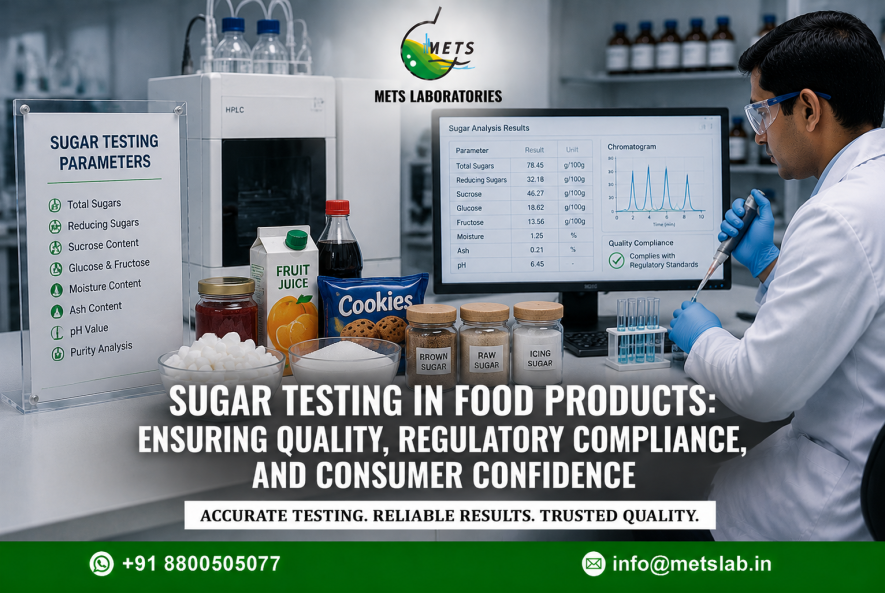
The scope of sugar testing depends on the product type, formulation, and applicable regulatory requirements. Laboratory analysis typically includes the determination of total sugars, added sugars, sucrose, glucose, fructose, reducing sugars, total carbohydrates, moisture, pH, and °Brix (total soluble solids). Depending on the product and customer requirements, testing may also include artificial sweeteners, preservatives, heavy metals, microbiological parameters, and nutritional composition.
These analyses help manufacturers verify product quality, support accurate nutritional labeling, ensure compliance with regulatory requirements, and maintain consistency across production batches.
Analytical Methods Used for Quantitative Analysis
At METS Laboratories, sugar testing is performed using internationally recognized analytical techniques, including:
- High-Performance Liquid Chromatography (HPLC)
- UV-Visible Spectrophotometry
- Polarimetry
- Refractometry (°Brix Measurement)
- Gas Chromatography (GC), where applicable
- ICP-OES for elemental analysis
- AOAC and ISO validated analytical methods
The analytical method is selected based on the product type, testing objective, and applicable regulatory or customer requirements, ensuring reliable and reproducible results.
Business Risks of Inadequate Sugar Testing
Failure to perform appropriate sugar testing can expose food manufacturers to significant regulatory, commercial, and reputational risks.
Common risks include:
- Incorrect nutritional labeling and misleading product claims
- Non-compliance with FSSAI regulations and customer specifications
- Product recalls and regulatory actions
- Export shipment delays or rejection
- Customer complaints arising from inconsistent product quality
- Loss of retailer and consumer confidence
- Increased production costs due to rejected batches
- Damage to brand reputation
- Financial losses and legal liabilities
Routine laboratory testing enables manufacturers to identify potential issues at an early stage, reducing business risks and supporting continuous quality improvement.
Why Choose METS Laboratories for Food Analysis?
METS Laboratories offers comprehensive sugar testing solutions to support manufacturers throughout the product lifecycle—from research and development to routine quality control and regulatory compliance.
Our capabilities include:
- Sugar Profile Analysis
- Nutritional Label Verification
- Chemical Testing
- Artificial Sweetener Analysis
- Heavy Metal Testing
- Food Safety Testing
- Microbiological Analysis
- Export Compliance Testing
- Product Quality Assessment
- Regulatory Compliance Support
Our experienced technical professionals use advanced analytical instrumentation and internationally accepted testing methods to deliver accurate, reliable, and timely results. We work closely with food manufacturers, importers, exporters, retailers, and brand owners to help ensure their products meet applicable regulatory and customer requirements.
Conclusion: Securing Compliance Through Testing
As food regulations evolve and consumers demand greater transparency regarding nutritional information, accurate sugar testing in food products has become a critical component of food quality assurance. Reliable laboratory analysis enables manufacturers to verify product composition, support nutritional labeling, comply with regulatory requirements, and maintain consistent product quality across a diverse range of food and beverage products.
To ensure your food products comply with strict international standards, heavy metal limits, and purity requirements, explore our comprehensive Halal, Porcine, and GMO-Free Assurance testing services or contact METS Laboratories today for expert analytical support.
Whether you are manufacturing beverages, confectionery, dairy products, bakery items, traditional sweets, processed foods, or nutritional products, scientifically validated sugar analysis helps strengthen consumer confidence and supports successful market access.
METS Laboratories is committed to providing accurate, reliable, and timely sugar testing services using advanced analytical technologies and internationally accepted methods. Partner with METS Laboratories to ensure your products meet the highest standards of quality, safety, and regulatory compliance.
Frequently Asked Questions (FAQs)
Why is sugar testing important for food products?
Which food products require sugar testing?
Which regulations support sugar testing in India?
Which analytical methods are commonly used for sugar analysis?
Why choose METS Laboratories for sugar testing?
Manufacturers and Exporters Recommend Us
Dedicated professionals committed to providing you with accurate and reliable testing services. Get METS Lab services today from the best lab experts & get the accurate reports from our laboratory.