

- Mets Admin
- October 6, 2026
- Testing Insights
- 0 Comments
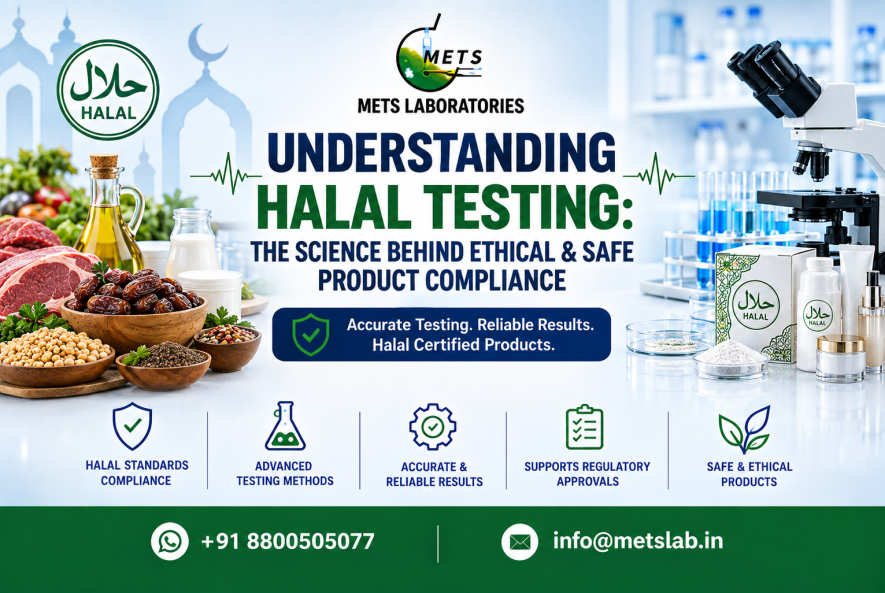
Introduction
In today’s global marketplace, demand for authentic, ethically sourced, and compliant Halal products is rising due to stricter regulatory standards, consumer safety expectations, and international accreditation requirements. To meet these rigorous expectations, advanced physical, biological, and chemical testing—particularly molecular DNA screening, alcohol quantification, and compositional analysis—has become essential. These techniques provide precise, reliable data on product authenticity, cross-contamination risks, and raw material purity, safeguarding brand integrity from raw ingredients to completed products.
Certifying products as Halal compliant extends beyond regulatory obligation; it builds consumer trust and protects brand reputation. By analyzing chemical composition, biological origin, and production hygiene, testing laboratories can verify raw materials and finished goods with certainty, preventing inadvertent non-compliance or supply chain adulteration. This assurance is vital for businesses operating across competitive global markets, where non-compliant ingredients can disqualify a product line. Ultimately, robust testing empowers manufacturers and exporters to operate confidently while upholding their commitment to consumer safety, transparency, and ethical integrity.
Why Is Halal Testing Important?
Rigorous testing for Halal compliance—including porcine DNA identification, residual alcohol measurement, animal-origin lipid verification, and pathogen screening—is essential. It acts as the final safeguard against complex global supply chains, ingredient mislabeling, or accidental cross-contamination. For instance, studies show that processed additives, gelatin capsules, and flavor carriers often carry trace non-permissible ingredients without explicit declaration on raw material spec sheets. Testing provides scientific proof for certification, ensuring products adhere to regional and international Halal standards.
This helps brands earn market access, prevent costly product recalls, and fulfill stringent compliance requirements. For quality assurance directors and regulatory managers, testing is a vital risk management tool that mitigates financial, legal, and brand liabilities. Ultimately, it serves as a “trust but verify” system, ensuring that supplier claims regarding ingredient purity and Halal status are completely accurate and defensible.

Key Parameters Evaluated During Testing
To overcome supply chain opacity, specialized laboratories employ a multi-faceted approach using a suite of advanced analytical techniques. These methods assess several key parameters to ensure comprehensive quality assurance:
- Porcine DNA Screening (PCR / qPCR): Detects trace levels of pork-derived DNA in raw meats, processed foods, gelatins, and cosmetics.
- Ethanol Content Analysis (Headspace GC-FID): Quantifies exact alcohol concentration to ensure compliance with threshold limits in foods, beverages, and personal care products.
- Animal Fat & Lard Authentication (FTIR / Mass Spectrometry): Differentiates permissible plant or animal fats from prohibited lard or non-Halal animal derivatives.
- Gelatin Origin Verification: Identifies whether gelatin used in capsules, confectionery, or dairy stems from Halal-certified bovine, porcine, or marine sources.
- Microbiological Safety & Purity Checks: Assesses pathogens, heavy metals, and adulterants to ensure products meet both Halal (permissible) and Tayyib (wholesome/safe) criteria.
- Synthetic Additive & Enzyme Profiling: Evaluates processing aids, emulsifiers, and enzymes to confirm they are derived from permissible non-animal or Halal-certified sources.
Types of Materials Commonly Tested
A wide array of consumer products and industrial raw materials undergo rigorous analytical testing to guarantee Halal compliance throughout the supply chain:
- Processed Foods & Beverages: Meats, poultry, dairy products, confectionery, baked goods, sauces, and flavor emulsions.
- Cosmetics & Personal Care: Lipsticks, creams, lotions, hair care products, and soaps containing emulsifiers, glycerin, or collagen.
- Pharmaceuticals & Nutraceuticals: Soft/hard gelatin capsules, active pharmaceutical ingredients (APIs), syrups, and dietary supplements.
- Food Additives & Processing Aids: Enzymes, stabilizers, emulsifiers (e.g., E471), colorants, and fragrance carriers.
Risks of Using Untested Ingredients
Using materials that have not undergone UL 94 flammability testing exposes manufacturers to serious and often irreversible consequences. The most critical risk is fire hazard, which can lead to property damage, injury, or even loss of life. Products that fail to meet regulatory requirements may be blocked from entering key markets, resulting in lost revenue and missed opportunities.
If untested materials reach consumers, the consequences escalate quickly. Product recalls generate substantial financial losses, including logistics, replacement, and legal costs. Companies may also face lawsuits and liability claims if their products cause harm. Certification bodies can reject products outright, forcing costly redesigns and delaying market launch. Over time, these failures damage brand reputation and erode customer trust, making recovery difficult.
Ultimately, skipping UL 94 testing may appear to save time and money upfront, but the long-term risks far outweigh any short-term savings.
Relevant Standards & Compliance Considerations
Testing laboratories must adhere to strict international quality and technical competence frameworks to ensure test results are globally accepted and legally defensible:
- ISO/IEC 17025:2017: The overarching standard for testing laboratory competence, ensuring robust quality management, calibration, and reproducible analytical data.
- GSO / UAE.S Standards (e.g., GSO 2055-1, GSO 993): Regional standards governing Halal food requirements, slaughtering practices, and analytical testing criteria.
- JAKIM & MUI Standards: Widely recognized South East Asian regulatory guidelines specifying strict testing parameters for Halal integrity.
- Validated Analytical Test Methods: Standardized methods such as real-time PCR for species identification and Gas Chromatography-Flame Ionization Detection (GC-FID) for precise ethanol quantification.
How METS Laboratories Supports Halal Compliance
METS Laboratories is a trusted analytical partner for food manufacturers, cosmetic brands, and pharmaceutical companies seeking total product compliance. As an ISO/IEC 17025:2017 accredited laboratory, METS Laboratories provides state-of-the-art testing for porcine DNA detection, alcohol quantification, fatty acid profiling, and ingredient authentication.
Equipped with advanced instrumentation—including real-time PCR systems, Gas Chromatography, and Mass Spectrometry—METS Laboratories delivers accurate, reproducible, and rapid test results. These analytical services empower businesses to reduce supply chain risks, satisfy regulatory requirements, and obtain verifiable scientific evidence for Halal certification. By verifying product purity and integrity, METS Laboratories helps organizations protect public trust, maintain brand reputation, and successfully access regional and global markets with complete confidence.


Conclusion
In today’s demanding regulatory and commercial environment, scientific testing for Halal integrity, safety, and purity is essential. Modern analytical methods like qPCR, Gas Chromatography, and Mass Spectrometry provide the precision needed to protect consumer trust, satisfy international regulations, and preserve brand equity. For food, cosmetic, and pharmaceutical companies, proactive testing is an indispensable investment in transparency, compliance, and long-term market growth.
METS Laboratories supports manufacturing and trading firms worldwide with accredited, expert analytical testing services. They empower businesses to confidently verify their products as compliant, safe, and authentic. By choosing METS Laboratories, organizations secure their supply chains, meet international quality standards, and access expanding Halal markets with total confidence.
Frequently Asked Questions (FAQs)
What is the primary difference between PCR testing and chemical analysis for Halal compliance?
How do laboratories detect trace porcine contamination in heat-processed foods or gelatins?
Is ethanol strictly prohibited in all Halal food and beverage formulations?
Why must cosmetics and personal care products undergo Halal testing?
How often should manufacturers send production batches for Halal testing?
Manufacturers and Exporters Recommend Us
Dedicated professionals committed to providing you with accurate and reliable testing services. Get METS Lab services today from the best lab experts & get the accurate reports from our laboratory.