


- Mets Admin
- November 16, 2026
- Testing Insights
- 0 Comments
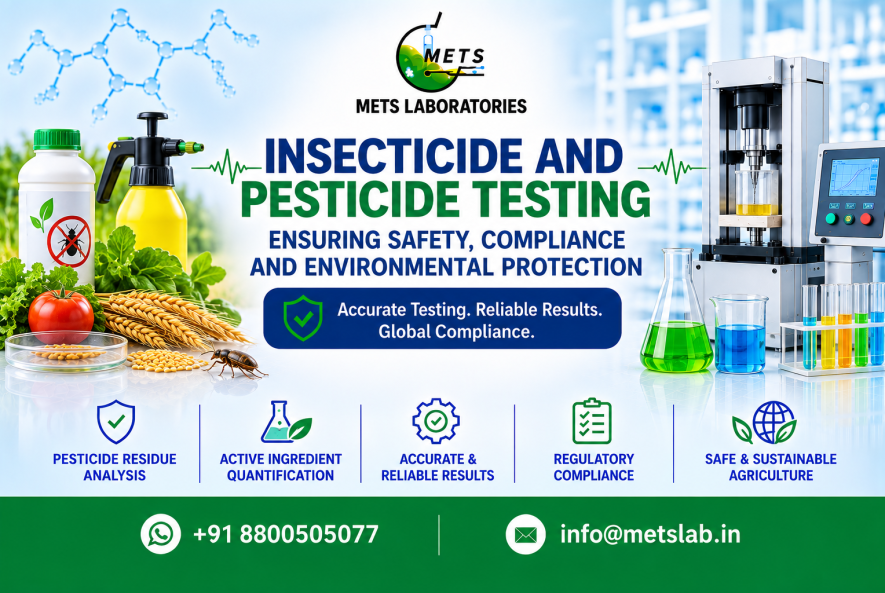
Accredited insecticide and pesticide testing evaluates the chemical composition, active ingredient purity, physical stability, and toxicological safety of agrochemical formulations. Operating under ISO/IEC 17025 protocols, laboratory testing measures active ingredient percentage, emulsion stability, wettability, suspensibility, pH, moisture content, and shelf-life stability in accordance with IS 6940:2025, CIBRC guidelines, FAO/WHO specifications, and CIPAC methods to ensure crop efficacy and regulatory approval.
Introduction to to Insecticide and Pesticide Testing
Insecticides and pesticides play an important role in modern agriculture, crop protection, public health, and pest management. Partnering with an ISO/IEC 17025 accredited laboratory for insecticide and pesticide testing is essential for agrochemical manufacturers, formulators, and exporters. These products help control harmful insects, weeds, fungi, and other pests that can affect agricultural productivity, stored commodities, and human environments. With the increasing demand for effective crop protection solutions, maintaining the quality, safety, and reliability of pesticide products has become increasingly important.
Pesticide formulations contain active ingredients along with solvents, carriers, emulsifiers, stabilizers, and other formulation additives. The quality and concentration of these components directly influence product characteristics, stability, and intended performance. Therefore, proper laboratory testing is essential to evaluate the chemical composition, physical properties, and formulation quality of pesticide products.
Pesticide testing is not just a quality control requirement; it is an essential step in ensuring formulation consistency, product reliability, regulatory compliance, and responsible use.
Comprehensive physical and chemical analysis helps manufacturers verify active ingredient content, identify impurities, evaluate formulation stability, and ensure that products meet applicable specifications and regulatory requirements.
Why Is Insecticide and Pesticide Testing Important?
Insecticides and pesticides must meet established quality specifications to ensure that their formulations are suitable for their intended applications. Variations in active ingredient concentration, contamination, or formulation characteristics may affect product quality and performance.
Laboratory testing provides scientific evidence to evaluate whether pesticide products conform to their specified requirements. It also helps manufacturers identify formulation defects, chemical impurities, and changes that may occur during storage.
The importance of pesticide testing includes:
- Active Ingredient Verification: Determines whether the active ingredient concentration meets the specified formulation requirements.
- Product Quality Assurance: Evaluates important physical and chemical characteristics of pesticide formulations.
- Formulation Stability: Helps identify changes in product properties during storage.
- Regulatory Compliance: Supports conformity with applicable BIS specifications, registered product specifications, and regulatory requirements.
- Product Consistency: Helps maintain uniform quality across different manufacturing batches.
- Contamination Control: Helps identify undesirable impurities and contaminants.
- Consumer and Environmental Protection: Supports the evaluation of product quality and relevant safety requirements.
A pesticide product must meet its specified quality requirements consistently. Accurate laboratory testing helps manufacturers maintain confidence in the formulation from production to its intended application.
Types of Insecticide and Pesticide Formulations Commonly Tested
Different pesticide formulations require different analytical approaches depending on their physical form, composition, and intended application.
Common formulation types include:
- Emulsifiable Concentrates (EC): Liquid formulations designed to form emulsions when mixed with water.
- Wettable Powders (WP): Powder formulations designed to disperse in water before application.
- Suspension Concentrates (SC): Formulations containing finely dispersed solid active ingredients in a liquid medium.
- Soluble Liquids (SL): Liquid formulations designed to form solutions when diluted with water.
- Granules (GR): Solid formulations containing active ingredients distributed within granular carriers.
- Dusting Powders (DP): Finely divided solid formulations intended for direct application.
- Water-Dispersible Granules (WG): Granular formulations designed to disperse in water before application.
- Technical Grade Pesticides: Concentrated active ingredient materials used in the manufacture of pesticide formulations.
Each formulation has specific physical and chemical characteristics. Therefore, selecting the appropriate testing parameters according to the formulation type and applicable product specification is essential.

Risks of Using Untested or Substandard Pesticide Products
Manufacturing, distributing, or using pesticide products without appropriate quality evaluation may lead to several potential problems.
- Incorrect Active Ingredient Concentration
Variations in active ingredient content may result in products that do not meet their specified composition requirements.
- Poor Formulation Stability
Unstable formulations may develop sedimentation, separation, caking, or other physical changes during storage.
- Inconsistent Product Performance
Variations in formulation quality may affect the expected performance of pesticide products during their intended application.
- Regulatory Non-Compliance
Products that fail to meet applicable specifications or regulatory requirements may face quality-related regulatory consequences.
- Storage and Handling Concerns
Changes in physical and chemical properties may affect product handling, storage, and suitability for its intended use.
- Environmental and Safety Concerns
Improperly formulated or contaminated products may create additional concerns relating to human health, animal health, and the environment.
Regular laboratory testing helps manufacturers identify quality deviations at an early stage and reduce the possibility of supplying substandard products to the market.
Relevant Indian Standards and Regulatory Requirements for Insecticide and Pesticide Testing
In India, pesticide quality and regulation are governed by applicable legislation, product-specific specifications, and regulatory requirements.
Important references include:
- Insecticides Act, 1968: Provides the legal framework for regulating the import, manufacture, sale, transport, distribution, and use of insecticides in India.
- Insecticides Rules, 1971: Prescribes relevant requirements for the implementation of the Insecticides Act.
- BIS Standards: Provide product-specific specifications and testing requirements for different pesticide formulations.
- Registered Product Specifications (RPS): Specify applicable quality and composition requirements for registered pesticide products.
- CIB&RC Requirements: The Central Insecticides Board and Registration Committee oversees registration-related evaluation and regulatory requirements for insecticides.
- FAO Specifications: Provide internationally recognized specifications for pesticide technical materials and formulations.
- CIPAC Methods: Provide standardized methods for the analysis and physical testing of pesticide formulations.
The selection of applicable standards and test methods depends on the pesticide active ingredient, formulation category, registered product specification, and intended testing purpose.
How METS Laboratories Supports Insecticide and Pesticide Testing
METS Laboratories supports manufacturers and agrochemical industries in evaluating the quality and composition of insecticide and pesticide products through appropriate laboratory testing services.
Our testing approach focuses on relevant physical and chemical characteristics of pesticide formulations, depending on the applicable test methods and laboratory scope.
Important testing parameters may include:
- Active Ingredient Content
- pH Determination
- Moisture Content
- Acidity and Alkalinity
- Emulsion Stability
- Suspensibility
- Wettability
- Flash Point
- Particle Size and Sieve Analysis
- Density and Viscosity
- Physical Appearance and Homogeneity
- Formulation Stability
Through systematic laboratory evaluation and suitable analytical procedures, manufacturers can obtain reliable test data to support product quality assurance, manufacturing consistency, and compliance assessment.
At METS Laboratories, we recognize that accurate testing is the foundation of reliable product quality. Our objective is to support manufacturers in evaluating pesticide formulations through dependable analytical testing and systematic quality assessment.
By adopting appropriate laboratory testing practices, manufacturers can strengthen their quality control systems, identify formulation-related issues, and maintain confidence in their products.


Conclusion
Insecticide and pesticide testing plays a vital role in maintaining the quality, consistency, and reliability of agrochemical products. Evaluating active ingredient content, physical characteristics, chemical properties, and formulation stability helps manufacturers verify product conformity and identify potential quality deviations. Testing in accordance with applicable Indian Standards and regulatory frameworks also ensures safe crop protection, environmental stewardship, and smooth market access.
To see how our agrochemical analysis extends to agricultural inputs and harvested crops, explore our specialized pesticide residue testing services, review our technical guide on fertilizer testing and soil nutrient analysis, or check our animal food and feed testing services. Contact METS Laboratories today to schedule certified testing for your agrochemical formulations.
Compliance with applicable Indian Standards, registered product specifications, and regulatory requirements is equally important for responsible pesticide manufacturing and quality assurance.
Quality pesticide products begin with accurate formulation, proper quality control, and reliable laboratory testing. Every analytical result contributes to better manufacturing decisions, improved product consistency, and greater confidence in product quality.
METS Laboratories aims to support the agrochemical industry through appropriate analytical testing services, helping manufacturers evaluate their products and strengthen their quality assurance practices.
METS Laboratories – Supporting Product Quality, Reliability and Confidence Through Scientific Testing.
Frequently Asked Questions (FAQs)
Why is pesticide testing important?
What are the important parameters tested in pesticide formulations?
How is active ingredient content determined in pesticides?
What is the difference between emulsifiable concentrate and wettable powder testing?
Which Indian regulations are applicable to pesticide testing?
Why is stability testing important for pesticide formulations?
What is the importance of pesticide residue testing?
Manufacturers and Exporters Recommend Us
Dedicated professionals committed to providing you with accurate and reliable testing services. Get METS Lab services today from the best lab experts & get the accurate reports from our laboratory.