


Mon - Fri 8am - 8pm
336 Utah City Centre
Globe Icon
Globe Icon

Food and Agricultural Products Testing

Food and Agricultural Products Testing - METS Laboratories

Food and Agricultural Products Testing – METS Laboratories

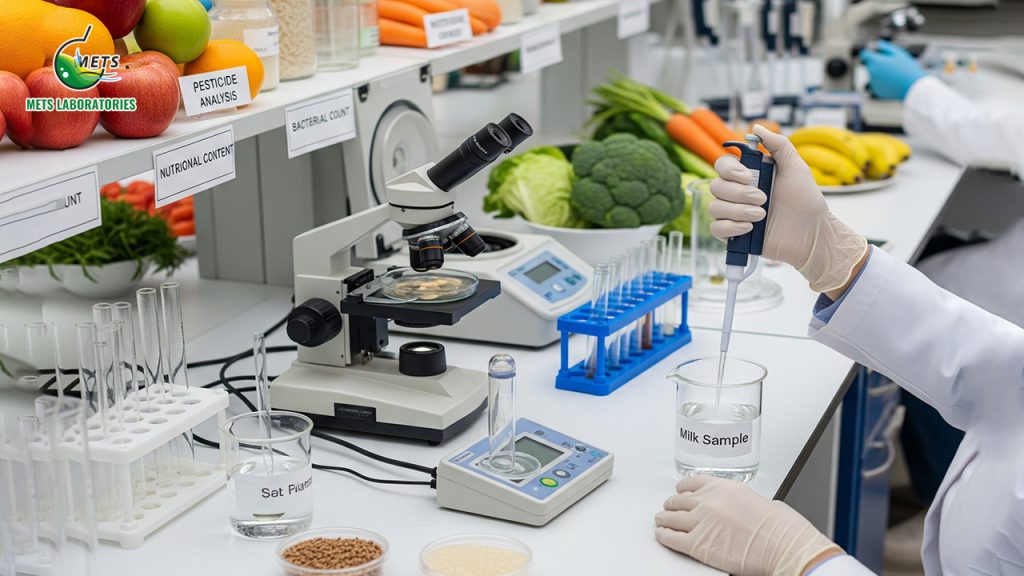
Food and agricultural products testing is a critical process that ensures the safety, quality, and compliance of food items and agricultural commodities with national and international standards. With increasing concerns about foodborne illnesses, pesticide residues, adulteration, and contamination, rigorous testing has become essential to protect consumer health and maintain trust in the food supply chain.

Testing encompasses a wide range of analyses, including:

  • Microbiological Testing – Detecting harmful bacteria, viruses, and fungi.
  • Chemical Analysis – Checking for pesticides, heavy metals, additives, and allergens.
  • Nutritional Labeling Verification – Ensuring accurate nutrient content claims.
  • Physical & Sensory Testing – Assessing texture, appearance, taste, and odor.
  • GMO & Authenticity Testing – Verifying non-GMO status and detecting food fraud.

By employing advanced techniques such as HPLC, GC-MS, PCR, and spectroscopy, laboratories help farmers, manufacturers, and regulatory bodies maintain high standards. Effective testing not only safeguards public health but also enhances trade by meeting export-import regulations.

As food systems evolve, continuous advancements in testing methodologies remain vital to addressing emerging risks and ensuring a sustainable, safe food supply.

Purpose of Food Testing

The primary purpose of testing food and agricultural products is to ensure safety, quality, and compliance with regulatory standards. Key objectives include:

  1. Food Safety Assurance
  • Detect harmful contaminants (e.g., pesticides, heavy metals, pathogens like Salmonella and E. coli).
  • Identify chemical residues (e.g., antibiotics in meat, aflatoxins in grains).
  • Prevent foodborne illnesses and protect public health.
  1. Quality Control & Authenticity
  • Verify nutritional content (e.g., vitamins, proteins, fats).
  • Check for adulteration (e.g., dilution, substitution, or fake ingredients).
  • Assess freshness, shelf life, and sensory attributes (taste, texture, aroma).
  1. Regulatory & Trade Compliance
  • Meet national & international standards (e.g., FDA, USDA, EU regulations, Codex Alimentarius).
  • Ensure labeling accuracy (e.g., organic, non-GMO, allergen-free claims).
  • Facilitate export/import clearance by complying with trade requirements.
  1. Environmental & Sustainability Monitoring
  • Test for soil/water contaminants affecting crops.
  • Ensure sustainable farming practices (e.g., pesticide overuse, GMO detection).
  1. Consumer Trust & Brand Protection
  • Build confidence in food brands through transparency.
  • Prevent recalls and legal issues by early hazard detection.
  1. Research & Innovation
  • Support product development (e.g., functional foods, fortified products).
  • Improve agricultural practices through data-driven insights.

By conducting rigorous testing, stakeholders (farmers, manufacturers, regulators, and consumers) ensure that food is safe, authentic, and high-quality from farm to fork.

Category of Foods

  • FSSAI manual for meat and meat products.
  • FSSAI manual for honey and other beehive products.
  • FSSAI manual for fish and fish products.
  • FSSAI manual for Beverages: Tea, coffee and Chicory.
  • FSSAI manual for cereal and cereal products.
  • FSSAI manual for dairy and dairy products.
  • FSSAI manual for oil and fat
  • FSSAI manual for fruits and vegetables.
  • FSSAI manual for food additives.
  • FSSAI manual for pesticides and residues
  • FSSAI manual for metals.
  • FSSAI manual for alcoholic beverages.

Types of Food Testing

Food and agricultural products testing ensures safety, quality, and compliance with regulatory standards. Testing can be categorized based on the type of analysis and the product being tested. Here are the main types:

Checks for harmful microorganisms that can cause foodborne illnesses.

  • Pathogen Detection:
    • Salmonella
    • E. coli (including O157:H7)
    • Listeria monocytogenes
    • Campylobacter
    • Staphylococcus aureus
  • Indicator Organisms:
    • Total Plate Count (TPC)
    • Yeast & Mold
    • Coliforms
    • Enterobacteriaceae

Detects harmful chemicals, residues, and toxins.

  • Pesticide Residues (e.g., glyphosate, organophosphates)
  • Heavy Metals (e.g., lead, arsenic, cadmium, mercury)
  • Mycotoxins (e.g., aflatoxin, ochratoxin, fumonisin)
  • Veterinary Drug Residues (e.g., antibiotics, hormones)
  • Allergens (e.g., gluten, peanuts, soy, milk)
  • Food Additives & Preservatives (e.g., sulfites, benzoates)

Determines the nutritional content of food products.

  • Macronutrients (proteins, fats, carbohydrates)
  • Micronutrients (vitamins, minerals)
  • Fiber content
  • Caloric value
  • Sugar & salt content

Ensures food is not diluted or mislabeled.

  • DNA Testing (e.g., meat speciation, GMO detection)
  • Isotope Analysis (e.g., honey, olive oil authenticity)
  • Melamine Detection (in milk products)
  • Species Identification (e.g., fish, meat fraud)

Evaluates texture, appearance, taste, and foreign materials.

  • Foreign Matter Detection (e.g., metal, glass, plastic)
  • Texture Analysis (e.g., tenderness of meat, crispness)
  • Color & Appearance Testing
  • Sensory Evaluation (taste, smell, mouthfeel)

Determines how long a product remains safe and high-quality.

  • Accelerated Shelf-Life Testing (exposing products to heat/humidity)
  • Microbial Growth Monitoring
  • Oxidation Testing (rancidity in oils)

Detects genetically engineered ingredients.

  • PCR-based GMO screening
  • Protein-based detection (ELISA)

Ensures safety in irrigation, processing, and packaging.

  • Water Quality Testing (e.g., microbial, chemical contaminants)
  • Surface Swab Testing (for sanitation verification)

Ensures packaging does not contaminate food.

  • Migration Testing (chemical leaching)
  • Barrier Properties (oxygen/moisture resistance)


Industries & Products Commonly Tested

  • Meat & Poultry (pathogens, hormones)
  • Dairy Products (antibiotics, adulteration)
  • Grains & Cereals (mycotoxins, pesticides)
  • Fruits & Vegetables (pesticides, microbial load)
  • Seafood (heavy metals, parasites)
  • Processed Foods (preservatives, allergens)
  • Beverages (alcohol content, contaminants)


Regulatory Bodies & Standards

  • FDA (U.S.)
  • USDA (U.S.)
  • EU Regulations (EFSA)
  • Codex Alimentarius
  • ISO Standards (e.g., ISO 17025 for labs)

What METS Laboratories Offers?

METS Laboratories offers a full-service package tailored to each client’s product type, target market, and testing objectives:
• Nutrition Label Testing as per national and international guidelines (FSSAI, FDA, EU)
• Custom Test Panels (e.g., Keto-friendly, diabetic-friendly product panels)
• Comparative analysis (before and after reformulation)
• Shelf-life nutritional degradation studies
• Export certification and third-party verification
• Sample pickup & courier coordination
• Online client dashboard to access real-time reports
• Rapid testing turnaround (as low as 3-5 business days for most products)
• Technical support for label preparation and regulatory queries

What We Ensure?

Who It’s For?

Protect Consumers. Satisfy Authorities. Boost Market Confidence.

Processed food nutrition testing is more than just a regulatory formality—it’s a key to building consumer trust and business credibility. When you partner with METS Laboratories:

• Consumers benefit from transparency and healthier choices.
• Authorities are assured of compliance with safety and nutritional labelling standards.
• Your brand gains market credibility, competitive edge, and readiness for expansion into new geographies.

In a crowded marketplace, nutrition testing offers a powerful differentiator—ensuring your product speaks the language of science, trust, and truth.

Frequently Asked Questions

How much sample is required for nutrition testing?

Typically, 300–500g per sample is sufficient. Specific tests may require more or less. We’ll confirm upon submission.

How long does testing take?

Standard turnaround time is 7–10 business days. Express testing may be available for select products.

Do you help with nutrition label design?

Yes. We provide validated data along with recommended nutrition facts layout as per the target region’s regulations.

Can you test both raw ingredients and finished products?

Absolutely. We test raw materials, semi-processed, and final packaged food items.

Are your reports accepted by authorities like FSSAI or FDA?

Yes. Our laboratory is ISO/IEC 17025: 2017accredited, and our reports are widely accepted across regulatory bodies.

What if my product fails compliance?

Our technical team will work with you to interpret the results and suggest corrective action or reformulation guidance.

Select the fields to be shown. Others will be hidden. Drag and drop to rearrange the order.
  • Image
  • SKU
  • Rating
  • Price
  • Stock
  • Availability
  • Add to cart
  • Description
  • Content
  • Weight
  • Dimensions
  • Additional information
Click outside to hide the comparison bar
Compare